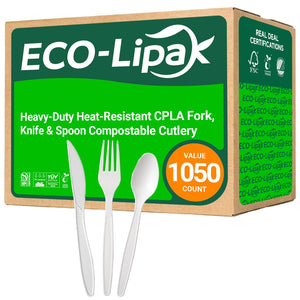
Quick Answer: Buy the 450-fork carton when nearly every menu item needs a fork and knives or spoons are rarely requested. Buy the 1,050-piece assorted CPLA cutlery carton when service includes mixed entrees, soups, desserts, and takeaway meals: it contains 300 knives, 450 forks, and 300 spoons. The right wholesale case is the one that matches actual utensil use, not simply the carton with the most pieces.
Wholesale CPLA cutlery is easiest to plan when the menu becomes a utensil forecast. ECO-Lipak's bulk CPLA cutlery listing offers two clear choices: 450 individual white forks or an assorted 1,050-piece carton. Both serve hot and cold food, but they solve different inventory problems. A cafeteria that uses forks for almost every meal should not accumulate spare knives. A caterer with changing menus should not run out of spoons halfway through service.
Key Takeaways
- The assorted carton contains 300 knives, 450 forks, and 300 spoons, for 1,050 pieces total.
- The fork-only carton contains 450 forks and works best for fork-led menus or as a targeted refill.
- Count utensils by menu item and guest behavior; one guest does not always equal one of every utensil.
- CPLA is a rigid, white plant-derived bioplastic designed for improved heat resistance, but buyers should still test it with their hottest normal food.
- Commercial compostability and local acceptance are separate checks. Never place CPLA in conventional plastic recycling unless the local program specifically says to do so.
Fork Carton vs Assorted Carton
| Buying factor | 450 forks | 1,050 assorted pieces |
|---|---|---|
| Exact mix | 450 forks | 300 knives, 450 forks, 300 spoons |
| Best fit | Salads, pasta, rice bowls, cake, tastings | Mixed catering menus, cafeterias, office lunches, takeout |
| Inventory benefit | Refills the utensil used fastest | Establishes a balanced starting inventory |
| Main risk | Guests need knives or spoons that are not stocked | Slow-moving utensils remain after forks run out |
| Planning unit | Fork-required servings | Individual utensil demand, not 1,050 complete settings |
The assorted carton is not 1,050 place settings. It supplies 1,050 individual utensils and can support at most 300 complete knife-fork-spoon sets because knives and spoons are the limiting pieces. That distinction matters in purchase orders, event proposals, and stock counts.

Turn the Menu Into a Utensil Count
- List every entree, side, dessert, and beverage add-on for the service period.
- Assign the minimum practical utensil to each item: fork, knife, spoon, or a combination.
- Multiply each utensil by expected servings, then add staff meals and a site-specific buffer.
- Subtract clean, usable inventory already on hand.
- Round up by the relevant case count and review the leftover balance for the next event.
For example, a 300-person pasta lunch may need roughly one fork per guest plus extras, but only a small number of knives. One 450-fork carton may cover it cleanly. A 300-person banquet with sliced protein, vegetables, soup, and dessert can use all three utensils; one assorted carton provides exactly 300 knives and spoons, while the 450 forks leave a practical fork reserve.
Three Real Foodservice Scenarios
1. A salad and grain-bowl cafe
Forks dominate. Spoons may be needed for soup specials and knives may be unnecessary for most bowls. Start with the 450-fork carton, then stock spoons separately only when the menu requires them. This keeps the back shelf from filling with low-use knives.
2. An office lunch program with rotating menus
Monday's pasta, Tuesday's soup, and Wednesday's sliced entree create uneven demand. The assorted carton gives the program a balanced base. Track withdrawals for four weeks. If forks consistently run out first, use a fork-only carton as the next refill rather than buying another full assortment.
3. A caterer serving 500 guests
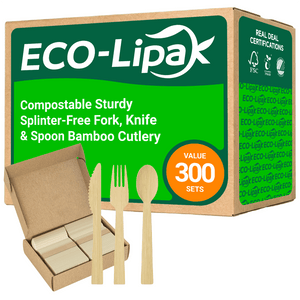
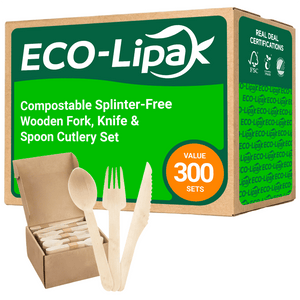
A single assorted carton cannot create 500 complete sets. Two cartons would provide 600 knives, 900 forks, and 600 spoons, leaving more forks because the assortment intentionally favors them. If the menu needs only forks and knives, compare two assorted cartons with a mixed order of fork-only CPLA and another material. The broader compostable cutlery collection includes bamboo and wooden formats that can suit a different presentation or purchasing plan.
What CPLA Changes in Service
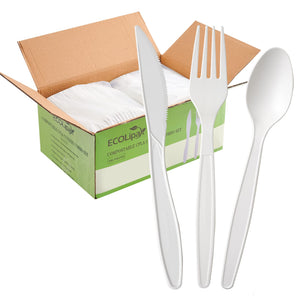
CPLA means crystallized polylactic acid. The crystallization process gives PLA-based utensils more rigidity and heat resistance than clear PLA is commonly designed to provide. ECO-Lipak's utensils are white, smooth, and shaped like familiar disposable plastic flatware: the fork is about 7 inches long and the spoon about 6.7 inches according to the product imagery. They are not wood-grain utensils, and they should not be pictured or described as bamboo.
Heat-resistant does not mean unlimited heat exposure. Test the utensil with the hottest thick food on the actual menu, especially dense casseroles, firm meat, or food held for a long period. Do not use disposable cutlery as a cooking tool or leave it against a hot pan. For a material-level comparison, read CPLA Cutlery: Pros, Cons, and When It Makes Sense.

Cost and Case Planning
At the currently listed prices, the 1,050-piece assortment has a lower approximate cost per individual utensil than the 450-fork carton, but that comparison is incomplete. A low cost per piece is not a saving if 300 knives sit unused. Calculate cost per utensil actually used during the planning period, then include storage space and emergency purchases caused by shortages. Recheck live prices before ordering.
For recurring service, use a minimum stock level: average weekly use multiplied by supplier lead time, plus a buffer based on the operation's real demand variation. Review stock by utensil, not by unopened carton count. A half-full assorted case may still be functionally empty if only knives remain.
Certification and End-of-Use Checks
CPLA is intended for commercial composting under appropriate conditions, not backyard compost by default. Buyers can search the BPI product catalog when a contract or organics program requires third-party certification. Then ask the receiving facility whether it accepts certified compostable cutlery and food residue.
The FTC Green Guides summary explains why compostable claims may need qualification when suitable facilities are not broadly available. A certification and a local acceptance rule answer different questions; confirm both before printing disposal signs.
Frequently Asked Questions
How many place settings are in the 1,050-piece carton?
It can make 300 complete knife-fork-spoon settings, with 150 extra forks. The carton contains 300 knives, 450 forks, and 300 spoons.
When is a fork-only carton more economical?
It is more economical when forks are the only utensil used for most servings or when forks run out before the knives and spoons from an existing assortment.
Can CPLA cutlery be used with hot food?
It is designed for hot and cold food and offers improved heat resistance. Test it with the operation's hottest normal menu item and do not treat it as a cooking utensil.
Is CPLA cutlery recyclable?
Do not place it in conventional plastic recycling unless the local program explicitly accepts it. CPLA is generally routed to an accepting commercial composting program where available.
Should a caterer provide every guest with all three utensils?
No. Match utensils to the menu and service style. Self-service bins or meal-specific packs can reduce unused pieces compared with automatically issuing a complete set.