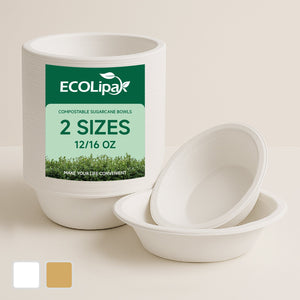
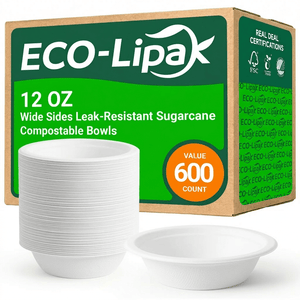
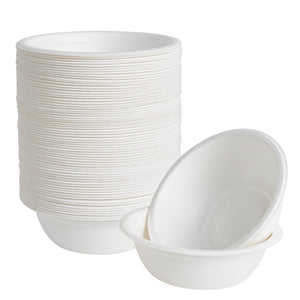
Quick Answer: A small deli should buy 16 oz wide-rim sugarcane bowls only after testing its actual portions in the exact bowl. ECO-Lipak currently offers white and natural 16 oz wide-rim variants in 150/box and 600/carton formats, including a dedicated wholesale 600/carton listing. Use the 150-count box for a menu trial; move to 600/carton when weekly sales, storage, and reorder timing support it. The listed bowls do not include a lid, so do not plan closed delivery service around an unverified lid fit.
Key Takeaways
- A 16 oz capacity is not a guarantee that every salad, grain bowl, or soup portion will present well. Test volume and weight together.
- Compare the 150/box and 600/carton variants with the wholesale 600/carton listing after the menu is stable.
- These are open, wide-rim fiber bowls. Confirm any lid or delivery packaging separately rather than assuming compatibility.
- Set a reorder point from bowls sold per service day, delivery lead time, and a small waste allowance.
Why the Rim Changes the Deli Experience
At a lunch counter, the bowl has two jobs. It has to hold the food, and it has to help the customer see what they are buying. A broad rim gives a composed salad or grain bowl a more open presentation than a tall, narrow container. That can be useful for a deli selling at a display counter, where a staff member finishes the bowl in front of the customer. It can also make a compact 16 oz portion look intentional rather than underfilled.
But the same open profile needs careful testing for takeaway. The product listing describes a wide-rim, molded sugarcane fiber bowl; it does not establish that a lid is included. If most orders leave the store by bicycle courier or go into a stacked bag, solve the closure and transport question first. A plated-looking lunch counter bowl and a sealed delivery package are not automatically the same SKU decision.

Build a Portion Trial Before a Case Order
Prepare your three most common items exactly as they are sold. For each, record the weight of the base, wet ingredients, dressing, and garnish. Fill the bowl in the same order staff use during a rush, then carry it from prep counter to pickup. Notice whether the rim stays clean enough to hand over, whether dressing pools at the edge, and whether a heavier topping makes the portion awkward to hold. A nominal 16 oz bowl can work beautifully for one composed salad and feel cramped for a soup with bread or a grain bowl with a large protein add-on.
Test a hot and a cold item only if they are part of your menu, and follow the product's current handling information for temperature and contact time. Do not infer oven or microwave suitability from the material name alone. If the menu has a saucy item, leave a sample filled for the realistic pickup interval and check the base and seams. Run this test with food, not just water, because oil, sauce, and weight change the result.
Compare Counts Without Overbuying
| Option | Practical use | Buyer check |
|---|---|---|
| 16 oz, 150/box | Menu trial or low-volume lunch service | Color, food presentation, and shelf space |
| 16 oz, 600/carton | Established item with steady demand | Case turnover and delivered cost |
| Wholesale 16 oz, 600/carton | Repeat wholesale purchasing | Exact variant and carton details at checkout |
Suppose a deli sells 28 bowl lunches a day, five days a week. That is 140 bowls a week. Allow 5% for remakes, sampling, and an occasional damaged bowl: the working number becomes 147. A 150-count box is almost one week's supply, while a 600-count carton is about four weeks at that rate. If your actual demand is only 12 bowls a day, a 600-count carton may last ten weeks. That can still be reasonable if storage is clean and dry, but the decision should be made with stock rotation and cash tied up in inventory in mind.
For a lead time of one week at 147 bowls of working demand, reorder when roughly one week's stock plus your chosen safety stock remains. A simple policy might be to place the next order when the sealed and open stock together reach 180 bowls, then adjust after four weeks of actual sales. Count physical bowls, not just case labels; partially opened cartons are easy to forget. If the deli closes two days a week, do not forecast seven service days.

Three Small-Deli Scenarios
A salad bar testing a new lunch special
Order a 150-count box in the preferred white or natural color and run the salad for one week. Watch how quickly the visible ingredients fill the wide base and whether staff need to wipe the rim. A dish that looks sparse may need a different portion or a smaller bowl, not a larger purchase order. The ECO-Lipak bowls collection is useful when comparing alternative shapes and capacities.
A neighborhood deli with predictable weekday demand
After the portion trial, a 600-count carton can simplify ordering when sales are stable. Use the weekly-sales calculation and set the next order date before the current carton is nearly empty. Ask the team to put the oldest carton first in the storage area. Standardizing one size across compatible salads and grain bowls can also reduce the number of open cases behind the counter.
A deli that sells mostly delivery orders
Do not assume the wide-rim bowl alone is a delivery solution. Test a separately verified closure or choose another packaging format for the travel-heavy menu. Walk a filled order through the same bagging and transport motions a courier uses. A bowl that performs well at the counter can still spill during a tilted handoff. The ECO-Lipak inquiry page can help clarify current variant and packaging questions before a bulk order.
Material Claims and Disposal
Sugarcane fiber is a useful alternative to some conventional disposable serving materials, but purchase decisions should still be grounded in performance, certifications, and local disposal rules. Check the exact product's current certifications and claims on its listing. Whether a used bowl can enter a commercial compost stream depends on the facility's acceptance policy and on food contamination rules. The US Environmental Protection Agency's composting overview explains the general process; your local collector is the final authority for what it will take.
Before placing the recurring order, make a one-page spec for staff: chosen size and color, intended menu items, whether the order is dine-in or pickup, and the correct storage location. That keeps a future substitute from being treated as identical just because it is also labeled 16 oz. It also makes price comparisons fairer, since a bowl that creates remakes or packaging problems may cost more in practice than its unit price suggests.
Frequently Asked Questions
Is a 16 oz wide-rim bowl large enough for a deli salad?
It may be, but fill one with the deli's actual ingredients and dressing before ordering by the carton. The visible width and usable depth matter as much as the nominal capacity.
Does the bowl come with a lid?
The referenced listings describe bowls and do not establish an included lid. Confirm any closure and fit separately before using the bowl for sealed takeaway or delivery.
When should I move from 150/box to 600/carton?
Move when a portion trial passes, weekly demand is consistent, and a carton turns over at a sensible pace. Compare the exact active variants and delivered cost at the time of purchase.
Can I use the same bowl for soup and salad?
Possibly, but test both under real service conditions. Hot liquid, carrying distance, and pickup delay impose different demands from a cold salad.
Are sugarcane bowls accepted in every compost program?
No. Facility acceptance varies. Verify the exact product and your local collection rules before telling customers to compost the used bowl.