Quick Answer: Wooden cutlery sets work best when most guests need a fork, knife, and spoon; separate-utensil packs work better when the menu uses one piece much faster than the others. ECO-Lipak lists both because “300 sets” means 300 place settings and 900 total utensils, while “900 forks” means 900 pieces of one utensil. Count each utensil from the menu before choosing the carton.
Key Takeaways
- One wooden cutlery set contains one fork, one knife, and one spoon.
- Three hundred sets equal 900 total utensils, but only 300 of each type.
- A fork-heavy lunch should not automatically receive equal fork, knife, and spoon quantities.
- Start with the menu count, add an explainable reserve, then round up to available packs.
- Keep sets and individual refills visibly separate so staff do not misread the stock balance.
A matched fork, knife, and spoon looks tidy in a place setting. Behind the scenes, however, utensils rarely disappear at the same rate. A salad bowl may need a fork only. Soup needs spoons. A plated lunch might need forks for everyone and knives for only part of the menu.
That is why the current ECO-Lipak listing is organized around two buying jobs: complete place settings and targeted replenishment. The format is less glamorous than the finished table, but it prevents “900 pieces” from being mistaken for 900 fully equipped guests.
What the Current Configurations Mean
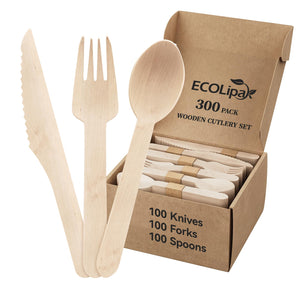
The wooden cutlery product currently offers complete sets, plus separate forks, knives, and spoons. The set is listed as one of each utensil. These are current pack facts, not an assumption based on the product photo.
| Variant | Place settings | Total utensils | Best planning use |
|---|---|---|---|
| 100 sets / box | 100 | 300: 100 forks, 100 knives, 100 spoons | Small event or a base supply for a mixed menu |
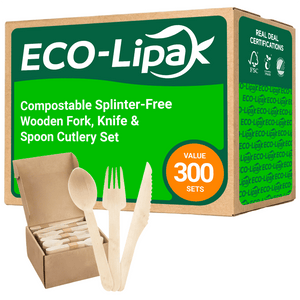
| 300 sets / carton | 300 | 900: 300 of each utensil | Matched service where all three pieces are expected |
| 300 forks, knives, or spoons / box | Not a set | 300 of the selected utensil | Targeted retail replenishment |
| 900 forks, knives, or spoons / carton | Not a set | 900 of the selected utensil | High-volume single-utensil demand |
The separate wholesale wooden cutlery listing starts at 300 sets or 900 of one selected utensil. This distinction matters in a purchase order: “one 900-piece carton” still needs the words forks, knives, spoons, or 300 sets.

Count the Menu, Not Just the Guests
Make one line for each utensil. Start with the number of servings that genuinely need it, then add a reserve for changes, drops, and extra service. A simple formula is:
Required utensil count = expected servings using that utensil x (1 + chosen reserve rate).
Round the result up to a whole piece, then compare it with the available pack size. Ten percent is a useful worked example for a stable event, not a universal rule.
| Menu line | Guests served | Forks | Knives | Spoons |
|---|---|---|---|---|
| Salad lunch | 250 | 250 | 75 | 25 |
| 10% planning reserve | — | 25 | 8 | 3 |
| Planning total | 250 | 275 | 83 | 28 |
Three 100-set boxes would supply 300 forks, 300 knives, and 300 spoons. A mixed plan of one 100-set box plus one 300-fork box supplies 400 forks, 100 knives, and 100 spoons. The mixed plan gives more forks and fewer unused knives and spoons, but it also leaves 125 extra forks. The better choice depends on upcoming menus, storage, and whether the remaining stock has a planned use.
Buying fewer total pieces is not automatically better if it creates a service shortage. Equally, a lower unit price is not useful when it leaves cartons of a utensil the menu rarely needs.
Three Operations Patterns
Matched Boxed Lunches
If every lunch contains a food that needs a fork and knife plus a spooned side or dessert, sets keep packing simple. Stage one set per meal and retain the reserve separately. Check the actual menu with the wooden utensils before service; material alone does not prove that every knife or fork suits every food texture.
Fork-Heavy Salad or Grain Bowl Service
Use a small base of sets for exceptions, then replenish forks separately. Put spoons near soups or desserts rather than adding one to every place setting. This approach makes the guest-facing station simpler and gives the inventory count a direct relationship to the menu.
Soup and Dessert Station
Count spoon servings independently. If forks are available elsewhere, do not duplicate them at the soup station without a reason. Refill in small batches and keep the rest protected; an open tray should not represent the entire reserve.

Build a Reorder Record That Anyone Can Read
Record stock as forks, knives, spoons, and unopened sets. Do not combine them into a single “cutlery pieces” number. After each service, note what was issued, what remained protected, and which item reached its reorder point first.
- Count unopened packs using the exact variant name.
- Estimate open stock by utensil type; do not convert a mixed bin back into sets.
- Subtract the next confirmed menu requirement.
- Order the pack configuration that covers the short line without creating an unexplained surplus.
The wooden cutlery collection provides the relevant purchase paths. For specification and documentation questions, use the resource library and match the answer to the exact product rather than to wooden utensils in general.
Keep Material and Disposal Claims Specific
The retail and wholesale listings identify birchwood as the material. That tells the buyer what this product is made from; it does not tell every location where a used utensil is accepted. Food residue, coatings or attached packaging, local rules, and the receiving facility still matter.
The EPA's food-service ware guidance puts reusables first when an effective collection and washing system works. For single-use compostable service ware, EPA emphasizes certification, local facility acceptance, and clearly separated collection. Do not send wooden utensils to recycling simply because they feel like a paper-related material.
FAQ
What is included in one wooden cutlery set?
The current ECO-Lipak set configuration contains one fork, one knife, and one spoon. Check the selected variant before ordering because single-utensil options appear on the same listing.
Are 300 wooden cutlery sets the same as 900 utensils?
Yes in total piece count, but the composition matters: 300 sets contain 300 forks, 300 knives, and 300 spoons. A 900-fork carton contains forks only.
What should I buy for a fork-heavy menu?
Count the fork servings and reserve separately. A base of sets plus a fork refill may fit better than buying equal quantities of all three utensils.
Can I mix wooden, bamboo, and CPLA utensils?
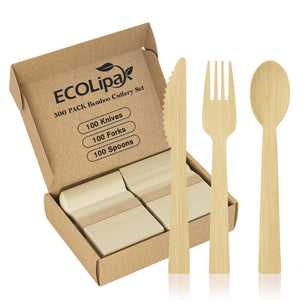
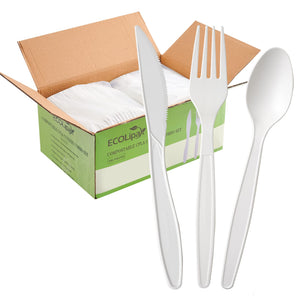
You can choose different utensils for different service needs, but test each exact item with the menu and make the disposal instructions clear. Do not assume they share specifications or end-of-life routes.
How should unused wooden cutlery be stored?
Keep it protected, clean, dry, and identifiable by utensil type and pack. Follow the supplier's storage instructions and separate anything exposed to moisture or contamination.