Quick Answer: For a school cafeteria buying 55-gallon compostable bags, order from a measured liner-change rate, not the number of bins alone. Test the liner on your actual container, confirm that the local organics collector accepts both the bag and its contents, then compare a 12-count box, 36-count carton, and 120-count wholesale carton against your weekly use. A compostable label is not a substitute for collection approval.
Key Takeaways
- A 55-gallon label describes nominal capacity; measure the bin rim, depth, and the filled bag's weight before committing to a case.
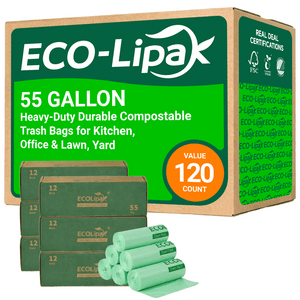
- Begin with a small fit trial. ECO-Lipak's 55-gallon bags have 12/box and 36/carton options, while its wholesale 55-gallon bag is offered at 120/carton.
- Use a reorder point that includes school days, liner changes per day, and delivery lead time. Do not count weekends when the cafeteria is closed.
- Check the waste hauler's accepted-material list before placing compostable liners at an organics station.
Start With the Waste Stream, Then the Bag
Picture the lunch rush ending at 12:45. The back-of-house team has one 55-gallon rolling bin for prep scraps, another near dish return, and a third that sometimes receives ordinary trash. Those stations may look identical, but they should not automatically receive the same liner. A bag intended for an accepted organics stream only helps when the collector allows that particular bag and the contents have been sorted correctly. A compostable liner in a landfill-bound trash bin does not turn the mixed waste into compost.
Ask the hauler or compost facility three plain questions: Are certified compostable liners accepted? Are there restrictions on size or material? Which food-contact items and scraps belong in the stream? The US Environmental Protection Agency's composting guidance is useful background, but local acceptance is the operational rule. Keep a short written instruction at each station so students, teachers, and kitchen staff are not guessing.

Run a Five-Minute Fit and Load Trial
Nominal gallon size is only the first filter. Measure the container's top perimeter and height, then check the product dimensions or ask for a sample. The liner needs enough material to fold over the rim and reach the bottom without being stretched tight. A loose bag that slides into the bin is a problem too. If a cart is wheeled across a rough floor, test it while the bag contains a normal lunch-service load, not just a handful of dry scraps.
Do not fill a 55-gallon liner to its nominal volume simply because it fits the can. Wet food scraps become heavy quickly. Establish a lift limit that staff can handle safely and replace a bag earlier when needed. At the end of a trial shift, record whether the liner tore at the rim, leaked at the bottom, or stayed in place during cart movement. Test the same routine for at least three ordinary service days, including the busiest menu day.
Compare Pack Sizes Against Real Usage
| Buying option | Best first use | What to check |
|---|---|---|
| 55-gallon, 12/box | Fit trial or one small station | Rim fit, tear resistance, and collector acceptance |
| 55-gallon, 36/carton | Modest recurring use | Actual daily changes and available dry storage |
| 55-gallon, 120/carton | Validated multi-station program | Case turnover, delivery timing, and budget |
Here is a workable calculation. Suppose three stations each use one liner per school day, and one station needs an extra change on two days each week. Weekly use is 3 x 5 + 2 = 17 bags. Over a 20-day school month, that is about 68 bags before a reserve. Add a practical buffer of 10-20% for schedule changes and occasional torn bags; at 15%, the planning figure is about 79 bags. This is a forecast, not a claim about how much any specific school will consume.
For that example, one 120-count carton lasts roughly seven school weeks at 17 bags per week. A 36-count carton lasts just over two weeks. If deliveries take ten school days, a reorder point should cover about 34 bags for that lead time plus the chosen reserve. Recalculate after the first month from an actual issue log. A district buying centrally should aggregate by cafeteria, but should still sample each bin model because a single size can fit differently across sites.

Three Cafeteria Buying Scenarios
One pilot organics station
Start with the 12-count box. The priority is proving fit and collection acceptance, not lowering a theoretical per-bag cost. Ask the collector to confirm the stream before putting new signs above the bin. After a week, compare actual changes with the original estimate. A pilot that uses only four bags a week does not need a 120-count commitment just yet.
Two kitchens sharing a purchasing order
Record the liner changes for each kitchen separately. If one site has a deeper rolling bin, it may need a different fit even though both bins are called 55-gallon. Once both pass the trial, the purchasing manager can compare 36-count cartons and 120-count cartons on delivered cost, shelf space, and how quickly inventory turns. The compostable trash bag collection is a useful starting point for checking currently available sizes.
High-volume district service
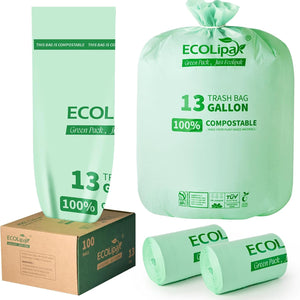
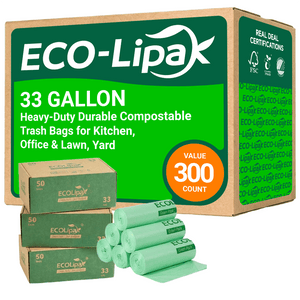
Standardize the approved station setup, then issue cases against a weekly count rather than leaving an open pallet at every school. Set a minimum stock level for each site and a central buffer for late deliveries. Where smaller prep-room bins are part of the same project, order the correct size instead of folding an oversized 55-gallon liner into a 13- or 33-gallon can. A good district plan reduces substitutions, contamination, and emergency purchases.
What a Buyer Should Ask Before Checkout
Confirm the exact variant and count shown on the product page, the intended waste stream, and the delivery window. Ask staff who change liners whether they prefer a roll or separated bag format, and whether the bag can be tied without overfilling. If your team needs help matching the order to multiple campuses, use the ECO-Lipak inquiry page with bin measurements and an estimated weekly change count. That is a more useful starting point than sending only a gallon number.
Compostability and strength are different questions. Certifications and material descriptions can help you screen a product, but the fit trial tells you whether the bag survives your specific cart, waste weight, and change procedure. Keep the first successful sample as a reference when reordering, and verify that the same variant is selected the next time.
Frequently Asked Questions
How many 55-gallon bags should a school cafeteria buy for a month?
Multiply the number of active stations by average changes per school day and the number of service days, then add extra changes and a modest reserve. For three stations at one change per day over 20 days, the base is 60 bags before any extra changes or buffer.
Does a compostable bag belong in every cafeteria trash can?
No. Use it where the local collector accepts the bag and the waste stream is managed accordingly. Mixed trash and nonaccepted organics can defeat the purpose of the liner.
Should I buy 120/carton immediately?
Only after fit, handling, and collection acceptance are confirmed. A 12-count box or 36-count carton can be a better first order for a new program, even if a larger case is attractive on paper.
What if the bag fits but tears when lifted?
Reduce the fill weight, change the handling routine, or test another liner. Wet food waste may reach an unsafe lifting weight well before the bin looks full. Record where the tear occurs so the next trial is specific.
Do 33-gallon and 55-gallon stations need the same reorder plan?
No. Keep separate counts and bin-fit records. Smaller stations may use different liners and change frequencies; combining their counts can make both forecasts wrong.