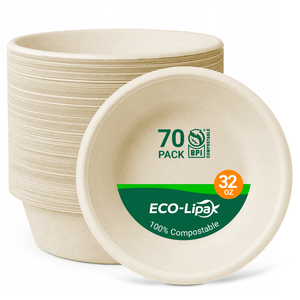
Quick Answer: For a winter soup counter, buy a 32 oz sugarcane bowl only when the served portion and toppings genuinely need that capacity. ECO-Lipak's natural 32 oz molded-fiber bowl is currently offered as 70 per box, and the broader bowl listing also shows a 560-count carton. Test the hot soup, carrying distance and any separate lid or cover before ordering. The bowl listing is not a promise of a matching lid or spillproof delivery.
Key Takeaways
- The current natural 32 oz option is 70 per box; a 560-count carton is listed on the broader bowl page.
- Measure the actual serving volume and leave headspace; 32 oz is nominal bowl capacity, not a fill target.
- For off-site travel, separately verify a compatible closure and perform a filled-container test.
- Confirm whether local compost collection accepts the exact used bowl.
First decide whether 32 oz belongs on the menu
A soup bar may offer a small cup, a regular lunch bowl and a large hearty serving. Buying one large format for every order can make regular portions look skimpy and increase packaging cost. The natural ECO-Lipak 32 oz sugarcane bowl is a round, beige molded-fiber bowl with a wide open top and shallow rim. The current sale listing shows 70 bowls per box. It is suitable to evaluate for a large portion of chili, stew or noodle soup with toppings, but it should be tested with the real recipe. A liquid volume written on a menu does not include all the solids, garnish and safe carrying headspace.
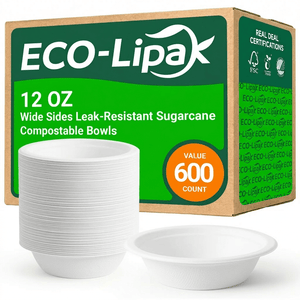
For smaller servings, the main sugarcane bowl range currently lists 12, 16, 20 and natural 32 oz variants, including a natural 32 oz 560-count carton. The selection is not simply a choice between “small” and “large.” Measure a normal order with the actual ladle and toppings, then place the bowl on the pickup counter. If the 20 oz version handles the portion well, a 32 oz bowl may be unnecessary. If the larger serving is the point of the winter menu, avoid overfilling a 20 oz bowl to save a few cents.

Turn soup sales into box or carton demand
Suppose a soup counter sells 45 large portions on each of four busy days and 20 on one quieter day. Weekly large-bowl demand is 45 x 4 + 20 = 200. A 10% reserve raises the plan to 220 bowls. Three 70-count boxes provide only 210, so four boxes or a different order configuration are needed. A 560-count carton covers roughly two and a half such weeks before reserve. If large portions account for only 30 sales a week, one 70-count box lasts more than two weeks; an entire carton may sit unused for a long time. The numbers should come from your own receipts, not a generic per-guest rate.
| Large soup bowls per week | With 10% reserve | 70-count boxes | 560-count carton |
|---|---|---|---|
| 30 | 33 | One box covers the week | About 18 weeks before reserve |
| 100 | 110 | Two boxes cover the week | About five weeks before reserve |
| 200 | 220 | Four boxes cover the week | About two and a half weeks |
These are planning examples, not shelf-life or delivery promises. For the first week of a new winter menu, a small order reduces the risk of choosing the wrong size. Once the portion and sales pattern are proven, compare the current delivered unit cost of boxes and the carton. Set a reorder trigger at expected use during supplier lead time plus the reserve needed for a cold-weather surge. Keep unused bowls clean and dry, and count opened sleeves separately from sealed cartons.
Three service situations
Hearty dine-in chili
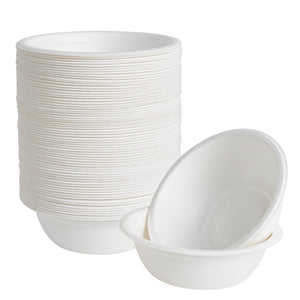
A large chili with beans and toppings may justify 32 oz, especially if the bowl is part of a full meal. Test the weight when full and the customer's carrying path from counter to table. Place a sample on the tray used during service. If the rim is comfortable and toppings stay inside with room to stir, the format may be right. A lighter soup served without sides might be better in a 20 oz bowl; the white 20 oz option is a separate product to compare.
Office lunch pickup
Guests may carry the bowl through a hallway or elevator. An open 32 oz bowl should not be treated as a sealed takeout container. Ask the supplier whether there is a compatible closure for the exact bowl, and test the complete packed meal before promising transport. If the menu needs a lidded soup package and none is verified, choose a proven soup container instead. Do not use the word “leakproof” for an open bowl.
Weekend community market
Cold weather can create short demand peaks. Keep a measured reserve behind the counter, but do not stage all 70 bowls where they can get wet or dirty. If the market serves small tasting portions as well, use a smaller bowl for those; a 32 oz vessel makes samples look awkward. The 12 or 16 oz wide-rim cartons may be relevant for a separate serving format, but they are not a substitute for a tested large bowl.

Material and disposal checks
The product listing presents the bowl as sugarcane fiber and gives compostability and PFAS-free claims. When a customer or buyer needs proof, request the current finished-product documentation for the exact SKU. The local organics processor must also accept that used food-contact bowl for the claim to become a useful disposal instruction. The U.S. EPA composting overview explains why an actual collection route matters. Do not tell guests to place a food-soiled bowl in paper recycling merely because the bowl resembles paper. Match the purchase to portion fit and service first, then communicate an accurate local end-of-life route.
Frequently Asked Questions
How many natural 32 oz bowls are in a box?
The current sale variant shows 70 per box. Recheck the selected option and stock at checkout.
Is 32 oz the amount of soup I should serve?
No. It is nominal bowl capacity. Measure the recipe and leave enough space to carry the bowl safely.
Does the bowl come with a lid?
Do not assume so. The current bowl listing describes bowls; verify a compatible closure separately if the meal travels.
When does a 560-count carton make sense?
When repeated sales support the quantity and clean, dry storage is available. Compare current delivered unit cost with 70-count boxes.
Can a used bowl be composted anywhere?
No. Acceptance depends on the exact product and the local collector or processing facility.