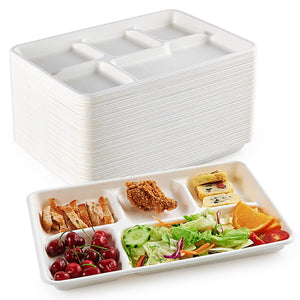
Quick Answer: Five-compartment sugarcane plates are best for meals that need portion control, separation, and fast serving: cafeterias, school lunches, corporate meals, buffets, and catered lunch lines. Use them when the menu has a main item, two sides, fruit or salad, and a small dessert or condiment space. If the menu is simpler, a three-compartment plate or clamshell may be the better fit.
Key Takeaways
- Five compartments help keep rice, protein, vegetables, fruit, and desserts separate.
- They are strongest for service lines where speed and consistency matter.
- Three-compartment plates are better for simpler menus with fewer sides.
- Closed clamshells are better for delivery, stacking, and longer transport.
- Good portion planning reduces waste because each food has a defined space.
Compartment plates are not only about neatness. In a busy service line, the plate quietly controls the workflow. Staff can build the same meal again and again without guessing where the fruit, protein, side, and dessert belong. Guests get a plate that looks organized, and operators get a more predictable portion.

When Five Compartments Are Worth It
| Menu pattern | Better format | Reason |
|---|---|---|
| Main, starch, vegetables, fruit, dessert | 5-compartment plate | Each item has a clear home and portions stay consistent. |
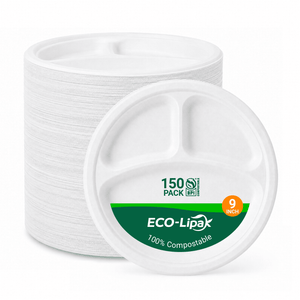
| Main plus two sides | 3-compartment plate | The layout is simpler and usually faster to fill. |
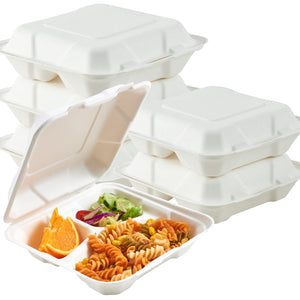
| Hot meal for pickup or delivery | Clamshell to-go box | Closure and stacking are more important than open separation. |
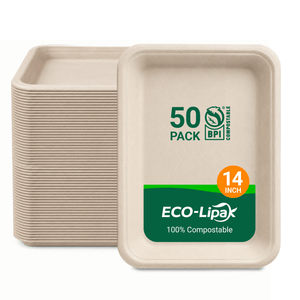
| Shared buffet food | Tray plus plates | Open trays handle display; plates handle guest servings. |
ECO-Lipak's heavy-duty sugarcane 5-compartment plates fit menus with multiple sides and controlled portions. For simpler meals, compare 3-compartment sugarcane plates. For meals that need closure, use 8 x 8 inch compartment clamshell boxes or 14 inch compostable food trays for open service.
Build A Portion Map Before Ordering
The biggest mistake is buying compartment plates before deciding the menu rhythm. A five-compartment plate works beautifully for balanced meals, but it can look empty if the menu only has a main and one side. Start with the plate map, then order the format.

- Assign each compartment. Main, starch, vegetable, fruit, dessert, or sauce should be planned before service.
- Test portion height. Tall foods can spill into nearby sections if the portion is too high.
- Separate dine-in from transport. Open plates and closed boxes solve different problems.
- Plan sauce separately. Use portion cups when sauce could soften or spread across sections.
- Check local disposal rules. Compostability still depends on collection and processing access.
The EPA composting overview explains why end-of-life planning depends on local facilities, not just product material.
FAQ
What are 5-compartment plates best for?
They are best for cafeterias, school meals, corporate lunches, buffets, and portion-controlled service lines.
When should I use a 3-compartment plate instead?
Use a 3-compartment plate when the menu has a main and only one or two sides.
Are compartment plates good for delivery?
Open compartment plates are better for service lines; clamshell boxes are better for delivery and stacking.
Do compartments reduce food waste?
They can help because each item has a defined portion space, which reduces over-serving.
What should go in the smallest compartment?
Use the smallest section for dessert, fruit, garnish, or a dry side; use sauce cups for wet condiments.