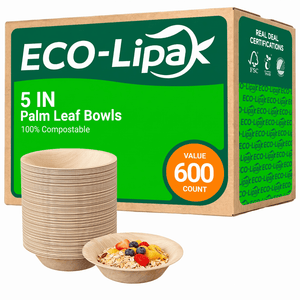
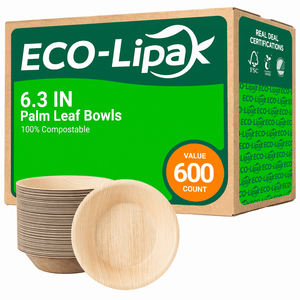
Quick Answer: Choose 5-inch palm leaf bowls for dips, tastings, desserts, and tightly controlled side portions. Choose 6.3-inch bowls for salads, grain sides, fruit, or a small individual course. ECO-Lipak currently lists both wholesale sizes in 600-count cartons: the 5-inch carton at $153.98, or about $0.257 per bowl, and the 6.3-inch carton at $191.98, or about $0.320 per bowl. The larger bowl costs about 6.3 cents more per serving, so test the actual menu portion before ordering.
Key Takeaways
- The 1.3-inch diameter difference changes portion capacity, table presence, and carton economics more than it first appears.
- A 5-inch bowl is the practical choice for dips, samples, desserts, and smaller sides; 6.3 inches gives salads and fuller sides more room.
- At prices listed on September 18, 2026, the 600-count cartons work out to about $0.257 and $0.320 per bowl before shipping and tax.
- Natural leaf grain and color vary from piece to piece. That variation is part of the material, not a print defect.
- Wholesale buyers should test food fit, hold time, nesting, carton storage, and the local disposal route before committing to repeat orders.
Buying wholesale palm leaf bowls is not simply a choice between small and large. The right size affects food cost, perceived portion, spill risk, buffet speed, storage space, and the number of unused bowls left after an event. A bowl that looks economical on a product page can become expensive when staff overfill it or guests take a second one because the portion feels too small.
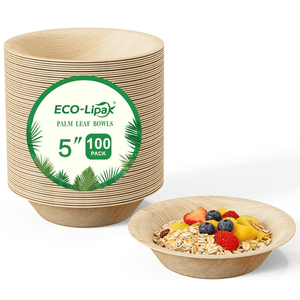
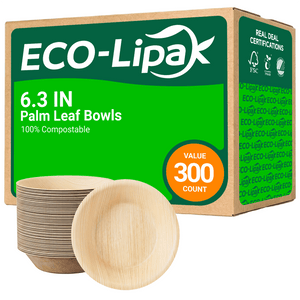
The ECO-Lipak 5-inch and 6.3-inch palm leaf bowls are shallow, round bowls pressed from fallen Areca palm leaves. They have visible natural grain and are intended for appetizers, sides, desserts, and similar foodservice uses. They are not deep soup cups, and their organic pattern will not look perfectly identical across a case.
5 vs 6.3 Inch: Wholesale Cost and Menu Fit
| Size | Wholesale Count | Listed Price | Approx. Cost Each | Best Starting Uses |
|---|---|---|---|---|
| 5 inch | 600/carton | $153.98 | $0.257 | Dips, tastings, desserts, small sides |
| 6.3 inch | 600/carton | $191.98 | $0.320 | Salads, fruit, grain sides, small courses |
These are September 18, 2026 list prices and may change. Freight, tax, discounts, breakage, and unused inventory are not included. Because both cartons contain 600 bowls, the price difference is easy to see: the 6.3-inch option adds $38 per carton, or roughly $0.063 per serving.
That difference may be justified when a larger bowl prevents spills or makes a $9 appetizer look properly presented. It may be wasted on a two-ounce dip. Price the packaging against the actual plated portion, not against the menu category alone.

Use Portion Tests, Not Diameter Alone
Diameter does not tell you exactly how much usable food volume you have. Palm leaf bowls are molded from a natural material, and the useful fill line sits below the rim. Saucy food also needs more headspace than dry snacks. Run a simple test with the serving spoon staff will actually use.
- Weigh or measure the standard menu portion.
- Place it in both sizes using the normal serving utensil.
- Carry each bowl ten steps and set it on a crowded table.
- Hold the food for the longest realistic service period.
- Score appearance, rim clearance, base stability, seepage, and guest handling.
For wet or oily recipes, test the actual food rather than relying on a general leak-resistant description. Leak resistance is not the same as indefinite liquid storage. For heating or chilling, follow the current product instructions and test the complete food-and-container combination under your normal process.
Three Real Buying Scenarios
1. A tasting reception with four small bites
A caterer serving mousse, ceviche, mini salads, and dessert samples wants one bowl style across the menu. The 5-inch bowl keeps the tasting portion intentional and takes less table space. Before ordering 600, the team plates all four recipes, checks whether liquid reaches the rim, and confirms that guests can hold the bowl while standing. If the salad looks crowded, the caterer can reserve 6.3-inch bowls for that course rather than oversizing every serving.
2. A buffet serving grain and vegetable sides
A self-serve buffet needs enough room for guests to use a serving spoon without pushing food over the edge. The 6.3-inch bowl is the safer starting point for couscous, roasted vegetables, fruit, or slaw. Staff should still define a fill line and serving utensil. A larger bowl can quietly increase food cost when guests interpret extra space as an invitation to take more.
3. A dessert bar with weekly events
A venue serves cobbler, cake bites, fruit, and chilled desserts. The 5-inch size works for dense desserts and controlled portions, while a dessert with whipped topping or garnish may need the larger rim. The buyer photographs both options under venue lighting, checks spoon clearance, then chooses the size that supports the menu most often. A small backup quantity of the other size can cover unusual events without duplicating full-carton inventory.

Calculate Cartons From Events and Reserve Stock
Bowls needed = guests x bowls per guest x booked events x (1 + reserve rate). Divide the result by 600 and round up. Keep the reserve rate visible so a planning assumption does not become permanent overbuying.
| Service Plan | Base Demand | With 5% Reserve | 600-Count Cartons |
|---|---|---|---|
| 200 guests, one bowl each | 200 | 210 | 1 |
| 150 guests, two bowls each | 300 | 315 | 1 |
| Four 180-guest events, one each | 720 | 756 | 2 |
One carton may cover a single event and leave substantial stock. That is reasonable only if there is dry, protected storage and another event will use the same size. Measure the shelf before ordering. Keep cartons off the floor, away from moisture, and protected from crushing. Use older stock first and inspect a sample from each incoming carton for clean edges, stable bases, and normal natural variation.
Presentation and Material Expectations
Palm leaf bowls have an earthy, premium look that works well for outdoor receptions, tasting tables, and menus where natural texture supports the presentation. Each piece can show different veins, tan shades, or darker marks. Buyers who need an identical white surface for every plate should recognize that this material intentionally looks variable.
The U.S. EPA home composting guidance explains the balance of greens, browns, moisture, and air in a home system, but local rules and product-specific claims still matter. Do not promise that a foodservice item will break down in every backyard pile. Ask the manufacturer what certification applies, and ask the receiving compost facility whether it accepts palm leaf tableware with food residue.
The FTC summary of the Green Guides is also useful when writing menu signs or sustainability claims. Use precise language that matches the product and the disposal route. “Made from palm leaves” is a material description; “will compost here” requires evidence and an actual accepted destination.
For related sizes and shapes, review the ECO-Lipak palm leaf tableware collection. Standardizing too many shapes can complicate receiving and storage, so add a second size only when it solves a repeat menu need.
A Practical Purchase Checklist
- Match the measured portion to the usable fill area.
- Test the wettest and heaviest recipe, not the easiest one.
- Calculate live unit cost from current price and carton count.
- Confirm 600 bowls can be stored dry without crushing.
- Accept normal natural grain variation before choosing the material.
- Set a reorder point from daily use, lead time, and a clear reserve.
- Verify the disposal instruction with the local receiving program.
Frequently Asked Questions
Are 5-inch palm leaf bowls large enough for side dishes?
They can work for compact, controlled sides, but test the measured serving. Loose salads, fruit, and dishes with garnish often present better in the 6.3-inch bowl.
How much does each wholesale bowl cost?
Using September 18, 2026 list prices, the 5-inch 600-count carton is about $0.257 per bowl and the 6.3-inch carton is about $0.320 before shipping and tax.
Will every palm leaf bowl look identical?
No. Natural grain, shade, and small visual variations are expected. Inspect samples if exact color uniformity is important to the event design.
Can palm leaf bowls hold soup?
These shallow bowls are better suited to appetizers, sides, desserts, and similar portions. Test any liquid-heavy menu for depth, hold time, handling, and seepage before service.
How many cartons should a caterer order?
Multiply guests by bowls per guest and booked events, add a defined reserve, then divide by 600 and round up. Include stock already on hand before placing the order.