Quick Answer: A six-roll case of 10-inch TAD commercial paper towels is a sensible fit for automatic roll dispensers in busy restrooms, schools, offices, and facilities when the dispenser accepts the roll dimensions and 4,800 sheets can turn before taking up excess storage. At the September 17, 2026 list price of $61.99, the case works out to about $10.33 per roll or 1.29 cents per sheet before freight and tax.
Key Takeaways
- Six rolls at 800 sheets each provide 4,800 sheets per case.
- The listed case price equals about $10.33 per roll and $0.0129 per sheet.
- TAD describes a through-air-drying process designed to create a soft, bulky, absorbent sheet structure.
- Dispenser compatibility must be confirmed by roll width, diameter, core, and feed design, not by the words “automatic dispenser” alone.
- The best case lasts long enough to reduce restocking without sitting so long that rolls absorb moisture or get crushed.
Commercial paper towels are often purchased by case price, yet facility cost is created at the dispenser. A cheaper roll that jams, tears into oversized lengths, or requires frequent service can cost more than its invoice suggests. A useful buying review therefore combines unit math with dispenser fit, sheets per visitor, labor, storage, and actual refill frequency.
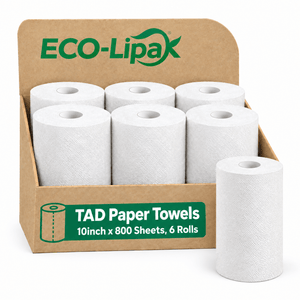
The ECO-Lipak TAD paper towel case contains six large white rolls, each listed at 10 inches wide and 800 sheets. The product is intended for commercial automatic dispensers and high-traffic locations. These are large hardwound roll towels, not household kitchen rolls, folded hand towels, or toilet tissue.
Case Cost and Capacity
| Measure | Calculation | Result | Why It Matters |
|---|---|---|---|
| Sheets per case | 6 rolls x 800 | 4,800 | Baseline supply capacity |
| Cost per roll | $61.99 / 6 | $10.33 | Compare refill cost |
| Cost per sheet | $61.99 / 4,800 | $0.0129 | Compare different case formats |
| Cases per month | Monthly sheets / 4,800 | Round up | Plan purchase quantity |
These numbers use the price visible on September 17, 2026 and exclude shipping, tax, dispenser waste, and maintenance labor. Cost per sheet is only a starting point. If a sensor dispenses two sheets at a time or users pull extra towels because one sheet does not feel sufficient, consumption rises. Measure actual rolls installed and removed rather than relying on foot traffic alone.

What TAD Changes
TAD stands for through-air drying. Instead of pressing a wet web flat against a conventional heated cylinder for most of the drying work, hot air moves through the sheet structure. The process can create more bulk and open space between fibers, which supports softness and liquid pickup. It does not make every TAD towel identical: fiber mix, basis weight, embossing, dispenser cut length, and converting still affect performance.
For a buyer, the practical test is not whether “TAD” sounds advanced. It is whether one normal dispense dries hands, stays intact when wet, feeds consistently, and produces an acceptable bin volume. Compare two rolls in the same dispenser at the same sensor setting. Record dispenses per hand-dry event and jams per roll.
Estimate Monthly Demand
Monthly sheets = daily users x sheets per user x operating days. Divide by 4,800 and round up to full cases. Add a small reserve based on lead time and the cost of a stockout.
| Facility | Assumption | Monthly Sheets | Starting Order |
|---|---|---|---|
| Small office | 45 users x 2 sheets x 22 days | 1,980 | 1 case may cover about two months |
| School wing | 180 users x 2 sheets x 20 days | 7,200 | 2 cases plus observed reserve |
| Busy public restroom | 300 users x 1.5 sheets x 30 days | 13,500 | 3 cases plus lead-time reserve |
The model is deliberately simple. Automatic dispensers often deliver a measured length rather than a literal pre-cut sheet, so “sheets per user” must match the product and machine. Use the formula for an initial estimate, then replace assumptions with one month of roll-change data.
Three Facility Scenarios
1. An office with low but steady traffic
A 4,800-sheet case may last several weeks. The purchase is attractive only if the stockroom can keep reserve rolls dry and undamaged. Mark the first-in, first-out shelf position, store rolls above the floor, and avoid placing them beside chemicals that can leak. A smaller reorder point protects cash while one unopened case provides continuity.
2. A school with predictable peaks
Traffic surges between classes and lunch periods. Load dispensers before the peak rather than waiting for an empty-roll complaint. If two sheets per student is the observed average, one 4,800-sheet case covers 2,400 hand-drying events. Keep reserve rolls near the service route but behind staff-controlled storage so restocking remains quick.
3. A public restroom with sensor dispensers
Test the shortest dispenser setting that still dries hands comfortably. A too-short dispense can create a second wave; a too-long setting increases use immediately. Compare total roll consumption, complaint volume, and service calls for two weeks. The winning setting is the one that controls cost without encouraging repeated touches or leaving users with visibly wet hands.

Use a Compatibility Checklist
- Record the dispenser manufacturer and model number.
- Confirm the maximum accepted roll width and diameter.
- Check core size and whether the dispenser requires a proprietary adapter.
- Install one roll and test initial feed, sensor response, and clean cut or tear.
- Run the roll through normal humidity and traffic for several days.
- Measure dispenses, jams, change time, and sheets used per day.
A product title cannot verify mechanical compatibility. If the dispenser manual is unavailable, measure the current working roll and compare it with the candidate product before buying. Facilities that need kitchen cleanup rather than restroom hand drying should review available paper and bathroom essentials and choose by task; a commercial hand-towel roll is not a substitute for every wiping job.
Hand Hygiene and Waste Control Work Together
The U.S. CDC recommends drying hands after washing because germs transfer more easily to and from wet hands. A reliable dispenser and an available towel matter more than a theoretical low cost when an empty unit interrupts that basic behavior.
At the same time, the U.S. EPA suggests source-reduction practices that prevent waste before it is created. For facility managers, practical steps include setting a sensible dispense length, maintaining sensors, tracking damaged rolls, and ordering quantities that fit the site. Do not make compostability or recycled-content claims unless the current product documentation supports them.
Frequently Asked Questions
How many sheets are in one case?
The case contains six rolls at 800 sheets each, for a listed total of 4,800 sheets.
What is the approximate cost per sheet?
At the September 17, 2026 list price of $61.99, the cost is about 1.29 cents per sheet before freight and tax.
Will the rolls fit every automatic dispenser?
No. Verify roll width, diameter, core, feed design, and the dispenser model. “Automatic” describes operation, not universal compatibility.
Are these the same as household paper towel rolls?
No. They are large commercial rolls intended for compatible automatic dispensers and facility hand-drying use.
How many cases should a facility buy?
Estimate monthly sheets from daily users, use per person, and operating days, then divide by 4,800. Add reserve stock equal to expected lead-time demand.