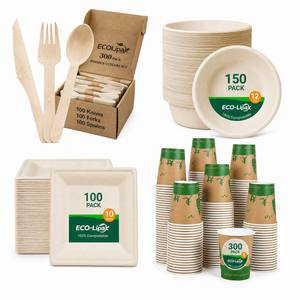
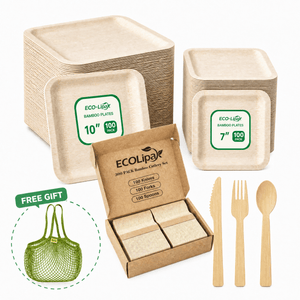
Quick Answer: A 100-guest tableware set should be judged component by component, not by the largest number on the bundle. ECO-Lipak's current natural set includes 100 ten-inch square plates, 150 twelve-ounce bowls, 300 eight-ounce paper cups, and 100 wooden cutlery sets. That covers one plate and one complete cutlery setting per guest, with extra bowls and enough cups for up to three planned beverage moments per guest.
Key Takeaways
- The set anchors 100 place settings because plates and complete cutlery sets are the limiting components.
- Extra bowls and cups create service flexibility; they do not automatically increase the seated guest count.
- Cup lids are not included, so any covered drink service needs a separate compatibility check and quantity plan.
- Count vendor meals, staff meals, damage, seconds, and course changes before treating 100 as the final attendance limit.
- Match disposal instructions to each material and the local receiving program.
“Serves 100” sounds complete, but an event does not consume every item at the same rate. A plated lunch may use one dinner plate and one cutlery set per guest. A soup-and-dessert program may use two bowls for some guests. A conference can easily use two or three cups per person across morning coffee, lunch, and an afternoon break.
The right way to evaluate a bundle is to map each component to a service moment. This reveals both the coverage and the gaps before the room is set.
What Is Included in the Current Natural Set?
The ECO-Lipak Natural Complete Tableware Set currently combines four coordinated components:
| Component | Included quantity | Coverage at 100 guests | Planning note |
|---|---|---|---|
| Natural 10 in square plates | 100 | 1 per guest | No built-in reserve for drops, seconds, or staff meals |
| Natural 12 oz bowls | 150 | 1 per guest plus 50 | Allocate extras to soup, salad, dessert, or reserve |
| Natural 8 oz paper cups | 300 | Up to 3 per guest | Plan by beverage round; lids are not included |
| Wooden cutlery sets | 100 sets | 1 set per guest | Each set contains a fork, knife, and spoon |
One cutlery set contains one fork, one knife, and one spoon, so the bundle includes 300 utensils in total. That does not mean it serves 300 diners. The sellable service unit is still 100 complete settings.
Browse the tableware set collection when comparing bundle structures. Keep the event menu beside the product page; otherwise, a visually coordinated set can hide a quantity mismatch.

Find the Limiting Component
For each component, divide the included quantity by expected uses per guest. Round down to find how many guests that component supports:
Component guest coverage = floor of [included quantity divided by planned uses per guest].
The smallest result is the bundle's practical guest coverage for that service plan.
- One plated meal: 100 plates / 1 = 100 guests; 100 cutlery sets / 1 = 100 guests.
- Two plate changes: 100 plates / 2 = 50 guests. A second plate order is needed for a true appetizer-and-dinner place setting.
- Three beverage rounds: 300 cups / 3 = 100 guests.
- Two bowls for every guest: 150 bowls / 2 = 75 guests. For 100 guests, add at least 50 bowls before reserve.
This calculation is more reliable than dividing the total number of pieces by attendees. Forks, cups, and bowls are not interchangeable.
Add People Who Are Easy to Miss
Start with the final guest count, then add meals for vendors, photographers, musicians, drivers, volunteers, and staff when those meals use the same serviceware. Add a separate reserve for dropped or damaged pieces and unexpected attendees.
Planned settings = guest settings + staff/vendor settings + chosen reserve.
For example, an event with 88 guests, 6 vendor meals, and a 6-setting reserve needs 100 complete settings. The bundle fits. An event with 96 guests, 8 vendor meals, and a 5% reserve needs more than 100 plates and cutlery sets, even though the invitation list is below 100.

Four Event Plans
Buffet Lunch With One Main Plate
Use one square plate and one cutlery set per attendee. Assign the bowl to salad, soup, or dessert only if that course is served to everyone. Keep the remaining bowls and cups protected as reserve rather than placing all stock on the buffet at once.
Office Conference With Three Beverage Breaks
The 300 cups can cover morning coffee, lunch, and an afternoon drink at one cup per person per round. If attendees refill using fresh cups or outside guests join a break, add cups. Test the exact beverage in the 8 oz format and source lids separately when covered service is required.
Casual Party With Soup and Dessert
One hundred bowls can cover soup for all guests, leaving 50 for dessert or reserve. If dessert also goes to every guest, the bundle is short by at least 50 bowls before adding a buffer. A menu change or separate dessert plate may solve the gap.
Catered Dinner With Vendor Meals
Count vendor meals as full settings when they use the same plate and cutlery. Review the office lunch tableware planning method for a station-by-station stock approach that also works for backstage and vendor meal areas.
Run a Ten-Setting Trial
- Plate the full menu. Test weight, sauces, cutlery, and bowl fill using normal portions.
- Build the drink station. Confirm cup size, fill level, sleeve or lid needs, and refill policy.
- Walk the service route. Carry a setting from buffet to seat and clear it as staff will.
- Record actual consumption. Note how many plates, bowls, cups, and sets ten guests use.
- Scale the result. Multiply by the final attendance plan and add a visible reserve.
A ten-setting trial catches menu and workflow problems that a product count cannot. It also helps decide whether a complete bundle or separately purchased components are the better fit.
Keep Material and Disposal Claims Precise
The set combines sugarcane plates and bowls, paper cups with a PLA lining, and wooden cutlery. Those materials may require different collection decisions. The U.S. EPA's food-service ware guidance recommends considering reusable systems where practical and matching compostable products to available collection and processing.
Use the ECO-Lipak resource library to match documents to the exact item. Confirm local acceptance before labeling an event bin, and keep nonaccepted lids, decorations, and food packaging out of the stream.
FAQ
Does a 100-guest tableware set serve exactly 100 people?
It supports 100 complete plate-and-cutlery settings under a one-setting-per-person plan. Staff meals, course changes, seconds, damage, and reserve can reduce practical coverage.
Why are there 150 bowls in a 100-guest set?
The extra 50 bowls create flexibility for an additional course, selected guests, or reserve. They do not provide two bowls for every guest.
Why are 300 cups included?
Three hundred cups can support up to three planned beverage moments per guest. Actual coverage falls when guests use fresh cups for refills or nonattendees share the station.
Are cup lids included in the set?
No. The current product description states that cup lids are not included. Match any lid to the exact cup diameter and test the fit before the event.
Should an event order a reserve?
Usually yes. Choose a reserve from attendance uncertainty, service style, damage history, and the cost of running short; record it as a count, not a vague percentage.