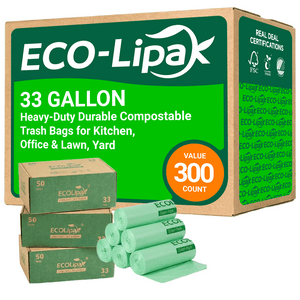
Quick Answer: A 33-gallon compostable liner is a sensible wholesale choice for a commercial bin only after a filled-bag trial confirms the rim, depth and load work together. ECO-Lipak's 33-gallon, 300-count carton can simplify replenishment for a repeatable waste station, but the right case quantity depends on liner changes per week and whether your collection program accepts compostable bags.
Key Takeaways
- Match the liner to the actual bin, not the nominal gallon label alone. Test the rim, usable depth and a normal filled load.
- Calculate bags from bin changes, then add a modest buffer. A 300-count carton is an ordering unit, not a promise about how long it will last.
- Put compostable liners only in a waste stream that accepts them. Certification and local collection rules answer different questions.
- Keep a separate liner size where small office or extra-large service bins make a 33-gallon bag a poor fit.
Start With the Bin You Actually Use
Facilities often buy by the number molded into a container, then discover that a nominal 33-gallon bag slips inside one bin and stretches across another. A slim rectangular opening, rolled rim, lid hardware and deep bottom can all change the fit. Measure the opening around the top and the distance from the rim to the bottom. Then install one liner with enough material to hold over the rim. A liner that just touches the rim when empty may pull down as soon as staff add food scraps or paper towels.
For a practical test, use a normal shift's waste, not a bag packed to its breaking point. Close the liner the way your team really closes it, lift it from the bin and carry it the usual distance. Look for slipping, tearing at contact points, liquid pooling and an awkward excess of unused bag. Those observations matter more than a generic “heavy-duty” label. If a sample fails, adjust size, loading practice or pickup frequency before committing to a wholesale carton.

Which Waste Station Is a 33-Gallon Liner For?
A 33-gallon liner is often considered for shared back-of-house or service-area bins: large enough to collect several rounds of waste, yet smaller than a large rollaway container. It is not automatically the correct bag for every “commercial” setting. Your waste stream, how often a team changes the bag and the weight of a typical load should guide the choice. If wet food scraps make each bag heavy, more frequent changes may be more workable than filling a larger liner to the rim.
| Station | What to check | Likely purchasing decision |
|---|---|---|
| Shared prep-area bin | Wide opening, wet-load weight and daily changes | Trial a 33-gallon liner and set a safe fill point |
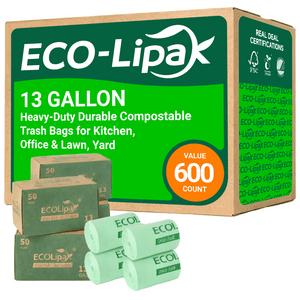
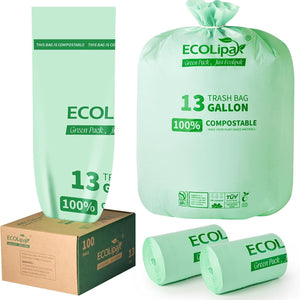
| Small office or restroom bin | Excess material and bag slipping | Compare a 13-gallon wholesale liner |
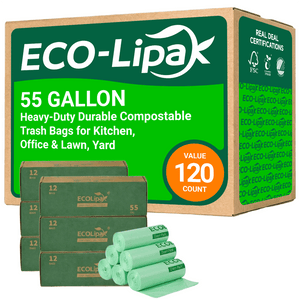
| Large event or loading-area bin | Rim circumference and full depth | Compare a 55-gallon wholesale liner |
One location may need two or three sizes. A mixed-size order can be more economical than forcing a single bag across incompatible bins. The compostable trash bag collection is useful for comparing those sizes, while the existing 13-, 33- and 55-gallon sizing guide goes deeper on bin measurements. This article focuses on the 33-gallon case order and the operating decision around it.
Turn a 300-Count Carton Into an Order Plan
Begin with the number of bins that truly take this liner. Multiply by changes per operating day, days per week and weeks until the next planned delivery. Add a buffer for a busy shift, torn bag or unexpected event; 10% is a planning example, not a universal standard. Round up to a whole carton only after you calculate the working demand.
Example A: Eight bins changed once per day, five days per week, across four weeks need 8 × 1 × 5 × 4 = 160 liners. With a 10% buffer, plan for 176. One 300-count carton covers that period and leaves 124 liners for the following cycle. That is useful stock, provided you have clean, dry space to store it.
Example B: Sixteen bins at the same daily schedule need 320 liners before any buffer. A single 300-count carton cannot cover four weeks; two cartons are the practical whole-carton order. If your purchasing system allows shorter reorder intervals, you could also schedule deliveries more often. Record opening stock, actual weekly use and the next delivery date so that purchasing is based on real consumption rather than a guessed monthly number.

Three Real-World Buying Situations
1. A Restaurant Prep Area
The team changes a shared bin at the end of each shift, but occasionally sooner after a busy lunch. Make the test load look like that lunch service and note how many liners are used during the busiest week, not just an average Tuesday. Keep the bag size fixed only if it seats securely and can be removed without dragging. If the waste stream is headed to a composting program, confirm liner acceptance with that program before labeling the station as compost.
2. A Multi-Floor Office
Only the break-room bins may need 33-gallon liners; desk-side and restroom containers may be much smaller. Count the qualifying bins separately. A facility manager who applies the 300-count case to every floor without this split can end up with excess large liners while running short of the small size. Use the same weekly worksheet for each liner type, then consolidate the purchase.
3. A Weekend Event Venue
Demand is uneven: setup, service and breakdown have different change rates. Estimate by event rather than by calendar day and hold a small reserve near the collection point. Do a fitted-bag trial with the venue's actual wheeled or stationary bins. A large event bin may call for 55 gallons, while a narrow concession bin may accept 33 gallons; the label “event” alone settles neither question.
Certification Does Not Set Your Disposal Route
Product certifications can help a buyer assess a material claim, but they do not guarantee that a local composting facility accepts that specific item. The EPA's compostable-plastics FAQ advises checking local acceptance and keeping compostable plastic out of conventional plastic recycling. Verify the actual product and applicable certification details through the ECO-Lipak certification guide, and ask the hauler whether liners are allowed with your organics stream. If they are not, do not present the liner as a route to local composting.
At receiving, compare carton count, bag size and the item's current specification against the purchase order. At the station, label the waste stream plainly and train staff on what belongs there. These steps matter because a good liner cannot compensate for contamination or an unaccepted collection method. A clear bag policy also helps avoid mixing bag sizes, which can make use-per-case data unreliable.
Frequently Asked Questions
Will a 33-gallon bag fit every 33-gallon trash can?
No. Opening shape, rim design and depth vary. Fit one bag to the actual can and test removal with a normal filled load before you order a carton.
How long will a 300-count carton last?
Divide 300 by the number of liners you use each week. If your site uses 40 per week, the carton lasts about 7.5 weeks before accounting for reserve stock or changing demand.
Can compostable liners go into plastic recycling?
No. Do not put a compostable liner in a conventional plastic recycling stream. Check whether your local organics collector accepts it; otherwise follow that collector's disposal instructions.
Is a certified compostable bag accepted by every composting facility?
No. Certification describes testing against a standard; a facility still sets its own accepted-material list. Confirm both the item's certification and your facility's policy.
When should I buy a different liner size?
Switch when the 33-gallon bag slips, cannot fold over the rim, leaves excessive unused material or creates an unnecessarily heavy full load. Trial the 13- or 55-gallon options where appropriate.