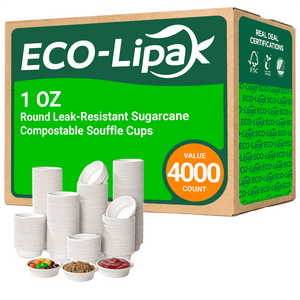
Quick Answer: Choose 1 oz compostable portion cups for tastes, spices, and tightly controlled samples; 2 oz cups for most sauces, dips, and dressings; and 4 oz cups for desserts, snacks, or larger sides. ECO-Lipak's wholesale cartons contain 4,000 one-ounce cups or 1,600 two- or four-ounce cups. Order from servings, cups per order, service days, and a 10% to 15% reserve rather than choosing the largest carton by price alone.
Key Takeaways
- The 1 oz carton contains 4,000 cups; the 2 oz and 4 oz cartons contain 1,600 cups each.
- At prices listed on September 16, 2026, approximate unit costs are $0.036, $0.077, and $0.089 for 1 oz, 2 oz, and 4 oz respectively.
- A smaller cup controls food cost only when the menu portion actually fits without overfilling.
- Use a 10% reserve for predictable daily service and up to 15% for events or sampling programs.
- BPI certification supports commercial compostability, but local facilities decide whether portion cups are accepted.
Small cups create large purchasing mistakes when buyers compare only carton prices. The right question is how many complete servings each carton covers at the portion your kitchen actually uses. A one-ounce cup may be economical for tasting oil or seasoning, but it creates messy overfilling when the menu calls for two ounces of dressing. A four-ounce cup can hold a dessert, yet it may be unnecessary for a teaspoon of hot sauce.
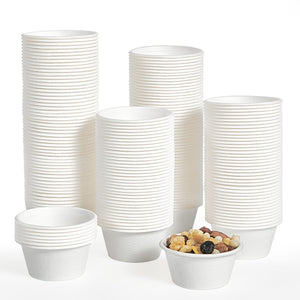
The ECO-Lipak wholesale sugarcane portion cup range uses matte white molded fiber in 1 oz, 2 oz, and 4 oz sizes. The product listing describes the cups as BPI certified, BPA-free, leak-resistant, and suitable for hot and cold foods. Carton count changes by size, so each variant must be planned as a separate inventory item.
1 oz vs 2 oz vs 4 oz: Carton and Cost Comparison
| Size | Wholesale Carton | Listed Price | Approx. Unit Cost | Best Starting Uses |
|---|---|---|---|---|
| 1 oz | 4,000 cups | $144.99 | $0.036 | Tastes, spices, tiny samples |
| 2 oz | 1,600 cups | $123.99 | $0.077 | Dips, dressings, sauces |
| 4 oz | 1,600 cups | $141.84 | $0.089 | Desserts, fruit, sides, snacks |
These calculations use prices visible on September 16, 2026 and exclude tax, freight, waste, and labor. Divide the live variant price by the live carton count for a current number. The lowest unit cost does not automatically create the lowest cost per order. If an order needs two 1 oz cups, the packaging use doubles and the customer handles two containers.

Use One Formula Before Ordering
Cups needed = orders or guests x cups per order x service periods + reserve.
Use 1.10 for a 10% reserve or 1.15 for a 15% reserve, then round up to a full carton. Count each cup that leaves the prep line. A meal with salsa and dressing uses two cups even when it is one order.
| Operation | Base Use | Reserve | Buying Result |
|---|---|---|---|
| Four-day grocery sampling program | 6 locations x 150 tastes x 4 days = 3,600 | 10% = 3,960 | One 4,000-count 1 oz carton |
| 500-guest event with two sauces | 500 x 2 = 1,000 | 10% = 1,100 | One 1,600-count 2 oz carton |
| Restaurant takeout week | 160 orders x 1.4 cups x 5 days = 1,120 | 10% = 1,232 | One 1,600-count 2 oz carton |
| 250 dessert servings | 250 x 1 = 250 | 15% = 288 | Consider a smaller box before a 1,600-count carton |
Three Buying Scenarios
1. A restaurant standardizing takeout sauces
Measure the finished sauce with the same ladle, scoop, or pump used during service. If the recipe target is 1.5 ounces, a 2 oz cup leaves practical headspace and reduces spills. Track how many orders receive zero, one, or two cups. An average of 1.4 cups per order is more useful than assuming every order receives one.
2. A grocery or brand sampling program
One-ounce cups make sense when the sample is intentionally small and consumed immediately. Six locations serving 150 tastes per day for four days need 3,600 cups. A 10% reserve brings the plan to 3,960, which fits one 4,000-count carton with only 40 cups left. Ship reserve sleeves to each site instead of leaving the entire buffer at one location.
3. A caterer serving dessert bites
Four-ounce cups can hold fruit, mousse, ice cream, or a composed tasting portion. A 250-guest reception with 15% reserve needs 288 cups, far below a 1,600-count carton. Unless the caterer has upcoming events, the smaller retail and box-size portion cup options may protect cash and storage space better than wholesale.

Test Capacity, Hold Time, and Transport
- Fill ten cups to the recipe's standard portion, leaving practical headspace.
- Hold hot or cold samples for the normal service time.
- Place cups beside the intended takeout containers or on the service tray.
- Check the rim, base, and sidewall for softening, spills, or difficult handling.
- Record cups used per order and damaged cups for one representative week.
- Set the reorder point from daily use x supplier lead days + reserve.
Lids are not listed as part of these variants. Do not assume a plastic or paper portion-cup lid will fit the molded-fiber rim. If covered transport is mandatory, confirm a tested closure before committing to a wholesale carton. For open sauce stations, control exposure with short replenishment cycles and food-safety procedures rather than improvising an unverified lid.
Plan the Disposal Stream Before Service
BPI's product catalog explains that listed products are certified for commercial compostability, while home-compost status is identified separately. Certification is not a universal collection instruction. The U.S. EPA recommends purchasing commercially compostable foodservice ware only when a local program accepts the product types and collection service is in place.
Ask the composter or hauler whether molded sugarcane portion cups are accepted with food scraps. Put that exact cup in sorting signs and keep conventional plastic condiment cups out of the same station. ECO-Lipak's compostable certification guide can help teams interpret common marks, but the receiving facility remains the final authority.
Frequently Asked Questions
What size portion cup is best for sauce?
Two ounces is the most practical starting point for many dips, dressings, and sauces. Test the recipe because one-ounce samples and four-ounce sides need different capacities.
How many cups are in each wholesale carton?
The referenced variants contain 4,000 one-ounce cups or 1,600 two- or four-ounce cups per carton.
What is the current cost per cup?
At prices listed on September 16, 2026, the approximate costs are 3.6 cents for 1 oz, 7.7 cents for 2 oz, and 8.9 cents for 4 oz. Recalculate from live pricing.
Do the compostable portion cups include lids?
No lids are listed with these wholesale variants. Verify a compatible closure separately if the cups must travel covered.
Can the cups go in a home compost bin?
Do not assume so. The product is presented with commercial compostability certification; follow verified product labeling and local program rules.