Quick Answer: Plan food sampling cups from the number of individual tastes you expect to hand out, not the number of people walking past the booth. For 200 planned tastes, an illustrative 10% handling reserve brings the cup requirement to 220. Test the actual food portion in the smallest suitable cup, then round the order up to the available pack size; cup capacity is not the same as serving quantity.
Key Takeaways
- One visitor trying two flavors uses two cups, even if each taste is very small.
- Choose the portion first and the cup size second.
- A handling reserve covers extra cups, not extra food that must be prepared in advance.
- Keep clean reserve stock protected and prepare small working batches.
- Confirm local collection rules before describing used sampling cups as compostable at your event.
A tasting booth can run out of cups while most of the food is still in the cooler. It can also finish the day with hundreds of unused cups and too much prepared food. Both problems often begin with the same shortcut: treating foot traffic, tastings, food portions, and packaging as one number.
Separate those numbers on the planning sheet. How many people are likely to stop? How many flavors will each person try? What is one taste? How many cups come in the pack? Once those questions are settled, the order becomes much easier to check.
Start With One Taste, Not a Full Cup
Choose enough food for someone to understand the flavor and texture. A preserve may need only a small spoonful. A chunky salsa may need room for a scoop and a cracker. A composed dessert bite needs space for its separate ingredients. Test each recipe with the utensil the customer will actually use.
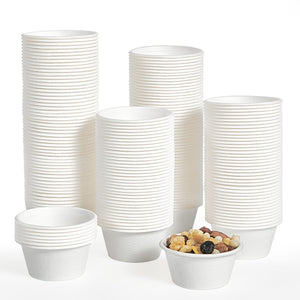
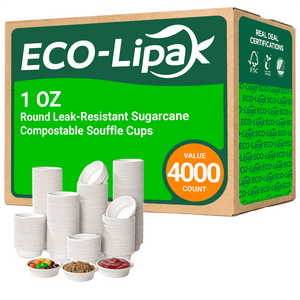
ECO-Lipak's white sugarcane souffle cups are available in 1 oz, 2 oz, and 4 oz sizes. Those are nominal container capacities, not instructions to fill each cup to the rim. A larger cup can be useful for clearance around a spoon without increasing the amount of food in the sample.

| Sample format | Starting cup to test | What decides the final fit |
|---|---|---|
| A spoonful of preserve or smooth dip | 1 oz | Can the customer reach the food without spilling it? |
| Chunky salsa or a small topping combination | 2 oz | Does the utensil have clearance around solid pieces? |
| A layered dessert bite or bulky dry sample | 4 oz | Can the ingredients sit below the rim without compressing? |
This table is a testing order, not a universal portion standard. Thick dips, fluffy grains, and dense desserts occupy space differently. For an existing takeout sauce program, use the separate sauce portion cup size guide; a sales demonstration has a different purpose from a full condiment serving.
A Worked Plan for 200 Tastes
Cups required = planned individual tastes x (1 + handling reserve). Round the answer up to a whole cup, then round again to full packs. The 10% reserve below is an example assumption, not a measured industry benchmark. Replace it with your own history once you have one.
| Planning line | Calculation | Result |
|---|---|---|
| Planned tastes | 200 individual servings | 200 cups in use |
| Illustrative handling reserve | 200 x 10% | 20 extra cups |
| Total cup requirement | 200 + 20 | 220 cups |
| If the tested size is 1 oz | 1 box x 500 cups | 500 purchased; 280 beyond this event's requirement |
| If the tested size is 2 oz or 4 oz | 2 boxes x 200 cups | 400 purchased; 180 beyond this event's requirement |
The current retail box quantities are 500 for 1 oz cups and 200 for both 2 oz and 4 oz cups. Carton options are 4,000 for 1 oz and 1,600 for each of the larger sizes. Check the selected variant before ordering, especially when comparing a retail box with a wholesale portion-cup carton.
Do not choose the wrong cup just to leave fewer pieces in storage. Keep unused cups protected for a later event, and compare total delivered cost with realistic future demand. The biggest carton is not automatically the best purchase for a one-off demonstration.
Calculate the Food Separately
If the tested portion is 5 mL, 200 tastes require 1,000 mL of usable product before preparation or transfer losses. If it is 10 mL, the same 200 tastes require 2,000 mL. Doubling the portion doubles the food requirement without changing the cup count.
For recipes portioned by weight, weigh several actual samples and use that measured average. Fluid volume does not tell you the weight of granola, whipped dessert, or thick dip. Keep the food reserve separate from the cup reserve: unused cups can stay sealed, while perishable food needs a suitable holding plan.
Three Sampling Setups, Three Different Counts
Farmers market: one product, one taste
A stall expecting 200 accepted samples needs the 220-cup example above. Foot traffic might be much higher. Count the samples actually handed out, not everyone who pauses at the display. For a new market, use the organizer's information as a starting estimate and record your own results.
Trade show: two flavors per visitor
If 200 visitors each try two flavors, the base requirement is 400 cups. With the same illustrative 10% reserve, plan 440 cups. Keep flavors in distinct positions and provide the ingredient information required for your service. Do not assume visitors will reuse a cup for the next sample.
Retail demonstration: short waves of demand
A grocery-store demonstration may serve only a few tastes between busy periods. Begin with a small working batch, such as 12 portions, then adjust to observed demand. The total cup order can remain 220 while the number of exposed food portions stays much lower.

Build Refills and Cleanup Into the Plan
Assign one person to monitor the working batch and keep reserve food at its required temperature. Use clean serving tools and protect the customer-facing samples as your venue requires. The FDA's buffet guidance supports small batches and replacing serving dishes instead of topping them up. Its general advice is not a substitute for your market's permits, local food code, or approved holding procedures.
Before ordering for an organics program, send the collector the exact cup and utensil details. The EPA notes that even some commercial composters do not accept compostable foodservice products in its foodservice ware guidance. A cup's material description alone does not establish an accepted disposal route.
After the event, record tastes served, cups lost to handling, protected stock left, and unused food. Those four numbers improve the next order more than the original visitor estimate does. Compare sizes in the souffle cup collection, then keep your planning notes alongside the ECO-Lipak resource library.
FAQ
How many cups do I need for 200 food samples?
Start with 200 cups, then add a handling reserve. A 10% example gives 220 cups. Round up to the pack size for the cup that actually fits your food.
Does a 1 oz sampling cup need 1 oz of food?
No. Nominal capacity describes the container. Your tasting portion may be much smaller, and space above the food helps handling.
What if every visitor tries two flavors?
Count two cups per participating visitor. Two tastes for 200 visitors means 400 cups before any reserve.
Should I prepare all the samples before opening?
No, not by default. Prepare working batches that suit demand and the food's holding requirements. Keep reserve food protected under the venue's approved procedures.
Can used sugarcane sampling cups go in the compost bin?
Only when the receiving program accepts that exact product type. Confirm the cup, utensil, liner, and collection arrangement before setting up the station.