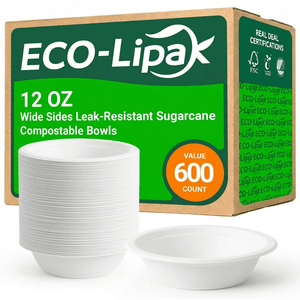
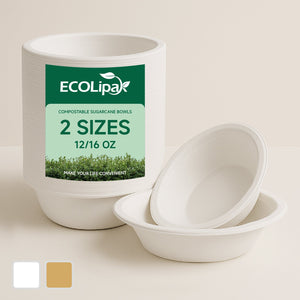
Quick Answer: Buy the 12 oz wide-rim sugarcane bowl for a measured salad, side, or lighter lunch; choose 16 oz when grains, protein, and toppings need more room. ECO-Lipak currently lists both sizes in 600-count wholesale cartons. On the listing checked September 27, 2026, the natural 12 oz carton is $69.38 ($0.116 per bowl) and the natural 16 oz carton is $83.56 ($0.139 per bowl). Confirm the live variant price and fit with your actual menu before ordering.
Key Takeaways
- The 12 oz and 16 oz labels describe capacity, not the visible diameter or the amount a fully garnished meal should hold.
- A 600-count carton covers 600 single-bowl servings on paper; at a 10% planning allowance, it covers about 545 planned servings.
- At the prices checked, the 16 oz natural bowl adds about 2.4 cents per bowl over the natural 12 oz version. Food cost and portion consistency matter more than that difference alone.
- Check the exact product variant, shipping terms, collection rules, and any lid compatibility separately. Do not assume a bowl has a matching lid just because another bowl does.
Why the wide rim matters at a lunch counter
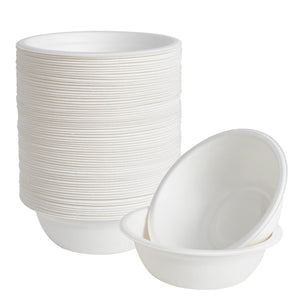
A wide-rim bowl presents food more openly than a deep soup cup. That can be useful when a salad or grain bowl is assembled in view of the customer and needs room for a spoon to move without pushing toppings over the edge. The material here is molded sugarcane fiber, not ceramic and not a paper cup. The current wholesale listing offers white and natural versions of 12 oz and 16 oz wide-rim bowls in 600-count cartons.
Size selection still starts with a filled sample. Twelve ounces of cooked grains, leafy greens, and dressing do not occupy a bowl in the same way. A leafy salad can rise above the rim while a dense bean bowl settles lower. Portion the actual recipe, add its lid only if a compatible lid has been verified, and carry it through the service route. That small test is more revealing than the ounce label alone.

12 oz versus 16 oz: the current carton math
The table uses the prices shown on September 27, 2026. Prices can change and do not include taxes, shipping, or discounts. Per-bowl prices are carton price divided by 600, rounded to the nearest tenth of a cent.
| Variant | Carton | Price checked | Approx. price per bowl | First menu to test |
|---|---|---|---|---|
| Natural 12 oz | 600 | $69.38 | $0.116 | Small salad, side, sample lunch |
| White 12 oz | 600 | $74.99 | $0.125 | Small salad with a white presentation |
| Natural 16 oz | 600 | $83.56 | $0.139 | Grain-and-protein lunch |
| White 16 oz | 600 | $86.56 | $0.144 | Full lunch with a white presentation |
The natural 16 oz option costs $14.18 more per carton than natural 12 oz. That is roughly $0.024 extra per bowl. If a larger vessel encourages a bigger serving of expensive protein, that ingredient change will usually be more consequential than the packaging difference. Set the recipe weight first, then choose the smallest bowl that presents it well.
Three service scenarios
Office salad program
A weekly office lunch with one measured salad and dressing served separately is a sensible 12 oz test. Prepare ten finished samples, leave them for the expected handoff interval, and watch whether greens crowd the rim. If a garnish falls away or guests mix in toppings at the desk, test 16 oz instead. The wide rim offers access, but the serving size must still be designed around the menu.
Build-your-own grain bowls
For a base of rice, beans, roasted vegetables, protein, and sauce, start the test with 16 oz. Keep a prepared 12 oz version alongside it so the team can compare overfill, presentation, and carry stability. For bowls with wet components, run a real transit test. The word “leak-resistant” in a product title is not a promise that any recipe can be carried or stacked without issue.
Event service for 500 lunches
At one bowl per guest, a 600-count carton yields a theoretical 100-bowl spare for 500 guests, a 20% allowance against guest count. At a 10% allowance, the planning calculation is 500 × 1.10 = 550 bowls, so one carton still covers this event. If 600 guests are expected, one carton leaves no allowance at all; order a second carton or a smaller compatible pack, depending on the replenishment plan. For a mixed menu, allocate sizes separately rather than treating 600 bowls of any size as interchangeable.

How to place a better wholesale order
First, measure the recipe as served. Second, choose natural or white for the presentation you actually want. Third, translate your expected number of portions into cartons: planned portions × your service allowance, divided by 600, rounded up. Fourth, read the current variant page for availability and delivery timing. Finally, verify the end-of-service collection route before describing any plate or bowl as a waste-reduction win.
For smaller pilots, the wide-rim bowl product with 150-count box options may make more sense than immediately committing to a large carton. For a different shape or larger menu, compare the standard sugarcane bowl range. ECO-Lipak's current listings describe compostability, but a foodservice buyer should still confirm the exact product's certification and whether the local organics program accepts foodservice ware. The US EPA's foodservice-ware guidance recommends buying commercially compostable ware only when a local program accepts it and collection is arranged.
Frequently Asked Questions
How many guests can one 600-count carton serve?
At one bowl each and no allowance, 600. With a 10% allowance, divide 600 by 1.10: about 545 planned guests. If some guests take a second bowl, build that into your estimate separately.
Is 12 oz enough for a grain bowl?
It depends on the weighed recipe. A light grain-and-vegetable side may fit; a full lunch with protein and toppings is a better 16 oz test. Fill both with your menu and check presentation and handling.
Are the white and natural variants the same price?
No. On the date checked, white costs more than natural in both sizes. Recheck live pricing before purchase because variant prices and promotions can change.
Can these bowls go into any compost bin?
No. Acceptance varies by program. Check the specific variant's certification details and ask your local compost hauler whether molded-fiber foodservice bowls are accepted.
Do these wholesale bowls come with lids?
Do not assume so. The selected wholesale listing is for bowls; confirm any lid as a separate compatible item and test the filled assembly before a takeout order.