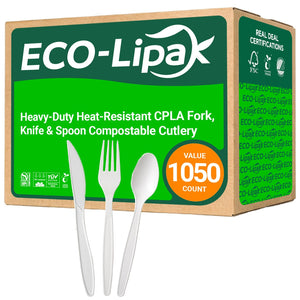
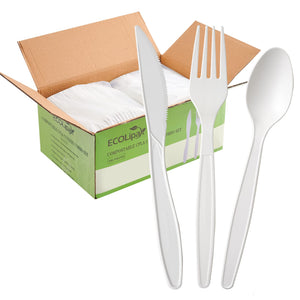
Quick Answer: For holiday catering, choose CPLA cutlery by menu and utensil use, not by guest count alone. ECO-Lipak's current wholesale listing offers an assorted 1,050-piece carton and a 450-fork carton. A buffet of salads and pastries may need far more forks than knives; a plated hot dinner may need a fuller mix. Count expected forks, spoons and knives separately, test the utensil with the real food, then buy the combination that covers service plus a small reserve.
Key Takeaways
- The current 1,050-count option is described as an assorted-piece carton; do not interpret it as 1,050 complete place settings.
- The 450-count fork carton suits menus where forks dominate, but it does not cover soup or knife service.
- Forecast each utensil type from the courses and serving method.
- Industrial compostability claims do not mean every local composting program accepts used CPLA utensils.
Start with the menu, not an equal trio
A holiday buffet can look like one event on a purchase order while involving several different eating moments. Guests might use a fork for a salad, a spoon for dessert and no knife at all. A plated roast dinner may be the opposite: guests need a fork and knife together, and dessert may introduce a clean spoon. If the buyer orders one fork, one knife and one spoon for every guest without looking at the food, the leftovers can be lopsided. That means money and storage tied up in the wrong utensils, and staff may still run out of the one type guests actually use.
The wholesale ECO-Lipak CPLA cutlery listing currently shows “Cutlery Sets / 1050/carton” and “Forks / 450/carton.” The wording should be read carefully: the 1,050 figure is a piece count in the listed variant, not a promise of 1,050 diners receiving three pieces each. Before checkout, ask for or confirm the exact fork/knife/spoon composition if it is not explicit on the selected variant page. The broader CPLA cutlery range also lists 350-piece boxes, 1,050-piece cartons and separate fork and spoon counts. Pick the SKU that matches the actual menu rather than making assumptions from a product title.

A simple purchase forecast
Suppose a caterer serves 220 guests a salad and a dessert. If the salad needs one fork and 80% of guests take dessert with a spoon, plan 220 forks and 176 spoons before reserve. A 10% working allowance gives 242 forks and 194 spoons. A 450-fork carton covers the forks, but it does nothing for spoons; the buyer must add an appropriate spoon option. In a second event with 300 roast dinners, each guest may need one fork and one knife, perhaps with a small reserve of each. The decision between assorted and single-utensil packs changes accordingly.
| Menu example | Likely utensil demand before reserve | Buying implication |
|---|---|---|
| 220 salads plus dessert for 80% | 220 forks, 176 spoons | Fork-only carton needs separate spoons |
| 300 plated roast dinners | 300 forks, 300 knives | Confirm assorted mix before purchase |
| 180 pastry samples | Often no cutlery, or a fork for some items | Do not buy full trios automatically |
These numbers are illustrative, not a universal consumption rate. Ask the service lead how the food is plated and whether guests return for another course with a clean utensil. Count catering staff needs separately from guest needs. Reconcile leftover unopened stock after the event; that number should reduce the next purchase, but a loose tray of used or exposed utensils should not be counted as sealed inventory. For repeat catering, keep a simple by-type usage sheet for several events, then set a reorder point based on lead time and your busiest planned booking.
Three holiday catering setups
Standing office reception
Guests carry small plates and move around the room. Forks often matter more than knives, while some finger foods need no utensil. Place the white CPLA forks next to the foods that require them and observe whether people take extras. A fork-only case can make sense if the menu is consistently fork-heavy, but order spoons separately for desserts that need them. Use a sample to check that the fork handles the actual food without bending uncomfortably.
Seated hot dinner
A hot entree with meat and vegetables might require both fork and knife. Test the knife against the served food, not just a soft sample. The product listing describes heat-resistant CPLA, but hot-service suitability still depends on the exact SKU and use conditions. If the assorted carton composition is unclear, verify it before committing to hundreds of pieces. Some menus also need a soup spoon; a dinner fork and knife do not cover that course.
Holiday dessert bar
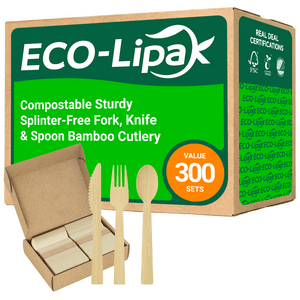
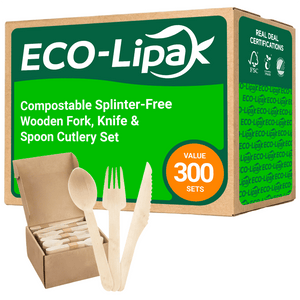
Small cakes, fruit and puddings create a mixed-use station. Estimate the number of fork and spoon desserts separately, and put each utensil near the matching item. If guests take a second dessert, they may take a fresh utensil. The practical buffer is therefore driven by expected serving moments, not just RSVPs. For a different tactile or visual presentation, compare bamboo and wooden cutlery, but do not assume those materials have identical strength, heat behavior or disposal paths.

Cost and end-of-life checks
Compare the current delivered cost per usable piece, not just carton price. A low cost per assorted piece may still be poor value if the caterer has a drawer full of unused knives after the event. Test comfort and food performance before scaling up. Check exact finished-product certification documentation when a client requires it; “compostable” is not enough to decide the collection bin. The U.S. EPA composting overview is a starting point for understanding why collection and processing infrastructure matters. Ask the local organics operator whether it accepts used CPLA cutlery. Do not put it into ordinary plastic recycling unless that local program explicitly accepts it.
Frequently Asked Questions
Does 1,050 pieces mean 1,050 full settings?
No. It is listed as a 1,050-piece assorted carton. Confirm the exact component mix before ordering.
When should I buy fork-only cartons?
When menu and past event counts show forks dominate and you already have a separate plan for knives and spoons.
Are CPLA utensils suitable for hot food?
The listing describes heat resistance, but test the selected utensil with the actual dish and follow current product guidance.
How large should the reserve be?
Use a small allowance based on refill behavior, second servings and delivery risk; 10% is an example, not a fixed rule.
Can used CPLA cutlery go into any compost bin?
No. Confirm acceptance for the exact item with the local processor or hauler.