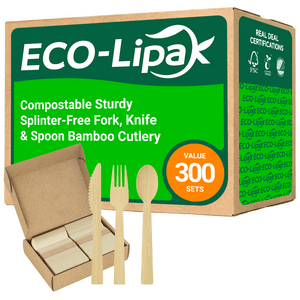
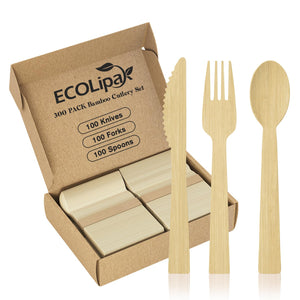
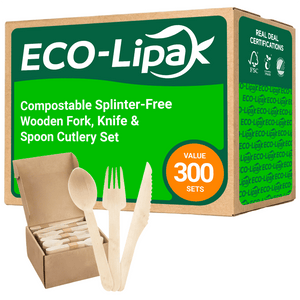
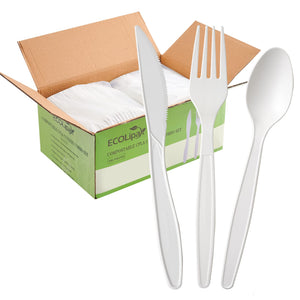
Quick Answer: A food truck selling mostly bowls should usually test fork-only bamboo cutlery before buying a complete fork, knife and spoon set for every order. ECO-Lipak sells wholesale bamboo cutlery as 900 forks per carton or 300 three-piece sets per carton. Count which meals actually need each utensil, add a modest rush buffer, then compare cost per served order rather than carton price alone. A set is useful when the menu genuinely needs all three pieces; otherwise it can leave unopened knives and spoons on the counter.
Key Takeaways
- Buy against the menu mix: fork-heavy bowls, spoon-heavy soups and knife-needed meals create different demand.
- The current wholesale options are 900 individual bamboo forks, knives or spoons per carton, or 300 three-piece sets per carton.
- Track utensils actually handed out, not only orders sold; many customers decline cutlery.
- Test texture and strength with the real food before ordering by the carton.
- Set a reorder point from daily use, supplier lead time and a buffer for busy events.
The wrong cutlery mix is a quiet expense. It does not show up as a failed order until a soup customer is handed a fork, or a bowl customer receives a three-piece set and throws two unused pieces away. A compact food truck has little room for extra cartons, so the purchasing decision needs to match the menu. The wholesale bamboo cutlery listing offers individual utensils and complete sets; the right variant depends on what goes out the window.

Fork-Only or Full Set: Calculate Demand by Menu
Start with your last two weeks of orders, or a conservative opening-week estimate. Mark each menu item as fork, spoon, knife or no utensil. Then observe how often customers bring their own, eat at a table with reusable cutlery or decline a disposable piece. For a new truck, use a one-week count before committing to a long replenishment cycle.
| Illustrative daily orders | Likely utensil | Daily pieces if accepted | First purchase question |
|---|---|---|---|
| 45 grain or salad bowls | Fork | 45 forks | Would a 900-fork carton serve the core menu? |
| 15 soup cups | Spoon | 15 spoons | Is a smaller spoon box better during the test? |
| 10 sliced sandwich plates | Often none; sometimes knife | Measure, do not assume 10 | Do customers actually request a knife? |
If all 45 bowl customers take a fork, a 900-fork carton covers about 20 operating days before spoilage or event reserve. If only 70% take one, it covers about 28 days. That difference matters more than a small change in unit price. A 300-set carton provides 300 forks, 300 knives and 300 spoons; it is not equivalent to 900 fork servings. The complete set works best when the same order needs all three pieces, or when packing a standardized meal kit is worth the extra material.
Compare Cost per Served Order
The current listing shows separate carton prices by utensil and variant, but those prices can change. At purchase time, divide the live carton price by the number of usable utensils for that variant. Then multiply by the number of utensils the meal actually needs. A fork-only bowl uses one fork; a set uses three pieces whether the customer wants them or not. Add packing labor, space and discarded extras to the comparison. Do not compare a 900-piece fork carton with a 300-set carton as though each creates 900 complete orders.
If volume is still uncertain, the smaller bamboo cutlery box options let a truck test forks, spoons or sets before ordering wholesale. Compare wholesale wooden cutlery only after testing it with the same dishes; a lower listed price is not enough if customers dislike the mouthfeel or a piece fails in the food.

Three Service Scenarios
Rice-bowl truck at weekday lunch
Most meals need one fork. Put fork-only stock at the handoff point and ask before adding it. A complete set may be reserved for a special plated meal. Record daily fork use and peak-hour use separately, since lunch demand is usually concentrated.
Soup and noodle pop-up
A spoon may matter more than a fork for soup, while noodles may call for a fork. Run a service test with the actual broth and noodles. A few spills or bent utensils can change the cost-per-meal calculation. The CPLA cutlery options are another comparison point when the menu needs a different handling profile, but check the exact product claims and local disposal route.
Festival with prepaid meal boxes
If every box includes a main, side and dessert that truly require multiple utensils, a 300-set carton can simplify packing. Count prepaid meals first, then a small walk-up buffer. Do not buy one set per ticket when many tickets are drink-only or handheld-food orders.
Set a Reorder Point the Crew Can Use
Suppose a truck uses 40 forks per operating day, delivery takes five operating days, and the owner wants two days of reserve. Reorder when usable fork stock is near 40 x (5 + 2) = 280 forks. Check open sleeves and committed catering orders. For spoons, make a separate calculation; using the fork threshold for every utensil hides the real shortage. If an event adds 150 bowl orders, reserve those forks before deciding whether the normal reorder point is enough.
Make the stock check simple: starting pieces, delivered pieces, pieces handed out, damaged pieces and ending pieces. If actual use is higher than expected, watch whether staff automatically place a set in every bag. A small sign asking customers whether they need cutlery can reduce unused pieces without making checkout complicated.
Material and Disposal Claims
Bamboo cutlery is not the same as a guarantee of local composting. Follow the exact product details and your collector's acceptance rules. The US EPA guidance on foodservice ware is useful when comparing material and end-of-life claims. Give customers a specific disposal instruction only when you know the local route.
For related formats, browse ECO-Lipak's cutlery collection. The existing 300 sets versus 900 pieces guide explains the pack formats; this buying plan addresses which format a food truck should use for its own menu and reorder cycle.
Frequently Asked Questions
Should a food truck buy bamboo forks or complete sets?
Buy forks first when the core menu mostly needs forks. Buy sets when most orders genuinely need a fork, knife and spoon together.
How many orders does a 900-fork carton cover?
At one fork per order, at most 900 orders before damaged stock. Actual coverage may be longer if some customers decline cutlery or shorter if an order needs multiple forks.
Is a 300-set carton the same as 900 servings?
No. It contains 300 complete sets, each with three pieces, so it covers 300 orders if every order needs one full set.
When should I reorder forks?
Multiply average forks used per day by delivery days plus buffer days, then add known event demand. In the example, 40 daily forks and seven days of coverage create a 280-fork trigger.
Is bamboo cutlery automatically compostable everywhere?
No. Check the exact product and local collection program before claiming a specific disposal outcome.