Quick Answer: Buy the 300-set wholesale bamboo cutlery carton when most guests need a fork, knife, and spoon together. Buy a 900-count carton of one utensil when the menu mainly needs forks, knives, or spoons, or when usage data shows one piece runs out first. At prices listed on September 16, 2026, complete sets cost about $0.22 per place setting, while individual utensils cost about $0.063 to $0.067 each.
Key Takeaways
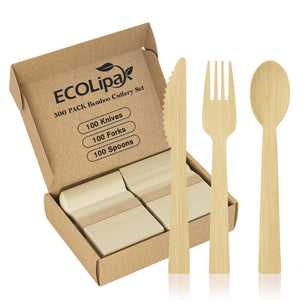
- The 300-set carton contains 300 forks, 300 knives, and 300 spoons: 900 utensils total.
- Individual cartons contain 900 forks, 900 knives, or 900 spoons.
- Complete sets simplify guest counts; single-utensil cartons prevent stock imbalance.
- Menu demand should determine the mix, not the assumption that every diner needs all three pieces.
- Bamboo does not create a universal compost-bin rule; confirm acceptance with the local facility.
Wholesale cutlery purchasing is an inventory-ratio decision disguised as a carton decision. A 300-set carton looks smaller than a 900-piece carton, but both contain 900 utensils. The difference is assortment: the set carton creates 300 complete place settings, while an individual carton creates 900 servings that use one utensil type.
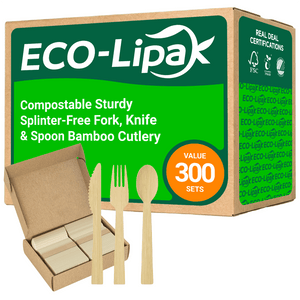
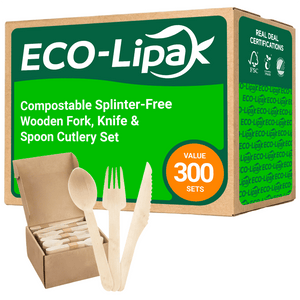
The ECO-Lipak wholesale bamboo cutlery range offers both configurations. The utensils are pale natural bamboo with a smooth finish and include forks, blunt table knives, and rounded spoons. Buyers can select 300 complete sets or 900-count cartons of one utensil.
300 Sets vs 900 Individual Pieces
| Configuration | Carton Contents | Listed Price | Approx. Unit Cost | Best Fit |
|---|---|---|---|---|
| Complete sets | 300 forks + 300 knives + 300 spoons | $65.99 | $0.22 per setting | Full meals and assigned place settings |
| Forks | 900 forks | $59.99 | $0.067 each | Salads, bowls, buffet mains |
| Knives | 900 knives | $56.99 | $0.063 each | Menus with food that must be cut |
| Spoons | 900 spoons | $58.99 | $0.066 each | Soup, yogurt, dessert, oatmeal |
Prices are those listed on September 16, 2026 and may change. Freight, tax, breakage, sleeves, and assembly labor are separate. A complete set costs about 7.3 cents per utensil, but the more useful number is 22 cents per guest because each sleeve completes one place setting.

Calculate From Menu Demand, Not Attendance Alone
Start with guest count, then assign an expected use rate to every utensil. A buffet with salad and pasta may need almost one fork per guest, but only a fraction of guests may use a knife. Soup service changes the ratio again.
Utensils needed = guests or orders x expected use rate + reserve.
| Service Scenario | Demand Calculation | Recommended Starting Carton |
|---|---|---|
| 250-guest plated wedding | 250 full sets x 1.15 = 288 sets | One 300-set carton |
| 600 boxed salads | 600 forks x 1.10 = 660 forks | One 900-fork carton |
| 450 soup servings | 450 spoons x 1.10 = 495 spoons | One 900-spoon carton |
| 300 mixed buffet meals | 300 forks, 180 knives, 90 spoons before reserve | Model single cartons against future events |
Three Operations, Three Different Choices
1. A caterer setting a 250-guest wedding
When every place setting receives the same three pieces, a set carton is the cleanest choice. A 15% reserve brings 250 settings to 287.5, rounded to 288. One 300-set carton covers the room and leaves twelve emergency settings. Assemble sleeves in advance and keep the reserve with the banquet captain.
2. A cafe serving salads and grain bowls
If most orders need only a fork, handing out full sets wastes knives and spoons and adds assembly work. At 600 weekly orders plus a 10% reserve, demand is 660 forks. One 900-fork carton covers the period and leaves 240 for the next cycle. Reorder from the fork count, not from the number of remaining knives.
3. A hotel running mixed events
A hotel may use complete sets for banquets, forks for breakfast buffets, and spoons for coffee stations or desserts. Keep one set SKU and separate replenishment SKUs. Review four weeks of issue-room data. If spoons repeatedly remain while forks disappear, shift the next purchase toward a fork carton instead of opening another full set carton.

When Sets Save Labor and When They Create Waste
Sets save time when staff would otherwise count and sleeve three individual pieces. They also make off-site deliveries easier because each meal can receive one packet. The tradeoff is forced assortment: a guest who needs only a fork still receives a knife and spoon unless staff offer pieces on request.
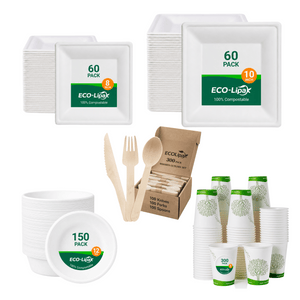
Individual cartons are better for self-serve stations and menus built around one utensil. They require more inventory lines, yet they make demand visible. Buyers comparing alternatives can review the bamboo cutlery collection and the broader compostable cutlery collection. A smaller box is often the right test before wholesale, even when the per-piece cost is higher.
Receiving and Reorder Workflow
- Confirm the carton configuration before opening: sets, forks, knives, or spoons.
- Inspect a sample from each inner pack for smooth edges and transit damage.
- Test the utensils with the toughest and hottest menu items planned.
- Store cartons dry and off the floor with older stock in front.
- Issue each utensil type separately in the inventory log.
- Reorder when average daily use x lead days + reserve reaches stock on hand.
A practical reserve is 10% for repeat service with stable history and 15% for a one-time event. Do not hide the reserve in the main buffet dispenser. Keep it in a controlled service location so early guests do not take extra pieces and erase the buffer.
Do Bamboo Utensils Belong in the Compost Bin?
Material alone does not decide the bin. The product is made from bamboo and is described for composting where facilities accept bamboo foodservice products. The U.S. EPA recommends matching foodservice purchasing to an available local collection and processing program. Ask the receiving facility whether bamboo forks, knives, and spoons are accepted, and whether food residue must be removed.
If the facility does not accept them, do not place the utensils in recycling. Use clear signs showing the exact utensil and stream. ECO-Lipak's resource list can support procurement research, but local rules remain the disposal instruction.
Frequently Asked Questions
What is included in 300 bamboo cutlery sets?
The carton contains 300 forks, 300 knives, and 300 spoons, creating 300 complete settings and 900 utensils total.
Is a 900-piece carton the same as 900 sets?
No. The individual cartons contain 900 of one utensil type. They do not create 900 three-piece place settings.
Which carton is best for a wedding?
The 300-set carton is the simplest choice when every guest receives a fork, knife, and spoon. Add 10% to 15% reserve to the confirmed guest count.
Are individual bamboo utensils cheaper per piece?
At the listed prices, yes. Individual utensils are about 6.3 to 6.7 cents each versus about 7.3 cents per piece within a complete set. Assembly convenience may still favor sets.
Can bamboo cutlery go in any compost bin?
No. Confirm that the local hauler or compost facility accepts bamboo foodservice ware before labeling the collection stream.