Quick Answer: The best compostable trash bag is one certified for the composting environment you can actually use, accepted by the receiving program, correctly sized for your bin, and strong enough for the intended load. Do not choose by a broad "biodegradable" claim or a brand ranking alone. Verify certification, local acceptance, dimensions, load type, closure, pack count, and storage instructions before buying.
Key Takeaways
- Commercial and home compostability are different claims with different conditions.
- Certification does not guarantee that a local hauler or facility accepts every compostable bag.
- Bin fit depends on dimensions and rim overhang, not gallon number alone.
- Food scraps, office waste, yard trimmings, and event cleanup place different demands on a bag.
- Compostable bags do not belong in conventional plastic-film recycling.
Search results for "best compostable trash bags" often turn into brand lists. That is not enough to make a good purchase. A bag can be certified and still be rejected by a local collection program. It can fit a 13-gallon label and still slip off a wide bin rim. It can feel sturdy with dry paper and fail when overloaded with sharp or wet waste.
A more useful comparison starts with seven checks that can be verified before the first roll is opened.

1. Certification and Composting Environment
Look for a certification tied to a defined composting environment, then check the current product listing or certification directory. BPI explains that its commercial and home compostability certification schemes use different test conditions because commercial and home compost systems operate differently.
A commercial compostability mark is not a promise that the bag will compost in a backyard pile. A home-compostability claim also needs specific support. If the package does not say which environment applies, do not fill in the missing detail yourself.
2. Local Program Acceptance
Ask the hauler, municipality, campus, restaurant organics program, or compost facility whether it accepts compostable bags and which certifications or colors it requires. Some programs want certified liners; others reject all bags because of sorting or processing limits.
The EPA's home composting guidance separates backyard composting from materials handled by commercial facilities. The receiving program's list is the operational rule. If there is no accepted organics route, buying a compostable liner does not create one.
3. Bin Fit and Bag Dimensions
Measure the bin's width, depth, height, and rim shape. A liner needs enough width to open over the rim and enough length to cover the inside height, reach the bottom, and leave a manageable overhang for tying or removal.
| Nominal size | Useful starting applications | Fit check |
|---|---|---|
| 13 gallon | Tall kitchen bins, office break rooms, routine household waste | Check wide or rectangular rim dimensions and lid clearance |
| 33 gallon | Medium cleanup bins, event back-of-house, lighter yard work | Check bin height, top circumference, and carried load |
| 55 gallon | Large event bins, commercial cleanup, selected yard applications | Confirm liner length and avoid overloading the larger volume |
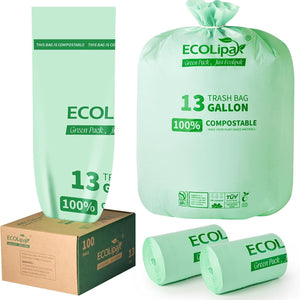
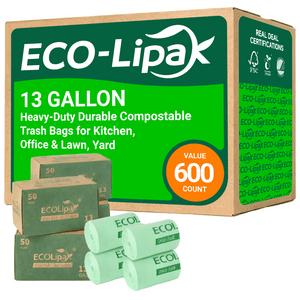
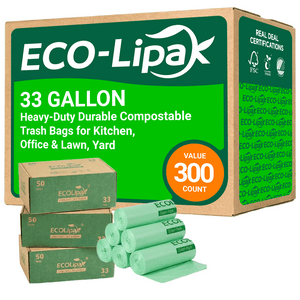
ECO-Lipak's compostable trash bags are offered in 13-, 33-, and 55-gallon options. The size label is a starting point. Test one liner in the exact bin before ordering for every room or event.
4. Load Type, Moisture, and Punctures
Define the load before evaluating strength. Food scraps create moisture and weight. Office paper is dry but can have sharp corners. Yard trimmings can puncture. Event cleanup mixes cups, plates, napkins, and food. A bag that works for one stream may not be the right choice for another.
Run a small service test using the normal waste and removal distance. Do not test with broken glass, exposed sharp metal, hot liquids, or items the waste program prohibits. Keep the filled weight manageable even when a large liner has more volume available.
5. Closure and Removal
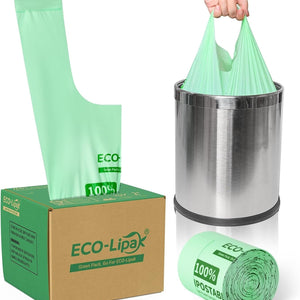
Look at how staff will close and carry the bag. A straight-top liner may be tied with the available film if enough overhang remains. A handled bag can be easier for a small countertop bin or routine household removal. Drawstrings, handles, and tie tabs change usable capacity, so compare the closure with the job rather than treating one style as universally stronger.
6. Pack Count and Reorder Point
Calculate bags per service day by location. A kitchen using one liner daily has a different reorder pattern from an event team that uses 30 in one afternoon. Count rolls or bags at the same time each week, note unusually busy periods, and reorder before the protected reserve is opened.
| Planning input | How to record it | Why it matters |
|---|---|---|
| Average liners used | Bags per day or event by bin location | Creates the base demand |
| Delivery lead time | Days between order and arrival | Shows how much stock must remain when ordering |
| Demand variation | Difference between normal and busy periods | Sets a measured reserve |
| Pack format | Bags per box or carton | Converts demand into purchasable units |
7. Storage and Shelf Rotation
Follow the product's storage instructions. Keep rolls sealed, dry, and away from excessive heat and direct sunlight. Use older stock first and avoid opening every carton at once. Storage cannot improve a poor bag choice, but careless storage can make a suitable product perform inconsistently.

A Buyer Scorecard
- Accepted destination confirmed: yes or no.
- Certification verified for that environment: yes or no.
- Exact bin test passed: rim fit, bottom reach, lid closure, and removal.
- Normal load test passed: moisture, weight, puncture risk, and carrying distance.
- Closure works for staff: no unsafe overfilling required.
- Pack count matches demand: normal use plus a measured reserve.
- Storage instructions are practical: a cool, dry, protected space is available.
If a product fails the first two checks, it is not the best compostable bag for that waste route, regardless of price or review count. If it passes those checks but fails the bin or load test, choose another size or format.
Compostable, Biodegradable, and Recyclable Are Not Synonyms
The FTC's Green Guides summary explains that compostable and degradable claims require substantiation and may need qualification based on where the item can break down. Broad, unqualified "eco-friendly" claims do not answer the buyer's operational questions.
Do not place compostable bags in conventional plastic-film recycling unless the local program explicitly accepts them. Do not assume a landfill provides composting conditions. Browse ECO-Lipak's compostable trash bag collection and resource list, then confirm the final route with the local program.
FAQ
What are the best compostable trash bags?
The best option is certified for the intended composting environment, accepted locally, correctly fitted to the bin, and tested with the normal load. There is no universal winner for every program and bin.
Are biodegradable and compostable trash bags the same?
No. Compostable claims are tied to defined composting conditions and supporting evidence. A broad biodegradable claim may not specify where or how quickly the item breaks down.
Can compostable trash bags go in a home compost pile?
Only when the product is specifically supported for home composting and the contents are suitable. A commercial compostability certification alone does not make a bag home-compostable.
Can compostable bags go in recycling?
Generally no. Keep them out of conventional plastic-film recycling unless the local program explicitly instructs otherwise.
How do I choose between 13, 33, and 55 gallons?
Match the nominal size to the bin and job, then verify width, depth, height, rim overhang, lid clearance, and safe filled weight with a real fit test.
How long do compostable trash bags take to break down?
There is no honest universal household timeline. Results depend on the certified environment, facility process, temperature, moisture, contents, and acceptance rules. Use the certification and receiving program rather than a generic month estimate.