Quick Answer: The best compostable portion cup is the one that holds your actual serving neatly, survives the way it is handed to the guest and has a credible end-of-use route. For sauces and small samples, ECO-Lipak's white sugarcane-fiber souffle cups are available in 1, 2 and 4 oz sizes. Start with the food and the service method, then compare pack counts and price; do not choose a cup solely because its description says “eco-friendly” or “biodegradable.”
Key Takeaways
- A 1 oz cup can be enough for a small condiment, 2 oz for a more generous dip and 4 oz for a tasting or dessert, but test the actual portion.
- These are lidless molded-fiber cups in the selected listings; do not assume a leakproof takeaway closure is included.
- At October 8, 2026 list prices, the 1 oz 500-count box costs $21.99, the 2 oz 200-count box $14.99 and the 4 oz 200-count box $19.99.
- Per-cup price only makes sense beside the food cost and the amount guests will actually take.
- Check the exact product's certification and local facility acceptance before sending used cups to an organics stream.
1. Match size to the food, not the menu label
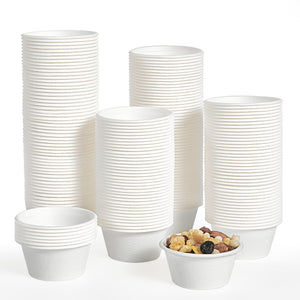
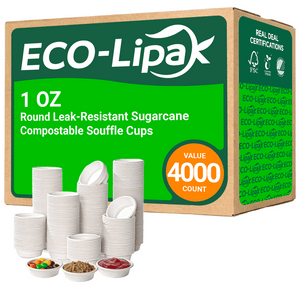
“Sauce cup” describes a job, not a standardized portion. ECO-Lipak's sugarcane souffle cup range has separate 1, 2 and 4 oz variants. A thick ketchup or aioli portion may sit comfortably in a smaller cup. A loose dressing, fruit sample or spoonable dessert may need more headroom than its measured volume suggests. Spoon a real serving into each size, carry it on a tray and look at the rim before settling on the purchase quantity.
The current cups are small, white, softly tapered molded-fiber vessels. They are not beverage cups. Avoid using a nominal four-ounce capacity as a target fill line when the guest must carry the cup through a buffet or pickup area. For a self-serve station, a little empty space can be more useful than squeezing in the maximum volume and leaving dressing on the outside of the rim.

2. Test food texture and temperature
Molded sugarcane fiber is a practical material for many hot and cold foods, but the relevant question is how the specific dish behaves over the service interval. Put the actual sauce, yogurt or fruit into a sample cup. Leave it for the length of a normal buffet hold or pickup delay, then check the rim, base and how a guest can pick it up. A viscous dip behaves differently from a thin vinaigrette. Acidic, oily and hot items should be tested separately rather than treated as one generic “sauce.”
For hot food or reheating, follow the selected product's packaging instructions and applicable temperature limits. Do not copy a heat claim from another material or cup size. A product may be listed for microwave use, but that does not remove the need to check the actual food, time and safe handling. This is a service test, not a laboratory certification.
3. Decide whether the cup will travel
A lidless portion cup can work at a stationary salad bar or on a tray handed across a counter. It is a different proposition inside a delivery bag with a loose sauce. The selected cup variants do not list an included lid, so do not call the package sealed or promise leakproof transport. For off-site orders, use a separately verified lid-and-cup system or place the sauce in another matched container. Put a trial order through the same turns, wait time and stacking conditions as a real customer pickup.
For larger service planning, ECO-Lipak's souffle cups collection shows the available small formats. Its bulk buying guide can help compare the carton commitment with the space on your prep shelf. A good serving cup is not only the one that fits a teaspoon; it is the one staff can restock cleanly during a rush.
4. Calculate the useful unit cost
Current ECO-Lipak list prices were checked October 8, 2026. Counts differ across sizes, so dividing price by the correct count is essential. The table uses the smaller box options; bulk cartons are separate variants, and shipping, taxes and promotions are excluded.
| White sugarcane cup | Box quantity | Listed price | Approx. per cup | Good first test |
|---|---|---|---|---|
| 1 oz | 500 | $21.99 | $0.044 | Small measured condiment |
| 2 oz | 200 | $14.99 | $0.075 | Dip or dressing |
| 4 oz | 200 | $19.99 | $0.100 | Fruit or dessert sample |
Suppose a 300-guest tasting offers one sauce with each plate. Allowing a 10% service buffer means roughly 330 cups. One 500-count 1 oz box covers the plan if that cup passes the portion test. If the recipe genuinely needs 2 oz, two 200-count boxes cover it; their $29.98 listed cost is the relevant purchase total, not the 1 oz cup's cheaper unit price. Avoid enlarging every serving just because a larger cup is only a few cents more: the extra food can cost more than the packaging.
Three ways to apply the checks
Counter-service condiment
For ketchup beside fries, measure what staff actually dispense. If a 1 oz portion looks sufficient and guests seldom ask for more, the smaller cup can be the sensible option. Put one cup on the normal tray and watch whether it is knocked over at pickup. If a thin sauce sloshes, change service method or container; do not assume a larger lidless cup will solve every spill.
Self-serve tasting flight
A market stall serving three small dips can place one sample in each cup, but the setup needs spare stock and clear restocking responsibility. Keep filled cups on a stable tray with enough spacing for guests to lift one without touching its neighbor. If portions are prepared in advance, check texture after the actual hold time. Run a ten-guest trial before committing to a case of a single size.
Dessert or fruit station
A 4 oz cup can present berries or a spoonable sweet more generously, but a scoop of ice cream may mound above the nominal cup volume. Plate, photograph and carry a sample before finalizing the serving spec. If the event calls for 240 portions plus a 10% buffer, target at least 264 cups, which means two 200-count boxes at this pack size. Shelf space and leftover stock should be part of that decision.

5. Verify the end-of-use route
Compostability is a product-and-location question, not a universal outcome. The current ECO-Lipak cup listing describes the molded-fiber range as BPI certified; check the exact variant documentation and ask the receiving facility whether it accepts used cups with food residue. The US EPA's food-service ware guidance recommends certified commercially compostable items only when a local program accepts them and collection is provided. The FTC Green Guides summary cautions against broad, unqualified environmental claims.
That is why this updated guide does not rank five unrelated brands or promise that a cup will disappear in a fixed number of months. The responsible purchasing decision is more concrete: fit the serving, test the handoff, calculate the correct box total and verify the local disposal instruction. Those checks also make the next reorder easier because they produce a repeatable spec rather than a vague preference.
Frequently Asked Questions
What size souffle cup is best for a dip?
Start with 1 or 2 oz and measure the real serving. Choose enough headroom for carrying rather than filling to the rim.
Are these sugarcane cups supplied with lids?
No lid is listed with the selected 1, 2 and 4 oz cup variants. Verify a separate closure before using them for delivery.
Which box has the lowest listed price per cup?
The 1 oz 500-count box is about $0.044 per cup at the October 8 price, but it is only a good buy when 1 oz suits the food.
Can sugarcane portion cups hold warm food?
They may suit many warm foods, but follow the exact product's instructions and test the dish at its actual serving temperature and hold time.
Can I put used cups in any compost bin?
No. Confirm the exact item's certification and that the receiving program accepts used molded-fiber food-service cups.