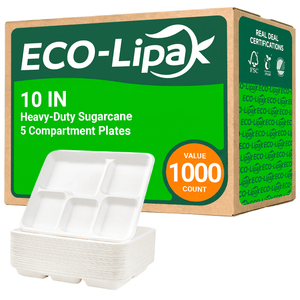
Quick Answer: Choose 10-inch bulk 5-compartment plates when portions are moderate and case efficiency matters; choose 12.5-inch plates when the menu needs more room for an entree, sides, bread, or sauced foods. ECO-Lipak's wholesale cartons contain 1,000 of the 10 x 8.25-inch trays or 800 of the 12.5 x 8.6-inch trays. The better value is the size that prevents crowding without leaving unused space on every plate.
Buying disposable compartment plates by the carton is a menu-planning decision, not just a price comparison. A tray that is too small slows the serving line as staff rearrange food. A tray that is too large raises per-meal packaging cost and takes more storage space. This guide compares ECO-Lipak's wholesale 5-compartment sugarcane plates using the details a cafeteria, caterer, meal program, church kitchen, or event operator can check before ordering.
Key Takeaways
- The 10-inch tray measures 10 x 8.25 inches and comes 1,000 per carton; it suits controlled portions and high meal counts.
- The 12.5-inch tray measures 12.5 x 8.6 inches and comes 800 per carton; its extra length gives the entree and side compartments more breathing room.
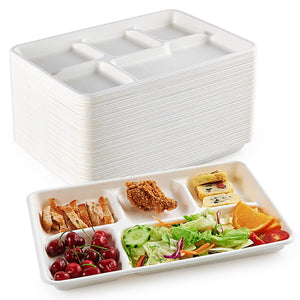
- Both formats use the same practical five-zone layout: two larger upper sections and three smaller lower sections.
- Compare cost per served meal, storage footprint, and the actual menu rather than carton price alone.
- For compostability claims, confirm the accepted waste stream at the serving location before writing disposal instructions for guests.
10-Inch vs 12.5-Inch at a Glance
| Buying factor | 10-inch option | 12.5-inch option |
|---|---|---|
| Overall size | 10 x 8.25 in | 12.5 x 8.6 in |
| Case count | 1,000 plates | 800 plates |
| Best menu fit | School lunch, tasting portions, breakfast, compact entrees | BBQ, catered dinners, entree plus bread, higher-volume plated meals |
| Storage consideration | More meals supplied by one carton | Fewer trays per carton, but each tray uses more shelf and service space |
| Primary risk | Overfilling compartments | Paying for unused plate area |
The shape matters as much as the headline dimension. These are rectangular molded-fiber trays, not round dinner plates. Two larger compartments sit across the top and three smaller compartments run below them. That arrangement works especially well when the entree needs separation from vegetables, fruit, bread, sauce, or dessert. Browse the broader compartment plate collection if your menu needs fewer sections or a round format.

Start With the Menu, Not the Plate
Print a typical menu and assign every item to a compartment. Do this before comparing unit prices. A compact breakfast of eggs, potatoes, fruit, toast, and a condiment can fit a 10-inch tray without looking sparse. A BBQ plate with pulled meat, two generous sides, cornbread, and sauce may need the 12.5-inch format so food does not bridge the compartment walls.
Sauced and oily foods deserve extra room. When staff mound food above a divider, separation becomes less reliable and the rim is harder to carry cleanly. Molded sugarcane fiber is designed to be sturdy and leak resistant, but the tray still needs to match the portion. The product is listed as microwave and freezer safe, PFAS-free, BPA-free, and suitable for commercial composting where accepted. For help interpreting environmental terms, use ECO-Lipak's compostable certification guide and confirm local collection rules.
Three Real-World Ordering Scenarios
1. A school meal program serving 700 lunches
The menu uses standardized portions: a sandwich or compact entree, one vegetable, fruit, a small snack, and sauce. The 10-inch tray is usually the more efficient starting point. One 1,000-count carton covers the planned service plus a buffer for damaged trays, staff meals, and attendance variation. Run one live lunch test before a recurring order, especially if students carry the tray without a separate support tray.
2. A caterer serving BBQ for 350 guests
Brisket or ribs, two scooped sides, bread, pickles, and sauce quickly consume surface area. The 12.5-inch tray gives staff more room to portion consistently and helps keep sauce away from dry items. An 800-count carton also leaves stock for a second booking. The useful calculation is carton cost divided by plates you expect to use, then compared with the labor and food waste caused by an undersized tray.
3. A community kitchen with rotating menus
When meals change every week, test the largest common entree rather than the smallest. If most menus fit the 10-inch tray and only one menu is crowded, it may be cheaper to adjust that menu or use a separate bowl. If large portions are routine, standardizing on 12.5 inches can simplify training and inventory. Operators purchasing several fiber formats can review ECO-Lipak's wholesale eco-friendly products together instead of treating each item as a separate order.
Calculate the Case in Meals, Not Pieces
- Forecast the number of meals for the ordering period.
- Add a realistic service buffer, commonly based on your own attendance and damage history.
- Divide the adjusted meal count by 1,000 for the 10-inch tray or 800 for the 12.5-inch tray.
- Round up to whole cartons and record leftover inventory for the next forecast.
- Compare unit cost only after confirming both sizes can hold the menu safely and neatly.
At the listed prices, the 10-inch 1,000-count carton has a lower approximate cost per plate than the 12.5-inch 800-count carton, but prices can change. Check the product page at order time and include freight, storage, and labor in the decision. A few cents saved per tray is not a saving if staff need extra bowls or guests discard food because compartments were overfilled.

What to Verify Before Checkout
- Compartment map: Confirm that two large and three small zones match the way your team portions food.
- Equipment fit: Measure shelves, warming areas, carts, and serving-line rails for the rectangular footprint.
- Heat workflow: Test the full meal under your normal holding and reheating process rather than relying on a generic material statement.
- Disposal signage: Do not label a bin “compost” unless the site has an organics program that accepts the item and food residue.
- Certification: Confirm the exact item and current certification information when a contract or municipal program requires it.
Frequently Asked Questions
Are 10-inch five-compartment plates large enough for dinner?
They can be, when portions are moderate and the entree is compact. Test one complete meal. If food sits above the dividers or reaches the rim, the 12.5-inch tray is the better operational fit.
How many plates are in a wholesale carton?
The ECO-Lipak wholesale listing offers 1,000 of the 10 x 8.25-inch trays or 800 of the 12.5 x 8.6-inch trays per carton.
Can sugarcane plates hold wet or oily food?
These molded-fiber plates are described as heavy duty and leak resistant. Performance still depends on food temperature, hold time, portion weight, and handling, so foodservice buyers should test their most demanding menu before a large recurring order.
Are the plates microwave safe?
The product listing identifies them as microwave and freezer safe. Use normal food-safety procedures, avoid overheating, and verify the complete meal process in your equipment.
Can the plates go into any compost bin?
No. Acceptance varies by hauler and composting facility. Ask the local program whether it accepts certified molded-fiber foodservice ware and how much food residue is allowed.