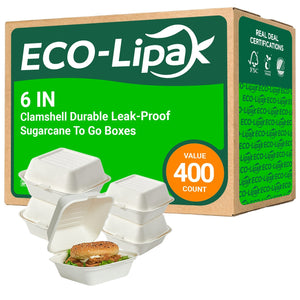
Quick Answer: A small bakery should buy 6-inch sugarcane clamshells only after testing its actual sandwich or pastry inside one. ECO-Lipak's current white, square, single-compartment 6-inch hinged box comes in 200 per box or 400 per carton. Forecast the number of items that truly need a rigid takeout box, add a modest service reserve, and choose the pack that covers the next delivery cycle. A 6-inch box is compact; larger meals may need an 8-inch or 9 x 6-inch format instead.
Key Takeaways
- Current white 6-inch boxes are listed as 200 per box and 400 per carton.
- Test height and closure with the exact pastry or sandwich, not just an empty box.
- Count boxed orders separately from items served on-site or in bags.
- Ask the local organics collector whether it accepts used molded-fiber food packaging.
Why a compact box can help a bakery
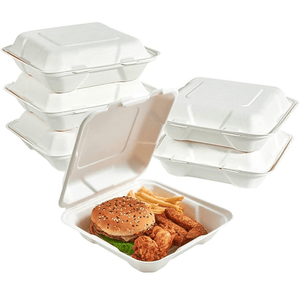
A small bakery does not need the same container for every sale. A croissant eaten immediately may go into a paper bag, while a breakfast sandwich carried across town needs more structure. A compact hinged clamshell can protect a single item from being crushed and gives staff one simple close-and-handoff motion. The tradeoff is space: the 6-inch footprint leaves little room for a large side, a tall frosting swirl or a full lunch plate. Buying by the phrase “to-go box” alone often leads to a case of containers that do not match the menu.
The white 6-inch ECO-Lipak clamshell is an opaque molded-fiber, single-compartment box with an attached hinged lid. Its current variants are 200 per box and 400 per carton. Open one, place the finished food inside with the actual liner or wrap, close it and check that the lid sits naturally without compressing the food. Test removal too: a pastry that fits but sticks to the lid is not a good service match. The listing's material and certification claims should be checked against the selected SKU and local disposal route.

Choose 200 or 400 by boxed-order demand
Suppose a bakery sells 70 breakfast sandwiches a day across five trading days. If 45% of customers take the sandwich away in a rigid box, the expected demand is 70 x 5 x 0.45 = 157 boxes. Adding a 10% working allowance gives about 173. One 200-count box covers that week and leaves a small carryover. If the same bakery boxes 80 sandwiches a day for five days, it needs 400 boxes before any allowance; one 400-count carton would be tight. Use your own point-of-sale mix rather than treating these example percentages as industry averages.
| Weekly pattern | Expected boxes | With 10% reserve | Pack decision |
|---|---|---|---|
| 70 sandwiches/day, 5 days, 45% boxed | 157.5 | 174 | One 200-count box |
| 40 boxed items/day, 5 days | 200 | 220 | 400-count carton or second box |
| 80 boxed items/day, 5 days | 400 | 440 | More than one 400-count carton |
Round the forecast up and then compare usable stock with the next delivery date. A 400-count carton may reduce repeat ordering for a steady bakery, but it takes more clean, dry storage space. Check current delivered unit cost at checkout rather than assuming a carton is always the better value. If seasonal menu changes reduce boxed orders, excess stock can sit for months. Set a reorder point at the expected number of boxes used during supplier lead time plus an event reserve, and count open sleeves rather than only unopened cases.
Three bakery orders that call for different packaging
Breakfast sandwich to go
A modest sandwich may fit the 6-inch square footprint, but the bread thickness and filling height decide whether the lid closes. Test it fresh and after the normal short holding period. Warm food can release steam, so judge whether the intended texture survives in a closed box. A rigid box helps protect the sandwich during handoff, yet it is not a promise against condensation. If a sandwich plus side is part of the order, the 8-inch clamshell may be a more appropriate trial.
Frosted pastry for a customer pickup
The limiting dimension may be height rather than width. A low-profile cookie is simple; a cupcake with tall frosting may touch the lid. Put the finished pastry in the test box and carry it around the counter as staff would. If the lid contacts decoration, choose a taller pastry container rather than forcing the clamshell. The right packaging is the one that protects the product's appearance when the customer opens it.
Lunch special with a side
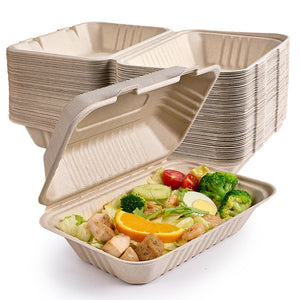
A 6-inch box is a poor assumption for a full lunch. Use a real meal mock-up and compare larger formats, including the 9 x 6-inch sugarcane clamshell. This is a different SKU with different available counts. Keep the compact box for the menu items that fit, and set up a separate bin for the larger containers so staff do not grab the wrong size during a rush.

What to check before a bulk purchase
Inspect the actual hinge, closure and food contact surface in a sample. Check the completed food after realistic holding and movement, especially if the product is hot or oily. Compare the wholesale clamshell selection only after size is settled; it lists a white 6-inch 400-count carton alongside larger formats, not one universal box. Ask for finished-product certification documentation when procurement requires it, and check with the local hauler before placing used food-soiled boxes in organics. The U.S. EPA composting overview is useful context on why composting depends on the collection and processing system. “Compostable” should not be used as a blanket disposal instruction for every customer.
Frequently Asked Questions
How many 6-inch boxes are in the current options?
The current white listing shows 200 per box and 400 per carton. Verify the selected variant at checkout.
Will a 6-inch box hold any breakfast sandwich?
No. Bread size, filling height and wrap change fit. Pack the finished item in a sample and close the lid.
Is the 400-count carton always cheaper?
Compare current delivered unit cost and storage needs. Prices and freight can change.
Can I use this box for hot food?
Follow the product's current temperature guidance and test the real food for steam, texture and closure during the intended hold.
Can customers home-compost the used box?
Do not assume so. Check the finished item's certification and the local processor's acceptance rules.