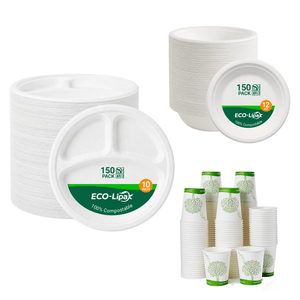
Quick Answer: ECO-Lipak's white food and drink serving set contains 150 round 10-inch three-compartment sugarcane plates, 150 white 12 oz wide-sided sugarcane bowls, and 300 white 8 oz paper cups. That is one plate, one bowl, and two cups for each of 150 guests, if every guest receives the same service. The cups are described for cold or room-temperature drinks; do not plan a hot-coffee station around them without choosing a suitable cup separately.
Key Takeaways
- One set supplies 150 plates, 150 bowls, and 300 cups. It does not list cutlery or lids as included.
- The current set price is $72.99, about $0.49 per planned 150-guest setting with two cups each, before shipping and tax.
- For more than 150 one-plate guests, the plate and bowl counts become the constraint even if cups remain.
- Plan the menu and beverage service before ordering: three divided plate sections, a wide bowl, and an 8 oz cold-drink cup may not fit every service style.
What Is Actually in the Set?
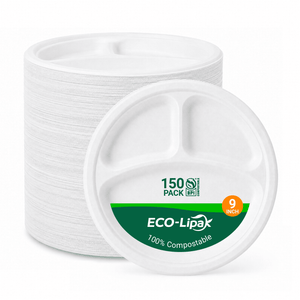
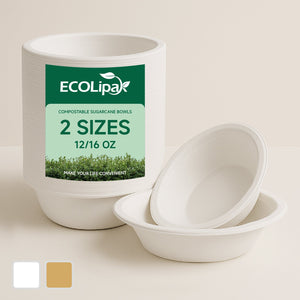
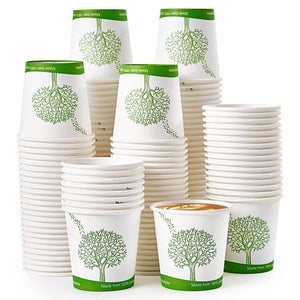
The plate is a white, round, 10-inch molded-fiber plate with three compartments. It is useful when a main and two sides should remain separate at a buffet. The bowl is a white, wide-sided 12 oz sugarcane bowl. It suits salads, grains, fruit, or similar portions; a broad bowl should not automatically be treated as a leakproof takeaway container. The cup is white, paper, and 8 oz, with a green tree motif. The product description specifies cold or room-temperature drinks. These are three different items with potentially different service and disposal considerations, even though they are sold as one orderable set.
| Component | Pieces in one set | For 150 guests | Check before service |
|---|---|---|---|
| 10-inch, three-compartment plate | 150 | 1 per guest | Does the menu need separated sections? |
| 12 oz wide-sided bowl | 150 | 1 per guest | Does the dish fit the bowl and holding time? |
| 8 oz paper cup | 300 | 2 per guest | Cold/room-temperature drink and refill plan |
The current listed price divided by 150 is $0.4866, rounded to about $0.49 per planned place setting. That is not an individual product price and does not include utensils, napkins, transport, tax, or service losses. Prices and availability can change. If your event needs just plates and cups, separate packs may be a better fit than a set that leaves bowls unused. Our 100-guest tableware count guide shows how to build a component-by-component estimate.

Guest-Count Math for 100, 150, and 175 People
For a 100-person office lunch, one set leaves 50 plates and 50 bowls after one of each per attendee, plus 100 cups after allowing two per attendee. That can be welcome reserve stock if a late attendee arrives or a piece is damaged. However, those remaining counts are not a substitute for a clear refill plan. If drinks are self-served and guests use fresh cups repeatedly, 300 cups may be consumed faster than the plate count suggests.
For a 150-person catered meal, the bundle has an exact one-to-one plate and bowl count. That is the cleanest mathematical match, but there is no spare plate or bowl for a dropped item, an extra staff meal, or a guest who returns for seconds. Consider a small separate reserve from the compartment plate collection or your on-hand stock. Cups provide two per person on paper, but actual use depends on whether you offer one beverage, refills, water, and other drinks.
For 175 people, one set is short by 25 plates and 25 bowls if each person needs one of each. The 300 cups would average only 1.71 per guest. If the event truly needs two cups per person, it is also short by 50 cups. You can top up individually or compare the cost and leftovers of a second set. A second full set would create 300 plates, 300 bowls, and 600 cups, so it may be wasteful for a small overrun unless future events can use the remainder.
Three Real Service Situations
Office lunch for roughly 120
One set yields 30 spare plates and bowls and 60 spare cups if people average two cups. Place the divided plates before the buffet and bowls beside dishes that actually need them. If the bowl is only for dessert, not every person may take one. Count those portions separately when planning future orders. For an office that hosts monthly lunches, leftover clean stock can be useful; for a one-off event with no storage, an exact-count assortment may be preferable.
Full buffet for 150
Use the three plate compartments for a main plus two sides, and reserve the wide bowls for salad, fruit, or another separate course. Set cups near cold drinks rather than hot coffee. Check how much beverage an 8 oz cup really provides after ice; a two-cup allocation could be tight if the event is long or outdoors. If meals are carried a distance, test a loaded plate and bowl on the route from buffet to table.
Mixed buffet and takeaway service
A three-compartment plate is an open plate, not a lidded transport box. For meals that must travel in a bag, compare a suitable sugarcane to-go box. The bowl likewise needs a separate compatible cover for takeaway liquids. A fixed event bundle still works for dine-in portions, but it is not automatically an all-purpose takeout system.

How to Avoid Leftovers or a Mid-Event Shortage
Start with the serving sequence rather than a single guest number. Does every diner use a plate and bowl, or is the bowl only for soup or dessert? Will guests take one cup and refill it, or use a fresh cup for each drink? Are staff and vendors included in the headcount? Write the expected demand for each piece, add a modest reserve, and compare each total with 150, 150, and 300. The limiting item determines whether one set is enough.
Do not assume every piece belongs in the same compost bin. The plates and bowls are molded sugarcane fiber, while the cups are paper with a lining. Acceptance depends on the entire item and your local collection program. The US EPA's foodservice ware guidance explains why material labels and real collection systems both matter. Check your hauler's current accepted-item list and keep clear signage at the event.
Buying Decision
This set makes the most sense for a buffet where separated plates, wide bowls, and two small cold-drink cups per guest are all useful. Check the live set listing for current piece counts and price, then list anything still missing: utensils, napkins, lids, or extra cups for a longer service. If the event has an unusual menu or many more than 150 guests, buying components individually may give you a better ratio and less leftover stock.
Frequently Asked Questions
Does the set include cutlery or lids?
The current set lists 150 plates, 150 bowls, and 300 cups. It does not list cutlery or lids as included. Verify the live listing before ordering, and budget for those pieces separately if needed.
Are the cups suitable for hot coffee?
The current description specifies cold or room-temperature drinks. For hot coffee, choose and test a cup explicitly intended for hot beverage service.
How many guests can one set serve?
It covers 150 guests only when each takes at most one plate, one bowl, and two cups, with no spare allowance. Your menu, staff meals, second helpings, and beverage refills can change the practical capacity.
Is a 12 oz bowl the same as a soup container?
Capacity is not the same as leakproof takeaway performance. Test the actual food, serving temperature, and transport time; use a compatible lidded container if the dish must travel.
Can all three items be composted together?
Not automatically. Ask the local organics processor whether it accepts the specific fiber plates and bowls and the lined paper cups. Plant-based material alone is not an acceptance decision.