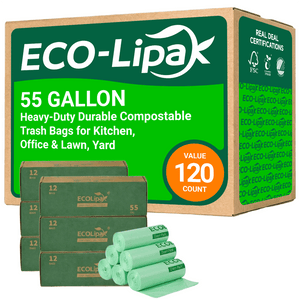
Quick Answer: A 120-count carton of wholesale 55 gallon compostable trash bags covers 120 liner changes before reserve stock. At four changes per day, that is 30 days; at eight changes per day, it is 15 days. Add a 10% to 15% operating reserve, test the liner on the actual cart, and confirm that the receiving compost facility accepts certified compostable bags before ordering for an organics program.
Key Takeaways
- Calculate demand by liner changes, not by the number of 55-gallon bins on site.
- A 120-count carton costs about $1.92 per liner at the listed $230.73 price on September 15, 2026; live pricing may change.
- The ECO-Lipak liner is approximately 42.16 by 48.03 inches, pale mint, handle-free, and made with a star-seal bottom.
- Allow 10% to 15% reserve for torn liners, attendance swings, and unusually wet loads.
- BPI certification supports commercial compostability, but the local facility still decides whether compostable bags are accepted.
Buying large liners by the carton looks straightforward until a venue runs out midway through an event or discovers that the bags do not match its organics program. The useful comparison is not simply price per carton. It is cost per liner, days of coverage, fit on the bin, load behavior, and the disposal route available at the site.
The ECO-Lipak 55 gallon compostable trash bag carton contains 120 liners. The product specification lists an approximate flat size of 42.16 inches wide by 48.03 inches tall, easy-tear rolls, a star-seal bottom, and BPI and OK Compost Industrial certifications. The liners are pale mint and do not have drawstrings or handles, so closure should be planned around tying, cart handling, or the waste vendor's collection method.
How Long Does a 120-Count Carton Last?
Use this formula before placing a purchase order:
Planned liners = bins in service x changes per bin per day x service days + reserve.
For a 15% reserve, multiply the expected changes by 1.15 and round up. The reserve is especially useful at events where ice melt, liquids, or weather can force an early change.
| Operating Pattern | Expected Changes | With 15% Reserve | 120-Count Coverage |
|---|---|---|---|
| 4 changes per day | 4 daily | 4.6 daily | About 26 days |
| 8 changes per day | 8 daily | 9.2 daily | About 13 days |
| 18 stations, 3 changes each | 54 for the event | 63 liners | 1 carton; 57 remain |
| 6 bins, 1.5 changes, 10 days | 90 total | 104 liners | 1 carton; 16 remain |
At the listed carton price of $230.73 on September 15, 2026, the simple unit cost is approximately $1.92 per liner. A venue using 63 liners for one event would therefore assign about $121.15 of liner cost to that event at the current price. Freight, taxes, damaged stock, and site labor are separate. Check the live product page when budgeting because pricing and availability can change.

Check Fit Before You Commit to a Carton
“55 gallon” describes nominal capacity, not a universal cart shape. A square commercial cart, a round can, and a wheeled outdoor bin can all carry the same gallon label while having different rim dimensions and depths. Measure the outer rim or circumference, then measure from one rim edge down the side, across the base, and up to the opposite rim. Leave enough overhang to keep the liner from slipping inside.
Run a five-bag trial with the heaviest realistic load. Seat the liner fully into the corners, fill it to the normal change point, lift it using the method staff actually use, and inspect the bottom and sidewall. A star-seal bottom is designed to distribute material across the base, but sharp catering pans, skewers, broken plastic, or protruding packaging can still puncture a thin liner. Keep those items out of an organics stream anyway.
Three Commercial Buying Scenarios
1. A venue with four back-of-house organics carts
Suppose each cart receives one new liner per operating day. The raw carton coverage is 30 days. With a 15% reserve, plan on roughly 26 operating days. Set the reorder point before the last 30 liners so supplier lead time and a busy weekend do not erase the buffer.
2. A festival with 18 staffed waste stations
If each station is expected to change three times, the base requirement is 54 liners. Adding 15% gives 62.1, which rounds to 63. One carton covers the event and leaves 57 liners. Store the reserve in two controlled service points rather than placing an entire roll at every station, where stock can disappear or become wet.
3. A warehouse or production yard
Six large carts changed an average of 1.5 times a day for ten operating days use 90 liners. A 15% reserve brings the purchase plan to 104. This fits within one carton, but the waste type matters: compostable liners belong with an accepted organics stream, not mixed industrial waste merely because the bag is certified.
Certification Does Not Guarantee Curbside Acceptance
BPI certification evaluates products against compostability standards for commercial composting conditions. It does not mean every municipal program or private hauler accepts every certified bag. Facilities manage contamination, processing time, equipment, and local rules differently. The U.S. EPA's composting guidance likewise directs users to check local options and accepted materials.
Before switching a facility to compostable liners, ask the receiving program three direct questions: Are BPI-certified collection bags accepted? Must the certification mark be visible? Are foodservice items allowed in the same stream? Record the answer in the waste plan and train staff from that rule. If the hauler does not accept compostable bags, do not put them into recycling and do not assume that sending them to landfill creates a composting outcome.

A Practical Receiving and Reorder Workflow
- Confirm the ordered variant is 55 gallon and 120 liners per carton.
- Inspect the carton for moisture or transit damage and count the rolls.
- Fit-test five liners on the actual carts before distributing stock.
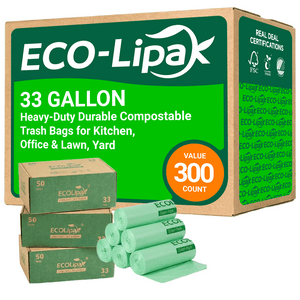
- Label storage by size so 33- and 55-gallon rolls are not mixed.
- Track daily changes for two representative weeks.
- Set the reorder point as average daily use x lead days + reserve.
Operations using multiple bin sizes can compare the broader compostable trash bag collection. Keep a simple size map near storage: cart location, nominal capacity, liner dimensions, roll count, and disposal stream. That one page prevents most emergency substitutions.
Frequently Asked Questions
How many bags are in the wholesale 55 gallon carton?
The referenced ECO-Lipak variant contains 120 55-gallon liners per carton. Confirm the selected variant before checkout because other sizes and carton counts may differ.
How much does each 55 gallon liner cost?
At the listed $230.73 carton price on September 15, 2026, the unit cost is about $1.92. Divide the current carton price by 120 for an updated figure.
Will a 55 gallon bag fit every 55 gallon bin?
No. Rim shape and bin depth vary. Compare the liner's approximate 42.16-by-48.03-inch dimensions with the actual cart and complete a loaded fit test.
Are these bags home compostable?
The product is presented for commercial composting and lists BPI and OK Compost Industrial certifications. Do not treat that as a home-compost claim.
Can a BPI-certified bag go in any green bin?
No. A green bin is a local collection system, not a universal acceptance label. Ask the hauler or compost facility whether certified collection bags are allowed.