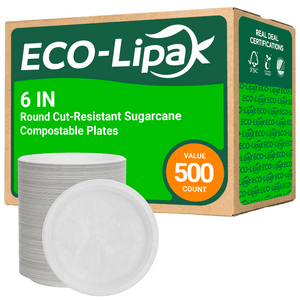
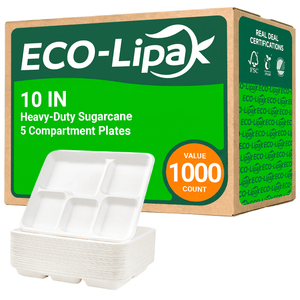
Quick Answer: For wholesale square sugarcane plates, the 6-inch size is a practical dessert or sample plate; the 10-inch size gives a full meal room to breathe. ECO-Lipak currently offers each natural-color size in a 1,000-count carton. At prices checked September 29, 2026, the 6-inch carton is $139.99 (about $0.14 per plate) and the 10-inch carton is $289.99 (about $0.29 per plate). Choose by what people will actually carry, then check how quickly your operation can use a full carton.
Key Takeaways
- These are two sizes of the same natural square molded-fiber plate, but they solve different serving jobs.
- Both cartons contain 1,000 plates; the listed unit prices are about $0.14 and $0.29 before shipping or tax.
- A small plate can save money at a dessert station, but using it for a full lunch can create spills and second-plate requests.
- Buying one carton of each creates 2,000 plates of inventory. Plan for the leftovers, not just the next event.
- Confirm local compost-facility acceptance before building a collection plan around any compostable plate.
What the 6-inch and 10-inch cartons actually contain
The comparison is between the two active variants on ECO-Lipak's wholesale natural square sugarcane plate listing. Both are molded from plant fiber and sold as 1,000-count cartons. The smaller plate is not a reduced-price version of a dinner plate; it has a different job. Its square corners give a little presentation space, but the usable flat center is still limited. The 10-inch plate is intended for an entree, buffet meal, or generous salad.
Before ordering, put a representative serving on each size. A plate that looks large enough while empty may feel crowded once a main, side, and sauce are added. Check how it behaves when a guest holds it with one hand, especially at a standing reception. The square shape can be useful for tidy buffet layouts, but it does not change the physical capacity of the plate.

Unit cost and menu fit
These listed prices were checked September 29, 2026; promotions, delivery, and tax can change the final cost. Divide the current price by the carton count again when you order.
| Variant | Carton | Listed price | Approx. unit cost | Best initial use |
|---|---|---|---|---|
| Natural 6-inch square | 1,000 plates | $139.99 | $0.140 | Samples, appetizers, cake, small dessert |
| Natural 10-inch square | 1,000 plates | $289.99 | $0.290 | Entrees, buffet lunches, full salads |
For a dessert-only station serving 300 portions, the plate consumption is 300 units, or about $42 at the posted 6-inch unit price. That is a consumption estimate, not a $42 checkout option: the current wholesale purchase is a full 1,000-count carton. For a 300-person meal service using one 10-inch plate each, consumption is about $87 of the large carton at the listed unit price. Small differences in per-plate cost become meaningful when volumes are predictable, but a poor size match can wipe out that saving.
Three real ordering scenarios
Bakery tastings and dessert passes
A bakery serves 200 small cake samples each weekend. At 800 samples across four weekends, one 1,000-count 6-inch carton leaves a modest 200-plate buffer. That is a sensible starting use for the smaller size. If the sample is served with sauce or a drink cup on the same plate, test it first; square dimensions alone do not guarantee enough room.
Corporate lunch buffet
A catering team serves 125 lunches each weekday. The larger 10-inch plate offers room for a protein, a side, and salad without making guests stack food. At one plate per guest, a 1,000-count carton covers eight 125-person lunch services before any breakage, second helpings, or staff meals. Add a measured buffer rather than claiming a carton always covers eight events. For menu designs that require separate food zones, compare a five-compartment sugarcane plate instead of forcing dividers into a plain square plate.
Mixed wedding or community event
A 500-guest event needs 500 dinner plates and perhaps 300 dessert plates. The current wholesale configuration requires one carton of each size, not a custom 500/300 split. After the event, 500 large and 700 small plates remain. That can be fine for a caterer with a future booking pipeline and dry storage. For a one-off host, the leftovers may outweigh the wholesale unit price. Check the compostable plates collection for smaller-format options before committing to 2,000 pieces.

Storage and service checks before checkout
Confirm where the carton will live, who opens it, and how stacks will be protected between services. Count the physical shelf positions, not just the nominal number of cartons a storeroom can hold. Keep clean plates covered and separate from wet prep. If the next event is months away, a lower unit price does not automatically justify long storage.
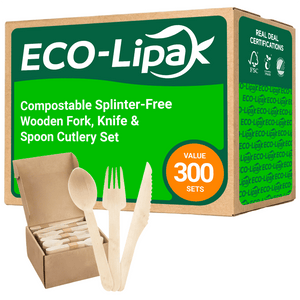
For catered meals, run a ten-person pilot with the actual menu and serving utensils. Watch for sauce migration, edge flex, and guests taking a second plate. If guests need cutlery, choose it for the meal rather than buying a decorative set by default; ECO-Lipak's wholesale wooden cutlery provides another planning input. A square plate can look refined on the table, but service flow is the more important test.
The product listing describes the plates as compostable. That is not the same as a guarantee that your local organics hauler accepts them. The US EPA food-service ware guidance advises checking that a commercial composting program accepts the exact ware and that collection is available. The FTC Green Guides summary also cautions against unqualified compostability claims where appropriate facilities are not broadly available. If compost collection is absent, make the buying choice on menu performance and an honest end-of-use plan.
Frequently Asked Questions
Can a 6-inch square plate hold a full lunch?
Usually not comfortably. It is better suited to small bites, cake, or samples. Test the exact meal rather than relying on the outer diameter alone.
Are both wholesale cartons 1,000 count?
Yes, for the two natural-square variants compared here. Recheck the live variant selector before purchase because assortment and availability can change.
Does the 10-inch plate cost twice as much?
At the prices checked, it is about $0.29 per plate versus $0.14, roughly $0.15 more per plate. Compare the live checkout price and the labor or waste caused by undersizing.
Should I buy both sizes for one event?
Only if both service stations truly need them and you have a use for leftover plates. One carton of each means 2,000 plates on hand.
Can used sugarcane plates go in any compost bin?
No. Ask the receiving compost program whether it accepts the exact plate type and food contamination level before promising composting at your event.