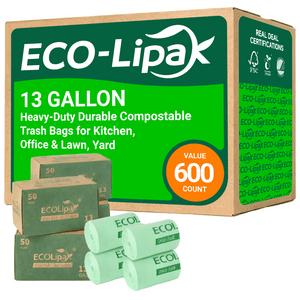
Quick Answer: The 600-count wholesale carton is the lower-cost choice for a 13-gallon compostable liner program that reliably uses hundreds of bags. At ECO-Lipak prices checked September 28, 2026, its $139.99 carton works out to about $0.233 per bag. The 200-count carton at $52.99 works out to about $0.265 per bag. Three 200-count cartons cost $158.97, or $18.98 more than one 600-count carton. Buy the larger carton only if the bags fit your bins, you can store them well, and your waste collection route accepts them.
Key Takeaways
- Compare the exact 13-gallon variants, not mixed 13-, 33-, and 55-gallon search results.
- One 600-count carton saves about 3.2 cents per bag versus the 200-count carton prices checked here, before shipping and tax.
- At 20 bin changes per workday, a 600-count carton lasts about 30 workdays; at five changes per day, it lasts about 120 workdays.
- Compostable bag certification does not ensure a hauler accepts bagged food scraps. Confirm the exact SKU and collection program before buying for organics service.
What is actually being compared?
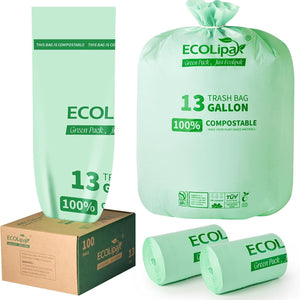
The main item is ECO-Lipak's 600-count wholesale 13-gallon compostable bag carton. The smaller option is the 13-gallon, 200-count variant on the multi-size compostable trash bag listing. Both are 13-gallon liners on the current pages. A 13-gallon label is a capacity category, not a fit guarantee for every bin. Measure the rim, height, and tie-off allowance on your actual receptacle and trial a filled bag before changing a site-wide purchasing plan.
Do not select a liner solely by a “heavy-duty” phrase in a product title. Kitchen prep scraps can be wet and unexpectedly heavy; an office paper bin usually is not. Test the bag with the waste mix, lifting route, and change frequency you expect. Keep a second container underneath a pilot if the route crosses carpet or guest areas.

600 versus 200: carton price is not the whole story
The following prices were recorded September 28, 2026, and may change. The unit figures divide listed carton price by bag count; delivery, taxes, promotions, and facility fees are excluded.
| 13-gallon purchase | Count | Listed price | Approx. cost per bag | Best first fit |
|---|---|---|---|---|
| Wholesale carton | 600 | $139.99 | $0.233 | Predictable high-use sites |
| Standard carton | 200 | $52.99 | $0.265 | Small pilot or tight storage |
| Standard box | 100 | $23.99 | $0.240 | Fit and handling test |
The 100-count box was also listed at a lower unit price than the 200-count carton on the date checked. That is why “buy bigger” is not a safe shortcut: variant pricing is not always monotonic. Check the live variant totals at checkout. If you need 600 bags and the posted prices remain the same, one wholesale carton costs $139.99; three 200-count cartons cost $158.97. The difference is $18.98, but a shipping threshold or limited shelf space can change the real decision.
Three stocking scenarios
Single café prep bin
A café changes one 13-gallon prep bin five days a week. At one bag per workday, 200 bags theoretically last 40 workweeks; 600 last 120. Even if the larger carton is cheaper per bag, its long storage period may be excessive for this site. Start with a smaller pack, verify fit and collection, then scale when the measured run rate warrants it.
Restaurant group with 20 daily changes
Across several locations, 20 bag changes per workday produce 100 per five-day week. A 600-count carton covers about six such weeks without a buffer. With a 10% planning allowance, a six-week order needs 660 bags, so one carton alone falls short. Two cartons may be sensible if every location uses the same liner and central storage is dry; otherwise distribute smaller cases and track which sites actually consume them.
Office building testing organics collection
An office plans four collection points but has not confirmed whether its hauler accepts compostable liners. The right first step is not six hundred bags. Ask the hauler which certified liners it accepts, trial the 13-gallon size in the actual bins, and estimate change frequency. A standard 100- or 200-count pack can limit stranded stock while the collection route is being established.

Certification and collection come before the reorder
Product titles describe BPI certification, but verify the exact item in the BPI certified-products catalog if certification is central to your procurement policy. The US EPA advises checking with local government or the collection provider about whether compostable plastics are accepted. A commercially compostable liner is not automatically home-compostable, nor should it be put into ordinary plastic-film recycling. Keep bin signage consistent with the actual route.
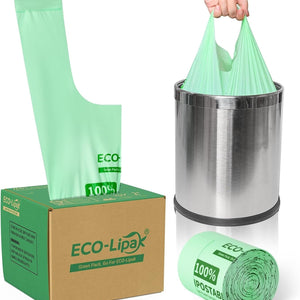
Once the route is confirmed, choose one receiving product and train staff on it. For smaller caddies or tie-handle needs, the handled compostable bag range is a different product with different dimensions; do not substitute it in the same cost comparison. Explore the compostable bags collection if several bin sizes need one coordinated supply plan.
Frequently Asked Questions
Is the 600-count carton always cheaper per bag?
No. It was cheaper than the 200-count carton at the prices checked, but variant prices and promotions change. Recalculate carton price divided by count before ordering.
How many bags does a 20-bin-per-day site need?
At one change per bin on 20 workdays, the baseline is 400 bags. Add a chosen allowance for extra changes; at 10%, plan 440 bags.
Are 13-gallon bags suitable for every 13-gallon bin?
No. Rim shape, bin depth, and desired overhang vary. Trial a bag in the actual receptacle and check safe lifting under your usual waste load.
Can these bags go in a home compost pile?
Do not assume so. Check the exact item's home-versus-commercial certification and follow the receiving program's rules.
Should compostable bags go in plastic recycling?
No. Compostable plastics can contaminate conventional plastic recycling. Ask your local facility for the correct route if compost collection is unavailable.