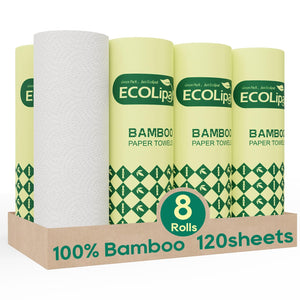
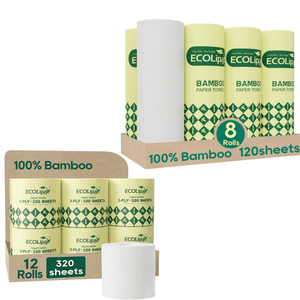
Quick Answer: Choose the 8-roll box of unbleached bamboo kitchen paper towels if you are testing the product or stocking a small baking weekend; choose the 32-roll carton when several prep days or a shared kitchen will actually use it and you can store the spare rolls clean and dry. ECO-Lipak lists 120 sheets per roll, so the two packs contain 960 and 3,840 sheets respectively. Count your likely sheet use before treating the larger carton as automatically better value.
Key Takeaways
- The listed towels are unbleached, natural tan, 2-ply bamboo kitchen rolls, not brown napkins or toilet tissue.
- Eight rolls contain 960 sheets; 32 rolls contain 3,840 sheets, based on the current 120-sheet product specification.
- For baking, split use into prep, spill response, and final cleanup so a single busy day does not distort the monthly order.
- Keep clean rolls away from flour dust and moisture. A large carton is useful only if the stock remains usable.
Why the natural roll belongs on the prep sheet
Holiday baking has a different rhythm from an ordinary weekday kitchen. A household may use a few sheets to wipe a counter and a cooling rack, while a small bakery may be changing tasks, clearing trays, and cleaning prep surfaces repeatedly. If the buyer simply counts people, the order will be wrong. Count work sessions and sheet use instead. These ECO-Lipak unbleached bamboo kitchen paper towels are sold in an 8-roll box and a 32-roll carton, with 120 sheets on each roll. That makes the arithmetic straightforward even when actual usage is uncertain.
For a first purchase, test a roll during the real job. Use it to catch a small spill, wipe a prep surface, and dry the edge of a clean serving tray according to your kitchen's hygiene rules. The roll's tan color and 2-ply construction are product characteristics; they do not replace a food-safety process. Do not use a towel that has touched raw ingredients on a ready-to-eat surface. Keep a separate cloth or disposable cleaning protocol where your kitchen requires one.
A sheet-count method for 8 or 32 rolls
Start with the number of baking sessions before the next reliable delivery, then estimate sheets per session. A trial kitchen might use 25 sheets in one prep and cleanup period. Ten sessions would use 250 sheets, well under the 960 sheets in one 8-roll box. A high-turnover prep team might use 180 sheets in a day. Twenty days would use 3,600 sheets, nearly the 3,840 sheets in a 32-roll carton, with little reserve. Build a sensible buffer around your own measured use rather than copying those illustrative rates.
| Current pack | Sheets in pack | Illustrative use | Buying judgment |
|---|---|---|---|
| 8 rolls | 8 x 120 = 960 | Small household or trial period | Better when use and storage are uncertain |
| 32 rolls | 32 x 120 = 3,840 | Repeated prep days or shared kitchen | Buy when the carton will be used before stock degrades |
| Example: 12 sessions x 45 sheets | 540 projected sheets | Holiday baking at home | 8-roll box leaves working reserve |
| Example: 20 sessions x 170 sheets | 3,400 projected sheets | Small commercial prep team | 32-roll carton leaves 440 sheets before buffer |
These are planning examples, not promises of how many sheets a recipe needs. If your team uses 170 sheets per session and wants a 15% buffer, the target becomes 3,910 sheets, just over one 32-roll carton. That is the moment to check a second box, delivery frequency, or a process change. A “big case” does not solve a shortfall if the math is wrong.

Three real buying situations
Home cookie weekend: one box is usually the low-risk choice when you have not measured consumption. It can live in a clean pantry and the remaining rolls continue in normal kitchen rotation. If you also need table napkins, do not substitute kitchen sheets for guest napkins merely because they are made of bamboo; the jobs and presentation differ. ECO-Lipak's paper essentials page shows the wider household-paper range.
Community bake sale: assign one open roll to the prep table and another to cleanup, with packaged spares elsewhere. Do not put the entire stock next to batter and beverage spills. A multi-table event may use towels faster than a household because each station independently reaches for a fresh sheet. Record how many rolls remain afterward; that is better evidence for the next event than an impression that “we used a lot.”
Small bakery or caterer: a carton may simplify purchasing across several prep dates. Before ordering, map where 32 individually wrapped rolls will sit. The wrapping can help keep the clean supply separate from active work, but the carton still needs a dry shelf and an owner who rotates older stock forward. If the team prefers a white towel for presentation-sensitive wipe-downs, compare the white bamboo kitchen towel variant instead of assuming color is the only difference; test both against the actual task.
What to check before making a sustainability claim
The product page identifies bamboo pulp and describes the rolls as unbleached. That supports a material-and-processing description, but does not prove that every sheet collected from a kitchen will be composted or recycled. Local programs differ, and grease or cleaning chemicals can change acceptance. The US EPA's municipal materials guidance explicitly tells readers to check with the local recycling or composting program. Keep the customer-facing claim modest: describe the towel accurately, then state the disposal route your location actually has.
Likewise, “food safe” on a product listing is not a license to reuse a soiled sheet between tasks. A clean sheet can be part of a tidy prep system; it does not sanitize a surface. For a bakery, the bigger performance question may be whether the sheet stays intact during a real wipe. Run that test on site before changing a standard operating procedure.

Buying checklist for the next order
Check the variant says 8/box or 32/carton, calculate 120 sheets per roll, and subtract the clean rolls already in stock. Compare the live delivered price per roll, not an old screenshot. Ask where the unopened rolls will be stored and whether the planned restock date falls before you use the last one. If your kitchen also stocks bathroom paper, plan that separately; a mixed household bundle may contain white towels rather than the unbleached rolls described here. Browse the kitchen paper towels collection when comparing formats.
Finally, separate supply planning from seasonal decoration. The same unbleached roll should still work in January's ordinary kitchen. A carton purchase should be justified by repeated use, not by the fact that it appears beside holiday cookies in a photograph.
Frequently Asked Questions
How many sheets are in the 8-roll box?
At the current listed 120 sheets per roll, the box contains 960 sheets. Confirm the live product specification before placing a future order.
How many sheets are in the 32-roll carton?
At 120 sheets per roll, the carton contains 3,840 sheets. That is four times the roll count of the 8-roll box, not necessarily four times the best value for a one-off event.
Are the unbleached towels brown napkins?
No. They are 2-ply kitchen paper towel rolls with natural tan bamboo paper. Guest napkins and kitchen towels have different serving jobs.
Should a small home baker buy the carton?
Only when the projected use, household rotation, storage space and delivered price support it. The 8-roll box is the lower-commitment trial purchase.
Can used bamboo kitchen towels go in recycling or compost?
Follow your local program's acceptance rules, especially for food-soiled or chemical-contaminated sheets. The fiber source alone does not determine the collection route.