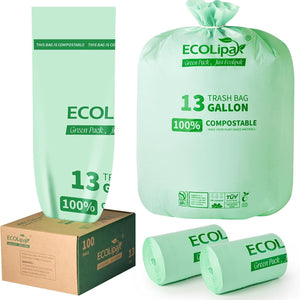
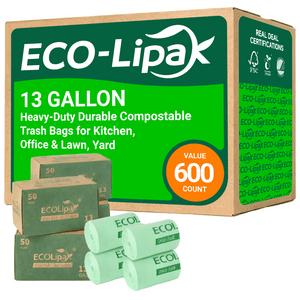
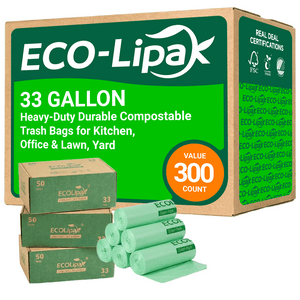
Quick Answer: BPI certification helps buyers identify compostable bags that have been reviewed against recognized compostability standards, but it does not mean every local composting program will accept the bag. Before buying, match the certification, bag size, waste stream, and local facility rules. For ECO-Lipak buyers, BPI certified compostable bags are most useful when kitchen, office, yard, or event cleanup is already organized around compostable waste collection.
Key Takeaways
- BPI certification supports compostability claims, but local composting acceptance still decides where the bag can go.
- Use certified compostable bags for food scraps, office cleanup, yard waste, or event waste only when the waste stream is sorted clearly.
- Choose 13 gallon bags for kitchen bins, 33 gallon bags for office or utility bins, and 55 gallon bags for large-volume cleanup.
- Do not treat “compostable” as the same as “disappears anywhere”; disposal conditions matter.
This is a News category update because certification language is becoming a bigger part of disposable product buying. A phrase like BPI certified can help, but it is only one part of the decision. The BPI certification program explains compostable product certification, while the EPA composting guidance shows why composting conditions and local programs matter.
What BPI Certification Means Before You Buy
BPI certification is meant to support compostability claims with third-party review. For a buyer, that makes the product easier to compare than a bag described only as green or earth-friendly. It still does not answer every practical question. You also need to know the bin size, waste type, pickup rules, and whether your composting program accepts compostable bags.
| Buying question | What to check | Why it matters |
|---|---|---|
| Is the bag certified? | Look for BPI certified language on the product page | Supports the compostability claim |
| Will my facility accept it? | Check local composting rules | Acceptance varies by program |
| What size do I need? | Match 13, 33, or 55 gallon to the bin | Prevents slipping, tearing, or wasted material |
| What waste goes inside? | Separate food scraps, yard waste, or event waste | Contamination can cause rejection |

How ECO-Lipak Buyers Should Use the Certification
For daily kitchen use, start with 13 gallon compostable trash bags. For office, utility, or light commercial cleanup, move to 33 gallon options such as wholesale 33 gallon compostable trash bags. For yard or event cleanup, a larger bag can help, but only if the load stays manageable.

Certification Is Not a Disposal Shortcut
Environmental claims should stay specific. The federal Green Guides in 16 CFR Part 260 are a useful reference for avoiding broad, unsupported wording. In practice, say what the product is designed for, then tell buyers to check local composting acceptance before disposal.
FAQ
Does BPI certified mean a bag is accepted in every compost bin?
No, BPI certification does not guarantee local acceptance. Composting programs decide what they accept based on facility rules and contamination concerns.
Are BPI certified compostable bags useful for home kitchens?
Yes, they can be useful for home kitchens when your waste program accepts compostable bags. A 13 gallon bag is the usual starting point for kitchen bins.
What bag size should an office choose?
A 33 gallon compostable bag is often a better office choice than a kitchen liner. It fits larger utility bins and higher daily volume.
Can compostable bags hold yard waste?
Yes, larger compostable bags can hold light yard waste such as leaves, but heavy wet loads should be split. A 55 gallon bag should not be overfilled simply because it has more volume.
Recommended Reading
- Compostable Trash Bag Size Guide — choose 13, 33, or 55 gallon bags by bin and use case.
- PFAS-Free Disposable Tableware Guide — compare safety and material claims before buying.
- About ECO-Lipak — learn how the brand frames practical eco-friendly purchasing.