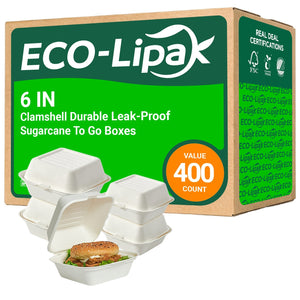
Quick Answer: Choose wholesale sugarcane clamshells by the food and service route first, then order complete cartons from the actual variant count. ECO-Lipak's current wholesale range includes 6-inch white boxes at 400 per carton, 8-inch white or natural boxes at 200 per carton, 9 x 6-inch white boxes at 300 per carton, and 9 x 6-inch natural boxes at 500 per carton. Forecast containers, add a written reserve, divide by the selected carton count, and always round up.
Key Takeaways
- The lowest carton count is not automatically the best buy; first confirm portion fit, closure, stacking, and delivery performance.
- Carton quantities differ by size and color, so each variant needs its own inventory calculation.
- A 10% reserve can be useful in examples, but every operation should choose a rate from its own demand and damage history.
- Run a real-menu pack test before committing to event or weekly volume.
- Keep compostability claims tied to the exact product and the receiving facility that accepts it.
Bulk packaging decisions often look simple on a product page: pick a size, compare a price, and order a carton. In practice, the costliest mistake is usually upstream. A box that is too small changes portions; a box that is too large wastes shelf space and may let food shift in transit. A carton count that does not match weekly demand either creates a stockout or leaves months of inventory in the storeroom.
The better purchasing question is not “How many cases should we buy?” It is “Which tested container should we buy, and how many complete cartons cover the next service window?”
Start With the Current Wholesale Variants
The ECO-Lipak wholesale sugarcane clamshell range currently lists five variant and carton combinations. Use the selected variant shown on the product page at the time of ordering, because size and count are connected.
| Current variant | Units per carton | Useful menu trial | Purchasing watch-out |
|---|---|---|---|
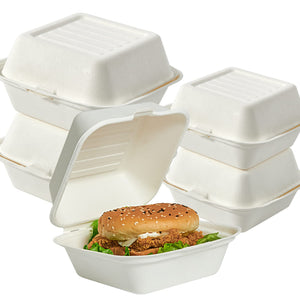
| White, 6 in | 400 | Snack, dessert, sandwich, or compact side | Do not force a full entree into the smaller footprint |
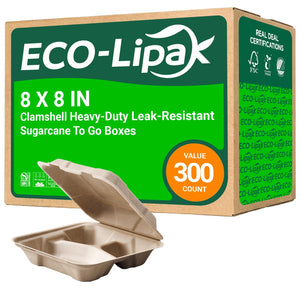
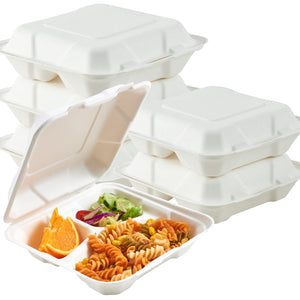
| White, 8 in | 200 | Standard lunch or medium entree | One carton covers fewer orders than the 6 in carton |
| Natural, 8 in | 200 | Standard lunch or medium entree | Color does not replace a closure and leak test |
| White, 9 x 6 in | 300 | Rectangular meal, sandwich with side, or combo | Confirm how the actual meal sits during delivery |
| Natural, 9 x 6 in | 500 | Higher-volume rectangular meal program | A larger carton needs more storage and cash coverage |
These menu examples are starting points, not guarantees. Food density, sauce level, side placement, garnish height, and closure pressure all matter. Review the broader to-go box collection only after defining the meal; otherwise, similar-looking options are difficult to compare.

Use One Carton Formula
Build the forecast from sellable orders, not from a vague estimate of “busy.” If one order uses one container, the calculation is:
Cartons needed = ceiling of [forecast orders x containers per order x (1 + chosen reserve rate) divided by units per carton].
The ceiling matters because Shopify sells these variants as complete cartons. The reserve should also be visible. Ten percent is used below to show the math; it is not a universal foodservice standard.
- 300 snack orders: 300 x 1 x 1.10 = 330 containers. One 400-count carton of 6-inch white clamshells leaves 70 after the plan.
- 300 rectangular meals: 300 x 1 x 1.10 = 330. The 300-count white 9 x 6-inch option requires two cartons, or 600 total, leaving 270.
- 450 rectangular meals: 450 x 1 x 1.10 = 495. One 500-count carton of natural 9 x 6-inch clamshells leaves five.
- 600 standard lunches: 600 x 1 x 1.10 = 660. The 200-count 8-inch variant requires four cartons, or 800 total, leaving 140.
Those leftovers are not automatically waste. They can become opening stock for the next period. The important number is the projected closing balance, because it tells the buyer whether the case size fits the ordering rhythm and available dry storage.
Run a Five-Meal Pack Test Before Buying Cases
- Prepare five typical meals. Include the sauciest, tallest, heaviest, and most fragile items that use the box.
- Close without forcing. Check the hinge, rim, and locks. A lid that closes on an empty sample may not close on a finished meal.
- Hold for the real service time. Include the normal wait on the pickup shelf and the expected delivery journey.
- Stack as the driver or customer will. Look for sliding, lid pressure, and condensation effects.
- Record pass or fail by menu item. Do not let one successful dry meal stand in for every recipe.
For a deeper look at moisture, compare clamshells and wide-rim bowls for takeout. Product documentation and certification references should be matched to the exact SKU through the ECO-Lipak resource library.

Four Operational Scenarios
Food Truck With a Short Menu
A food truck serving one sandwich, one rice bowl, and one side can often narrow the range quickly. Trial a small box for the side and one larger format for both mains only if both meals close and travel reliably. Read the peak-hour clamshell workflow before changing the service line.
Restaurant With Delivery Aggregators
Model the longest realistic journey, not only the handoff at the counter. Add sauce cups or dividers only when the menu needs them, then count those components separately. Photograph the approved pack so every shift follows the same arrangement.
Caterer With a 450-Meal Event
The 500-count natural 9 x 6-inch carton looks mathematically neat with a 10% reserve, but event setup may require meals to be packed in waves. Confirm that the closed boxes stack on the available racks and that the carton arrives early enough for receiving checks.
Growing Cafe Between Retail Packs and Cartons
A cafe testing a new lunch can begin with the retail and carton clamshell listing, then move to a wholesale-only variant when the menu and weekly volume stabilize. The move should follow usage data, not a guess that wholesale is always cheaper after storage and leftover stock.
Keep Environmental Claims Specific
The exact product listing describes these clamshells as sugarcane bagasse and provides product-specific certification and use information. That does not mean every molded-fiber box has the same specification or that every community accepts used foodservice ware.
The U.S. EPA food-service ware guidance recommends looking at the whole system, including reuse opportunities and the collection infrastructure available. The BPI FAQ also helps explain certification and commercial composting context. Confirm acceptance with the receiving facility before placing a compost bin label.
FAQ
How many wholesale sugarcane clamshells are in a carton?
The current ECO-Lipak listing varies by selected variant: 200, 300, 400, or 500 per carton. Read the selected size and color together with its count before ordering.
Which clamshell size is best for a full takeout meal?
There is no universal answer. Start with the 8-inch or 9 x 6-inch options, then test the actual entree, sides, sauce, closure, and delivery stack.
How much reserve stock should a restaurant add?
Choose a rate from demand variation, mispacks, damage, supplier lead time, and the cost of a stockout. Ten percent is a transparent example, not a mandatory rule.
Are sugarcane clamshells suitable for hot or saucy food?
Use the exact product instructions and run a time-based menu test. “Leak-resistant” should not be treated as a promise that every liquid or sauce can be held indefinitely.
Can used sugarcane clamshells go in a compost bin?
Only when the exact item and its food residue meet the local receiving program's rules. Confirm acceptance instead of relying on the material name alone.