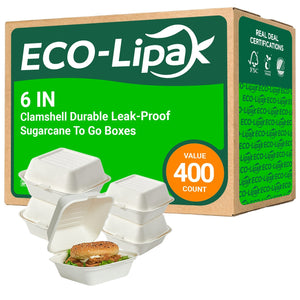
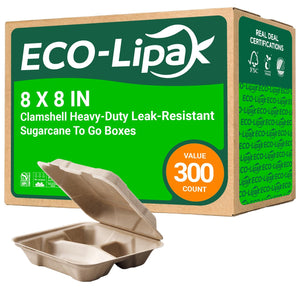
Quick Answer: A Black Friday takeout-box offer is worth buying only if the box fits your menu, the delivered cost per usable container beats your normal purchasing option, and the carton can be stored and used before demand changes. Record your baseline carton price now, then compare the live offer on the day; do not buy by discount percentage alone. ECO-Lipak's wholesale sugarcane clamshell range has different counts for 6-inch, 8-inch and 9 x 6-inch variants, so the unit count must be checked before any price comparison.
Key Takeaways
- Black Friday is a price-check window, not evidence that every product is discounted.
- Compare the selected variant's carton count, shipping, tax and likely unusable boxes; a headline price is not a cost per meal.
- Test the real menu inside the box before buying more than one carton.
- Plan storage and replenishment timing so a seasonal purchase does not crowd the prep area or tie up cash for months.
Make a baseline sheet before the promotion starts
Foodservice teams often reach Black Friday with an urgent order but no comparison number. The first useful action is to write down the normal delivered price of the exact box variant you already use. Capture carton quantity, dimensions, color, shipping cost, tax, expected arrival date and the last time the box failed a meal test. Then open the wholesale sugarcane clamshell page or the to-go box collection to see the current variants. A different size or count is not the same offer even if the product photograph looks similar.
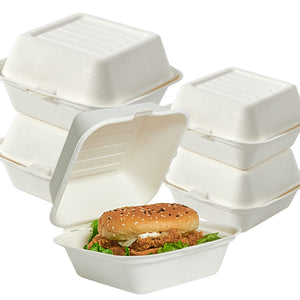
The current wholesale listing includes white 6-inch boxes in a 400-count carton, white or natural 8-inch boxes in 200-count cartons, white 9 x 6-inch boxes in a 300-count carton, and natural 9 x 6-inch boxes in a 500-count carton. Availability and price can change, so use the live variant selector when you actually order. Do not turn the numbers in this guide into a claim that a Black Friday promotion is active today or guaranteed later.
The site has a sale collection, but an item appearing there does not by itself make it the best procurement choice. Compare the same dimensions and carton unit, and check any terms at checkout. If a promotional box is a different material, closure or size, the apparent saving may disappear through leaks, re-packing or extra side containers.

Five checks before you commit to a carton
| Check | Record this | Why it changes the decision |
|---|---|---|
| Format | 6-inch, 8-inch or 9 x 6-inch; white or natural | Different menus need different footprints and clearances. |
| Carton count | 400, 200, 300 or 500 on the selected variant | Headline carton price means little without the denominator. |
| Delivered cost | Item price plus shipping and tax | Freight can erase a nominal markdown. |
| Usable rate | Boxes that pass your meal and closure test | Crushed or ill-fitting units are not saleable meals. |
| Cash and space | Weeks to use and shelf footprint | An overbuy creates storage and cash-flow costs. |
Use a transparent calculation: delivered carton cost ÷ usable boxes. Suppose a hypothetical carton costs $90 delivered and contains 300 boxes, but 10 boxes are damaged or unsuitable for your menu. The usable cost is $90 ÷ 290, about $0.31 per box, not $0.30. These dollar figures are an illustration, not a current ECO-Lipak price. For a true promotion comparison, repeat the arithmetic with the checkout total from both the regular and promoted options.
A second useful number is weeks of stock: usable boxes ÷ average boxes used per week. At 75 boxes per week, a 300-count carton is roughly four weeks before any reserve. If your menu changes after the holidays or demand drops in January, a six-month purchase may be less attractive than it looks. Ask the operations team how many cartons actually fit on a clean, dry shelf without blocking access or damaging the bottom boxes.
Run the meal-fit test that discounts cannot replace
Place your normal entree, side and garnish in the box while the food is at normal service temperature. Close the lid without forcing it. Move the closed box from prep counter to a carry bag, then open it after a realistic wait. Check whether steam softened the food, whether sauce reached the seam, whether the lock stayed engaged, and whether the meal still looks presentable. The product descriptions call the clamshells leak-resistant, but no takeout box makes a soup spill-proof without the right menu and closure.
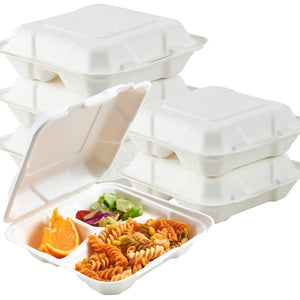
The 6-inch box is a reasonable sample candidate for a pastry, snack or modest side; an 8-inch format may fit a standard lunch; a 9 x 6-inch rectangle can suit a sandwich with a side. These are starting points, not dimension guarantees for every menu. For a very wet meal, use a tested bowl or a separate sauce cup instead of stretching a clamshell beyond its job. If food separation is the problem, compare the 8 x 8-inch compartment clamshell; its divider changes the fit test and its carton count differs by color.

Three Black Friday buying situations
Independent cafe with one lunch bestseller
Use last month's lunch-order count as the baseline. Sample the exact box around the bestselling sandwich and side, then decide whether a 200- or 300-count carton provides a sensible run rate. A single carton bought at a modest verified saving may be more useful than a large multi-carton order that fills the dry-goods shelf. Ask when the carton can arrive; a promotion that arrives after a busy weekend does not solve an immediate shortage.
Food truck with two menu formats
Do not assume one clamshell can handle both a compact snack and a full saucy meal. You may need two variants and two unit-cost comparisons. Write the menu item next to the corresponding box SKU. If the promotional stock only covers one format, buy the other through the normal route rather than re-designing portions around an unsuitable box. Keep enough working stock outside the vehicle so the truck does not become a storage unit.
Caterer planning December events
Count confirmed meals and a measured service buffer, then separate plated service from takeout leftovers. If 280 packed dinners are contracted, one 300-count white 9 x 6-inch carton leaves 20 boxes before breakage or extras. A 500-count natural carton may create more than 200 unused boxes unless upcoming events will consume them. Bring the sample to the kitchen manager: a box that fits the photo may still fail on a hot side dish.
Certification and disposal are still purchasing variables
The listing describes molded sugarcane fiber and a compostability certification claim. Verify the exact item or SKU using a trusted directory such as BPI's certified-product search if certification matters to a customer contract. The EPA recommends commercially compostable foodservice ware only when the local program accepts that product type and collection is arranged. A holiday promotion does not change what your local hauler takes. The bulk purchasing guide is useful for a broader category order, but this article focuses on choosing a specific takeout-box carton when price pressure is high.
Finally, save the chosen variant, delivered cost and outcome of the meal test in the purchasing record. This gives next year's buyer a real baseline. Black Friday is most valuable when it improves an already sensible packaging plan, not when it causes the business to inherit a shelf of boxes that never matched the menu.
Frequently Asked Questions
Are ECO-Lipak takeout boxes already on Black Friday sale?
Do not assume so. Check the live product and sale pages when the promotion period arrives; this guide does not announce a discount.
Which carton count should I use for a price comparison?
Use the count on the exact selected variant. The current wholesale range includes 200-, 300-, 400- and 500-count cartons depending on size and color.
How do I compare two different carton sizes?
First confirm both boxes fit the same meal. Then divide each delivered carton total by its usable box count, and include storage and arrival timing in the final choice.
Can a clamshell carry soup or thin sauce?
Do not rely on it without a real transport test. A bowl or sealed sauce container is generally the more appropriate starting point for liquids.
Should I buy months of boxes because the per-unit cost is lower?
Only if you have predictable demand, clean storage space and enough cash without risking a later menu change. Compare weeks of stock, not just cents per box.