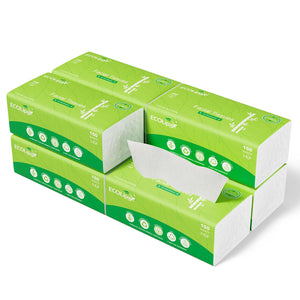
Quick Answer: For a small hotel, order facial tissue from actual room-turnover policy, not from room count alone. Decide when housekeeping places a fresh sealed pack, count those changes over the delivery period, then add a measured reserve. ECO-Lipak's 3-ply white bamboo facial tissues come as low soft packs with 150 pulls per pack and order options of 8, 12, 32, or 48 packs.
Key Takeaways
- Occupied room-nights do not equal tissue packs consumed; a three-night stay may use part of one pack.
- Use guest checkouts, full-pack replacements, public-area refills, and a small reserve as separate demand drivers.
- Check that the green-and-white soft pack fits the surface or holder you actually use; it is not a rigid cube tissue box.
- Choose 8- or 12-pack boxes for a pilot, then compare 32- and 48-pack cartons after measuring weekly use.
- Keep facial tissue, bathroom tissue, and cleaning towels as distinct inventory lines; they are not interchangeable.
The common shortcut, “one box per room,” feels tidy on a purchase order but often misses the way a property actually operates. Some hotels place a new sealed pack for each incoming guest. Others replenish only when the opened pack is nearly empty, subject to their housekeeping standards. A lobby, breakfast area, or meeting room can add another source of demand. The right starting point is a written replenishment rule and two weeks of observed use.
The ECO-Lipak white bamboo facial tissue listing specifies three-ply tissue in a flexible soft pack, 150 pulls per pack, with 8, 12, 32, and 48-pack purchasing options. The same listing describes the white tissue and green package. Confirm today's variant availability on the product page before ordering; a pack-count plan should not assume a particular carton remains in stock.
First Define What Counts as a Replacement
A useful housekeeping log has four lines: packs opened in guest rooms, packs placed at turnover, packs used in public areas, and damaged or misplaced packs. Do not count a partially used pack as a full new pack just because a room was occupied. Do not carry an opened pack between guest rooms unless your property's hygiene policy allows it. If your standard requires a fresh sealed pack at every checkout, that policy gives you a reliable turnover-based baseline. If not, measure actual replacements instead of inserting a made-up one-pack-per-stay rule.
| Restock trigger | What to count | Common planning error |
|---|---|---|
| Guest checkout | New sealed packs placed under your room standard | Treating every occupied night as a new pack |
| In-stay service | Actual near-empty or damaged packs replaced | Ignoring long-stay rooms |
| Lobby or breakfast station | Public-area packs opened or replaced | Hiding demand inside the room estimate |
| Reserve | Documented spikes, damage, and lead-time uncertainty | Adding an unexplained large safety stock |
One pull is a use event, not a room-night. The 150-pull product specification helps compare capacity after you have measured use, but it cannot predict how many guests will reach for a tissue. Keep the reorder model in packs until you have a good on-property usage record.

Worked Example: 18 Turnovers Each Week
Suppose a 24-room inn has 18 guest turnovers per week and its policy calls for one fresh sealed tissue pack at each turnover. Over a four-week purchasing cycle, baseline demand is 18 x 4 = 72 packs. A 10% operational reserve adds 7.2 packs, rounded up to eight, for a target of 80 packs. One 48-pack carton plus one 32-pack carton reaches 80 exactly. This is a planning example, not a claim that every 24-room property uses 80 packs monthly.
If the inn instead replaces packs only when empty, the turnover number will overstate demand. Use the housekeeping log: for example, 11 room replacements plus 3 public-area replacements per week becomes 14 x 4 = 56 packs before reserve. The difference between 56 and 72 is why a short pilot can pay for itself. A buyer who cannot yet estimate use can trial the 8- or 12-pack option, measure replacements for two weeks, and then decide whether a 32- or 48-pack carton fits the delivery rhythm.
On the reorder sheet, write the rule as packs required = measured replacements during lead time + reserve - usable packs already on hand. Round the result up to an available order combination, not down to the nearest carton. Separate public-area tissue from guest-room tissue if different teams replenish them.
Three Small-Property Situations
Guest room with a bedside tissue spot
Place the soft pack where a guest can pull a tissue without lifting it off the surface. Check whether the bedside table has enough space and whether the pack remains tidy as it gets lighter. If you use a decorative sleeve, test a full and a half-used pack; the opening needs to line up. The guest-room tissue placement guide covers placement details; this article focuses on ordering volume.
Public lobby or breakfast corner
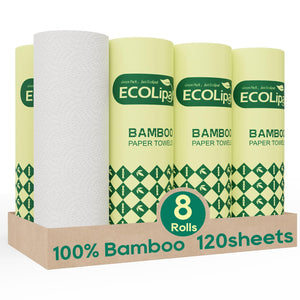
These spots can empty faster than a quiet guest room. Put a separate opening date on the housekeeping checklist and record each replacement. If the station sits next to food, keep facial tissue separate from the kitchen paper towels intended for spill cleanup. Soft facial tissue is for personal use, not a substitute for a cleaning towel or food-contact paper.
Weekend peak or group booking
Group arrivals can compress many turnovers into one day. Stage enough sealed packs on a housekeeping cart for the rooms on that day's list, with a small back-of-house buffer. The point of a reserve is to avoid a missed room, not to leave cartons indefinitely in an overheated or damp storage corner. Keep the stock dry and rotate older cartons forward.

What to Check Before Buying a Carton
Evaluate the product as an operating supply, not only as a sustainability label. The bamboo facial tissue collection is a useful starting point, but the specific product listing is where you should confirm pack size, ply, and current variant. Run a room test for package footprint and ease of pulling. Ask housekeeping whether the soft pack stays clean in its intended position. Then calculate cost per pack from the current listing and compare it against actual replacement rate, not just the price of a large carton.
For environmental claims, say precisely what you know: this product is listed as bamboo tissue, but bamboo does not automatically mean recycled, compostable in every setting, or free of environmental impact. The FTC Green Guides in 16 CFR Part 260 warn against broad, unqualified green claims. The EPA's materials-management hierarchy emphasizes source reduction, including careful purchasing and avoiding unnecessary waste. An accurate restock model is a more credible sustainability step than a vague “eco” sign on the housekeeping cart.
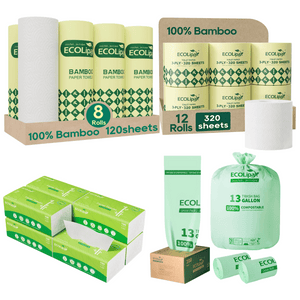
If you are standardizing several room supplies at once, keep each product's use distinct. The ECO-Lipak home essentials set demonstrates how facial tissue, toilet paper, kitchen towels, and waste bags serve different tasks. A hotel buyer should still order according to each item's actual consumption and service standard.
A Simple Four-Week Reorder Routine
- Write the guest-room replenishment rule and note which public areas use the same pack.
- Record pack replacements for two representative weeks, including a busy checkout day.
- Multiply average weekly replacements by the weeks between deliveries.
- Add a modest, justified reserve and subtract usable packs on hand.
- Build the order from 8-, 12-, 32-, or 48-pack options and review the calculation after the first cycle.
When the log changes, the next order should change with it. A restock rule that is easy for staff to follow is more valuable than a beautifully precise forecast no one updates.
Frequently Asked Questions
How many facial tissue packs should a hotel room use per month?
There is no universal number. Count actual replacements and apply your turnover policy; room occupancy alone does not tell you how many full packs were used.
Are ECO-Lipak facial tissues sold in cardboard cube boxes?
No. The listed product is a flexible, low-profile soft pack. Test it on the room surface or inside the holder you intend to use.
What does 150 pulls per pack mean for purchasing?
It describes the pack capacity, not how many guest nights one pack will last. Use your own replacement log to convert capacity into an order interval.
Should a small inn buy the 48-pack carton immediately?
Only when measured use and storage support it. An 8- or 12-pack trial can establish the room fit and replacement rate before a larger order.
Can facial tissues replace paper towels on a housekeeping cart?
No. Keep soft facial tissue for guest personal use and choose a suitable towel for cleaning tasks.