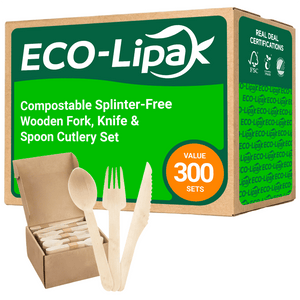
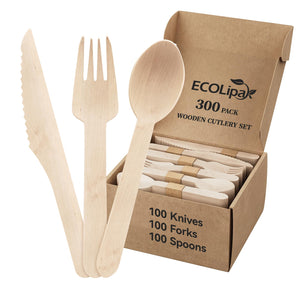
Quick Answer: Choose 300 complete wooden cutlery sets when most guests need a fork, knife, and spoon together. Choose a 900-count carton of one utensil when the menu is utensil-specific, such as forks for salads or spoons for soup. At the current listed prices, the 300-set carton costs about $0.16 per complete place setting, while individual 900-count cartons cost about $0.05 to $0.06 per utensil.
Key Takeaways
- A 300-set carton contains 300 forks, 300 knives, and 300 spoons, or 900 utensils total.
- A 900-piece carton contains only one utensil type, so it is a replenishment carton rather than 900 full place settings.
- For a balanced meal, complete sets simplify packing and inventory. For a one-utensil menu, singles usually prevent waste.
- With a 10% service buffer, one 300-set carton supports about 272 guests; one 900-count single-utensil carton supports about 818 servings.
- Compostability and disposal access are separate questions. Confirm the product claim and the receiving facility before setting up a compost bin.
Wholesale cutlery counts can be surprisingly easy to misread. A carton marked "900 pieces" sounds three times larger than 300 sets, but the two options solve different stocking problems. The ECO-Lipak wholesale wooden cutlery range offers 300 complete sets or 900 forks, knives, or spoons in a single-type carton. The useful comparison is not just piece count. It is the number of meals the carton can actually serve.
300 Sets vs 900 Pieces at a Glance
| Carton option | What is inside | Current price | Approximate unit cost | Best use |
|---|---|---|---|---|
| 300 complete sets | 300 forks, 300 knives, 300 spoons | $46.70 | $0.16 per set | Boxed meals, mixed menus, guest place settings |
| 900 knives | 900 knives | $49.99 | $0.056 per knife | Menus that need cutting but not a full set |
| 900 forks | 900 forks | $47.19 | $0.052 per fork | Salads, pasta, grain bowls, tasting stations |
| 900 spoons | 900 spoons | $47.93 | $0.053 per spoon | Soup, chili, yogurt, desserts |
Prices above reflect the product listing checked for this guide and can change. For 900 full fork-knife-spoon place settings, three 300-set cartons total $140.10. Buying one 900-count carton of each utensil totals $145.11. The five-dollar difference is small; workflow and menu fit should make the decision.

Start With the Menu, Not the Carton Count
The fastest buying rule is to map one utensil to each menu item. A boxed sandwich lunch may need a fork only for a side salad. A plated catered meal may need all three utensils. Soup service needs spoons, while a dessert sampler may need forks or spoons but rarely knives.
A complete set is convenient when menus change, meals are packed off-site, or staff cannot customize every bag. Single-utensil cartons make more sense when demand is predictable. A salad bar that uses forks ten times faster than knives should not keep opening full sets just to reach the fork.
This is also why a broad cutlery collection matters for purchasing teams: material, utensil mix, and pack format should be selected together rather than treated as separate decisions.
Use a Service Buffer That Matches the Event
A practical ordering formula is:
Expected servings x 1.10 = target utensil count
The extra 10% covers dropped utensils, unexpected guests, staff meals, and guests who return for another course. For tightly controlled boxed meals, 5% may be enough. For self-service events or outdoor catering, 10% to 15% is more realistic.
| Expected demand | Count with 10% buffer | Best carton choice | What remains |
|---|---|---|---|
| 250 complete meals | 275 sets | One 300-set carton | 25 spare sets |
| 750 salad servings | 825 forks | One 900-fork carton | 75 spare forks |
| 500 soup servings | 550 spoons | One 900-spoon carton | 350 spoons for the next service |
| 800 full place settings | 880 sets | Three 300-set cartons | 20 spare sets |
Three Real Ordering Scenarios
1. Office Catering for 250 People
The menu includes a hot entree, salad, and dessert. Because guests may use more than one utensil and the caterer is packing off-site, one 300-set carton is the cleanest choice. Staff can place one set with each meal and keep 50 sets in reserve before applying a formal buffer.
2. A 750-Serving Grain Bowl Station
Every bowl needs a fork, but knives and spoons would mostly go unused. One 900-fork carton covers the service with 150 extras, or 75 extras after a 10% planning buffer. This is exactly where a single-utensil carton reduces overpacking.
3. A Caterer With Changing Weekly Menus
Demand is uneven: forks move fastest, spoons next, and knives slowest. Start with complete sets for flexible jobs, then use single-type cartons to correct the imbalance. The purchasing signal is not total utensil inventory; it is inventory by utensil type.
Storage and Reorder Planning
Label storage locations by format: complete sets, forks, knives, and spoons. Record the opening count before a service and the closing count after cleanup. After three events, the team will have a usable consumption ratio instead of a guess.
A simple reorder point is:
Average weekly use x supplier lead time in weeks + one event buffer
If a caterer uses 400 forks per week, has a two-week replenishment window, and wants 150 forks in reserve, the reorder point is 950 forks. That number shows why a 900-fork carton should be reordered before the current carton is empty.

What Buyers Should Verify Beyond Quantity
- Menu performance: Test the fork with dense salads, the spoon with hot soup, and the knife with the toughest item actually served.
- Surface finish: A smooth, splinter-free feel matters during a full meal, not just during a quick sample.
- Packaging workflow: Decide whether staff need pre-grouped sets or fast access to open bins of one utensil.
- Disposal route: Do not assume a plant-based item belongs in every compost stream. Ask the local facility what it accepts.
The FTC Green Guides summary explains why compostable and recyclable claims need clear qualification. A product claim does not replace local disposal instructions. For a broader view of certified compostability, BPI describes separate commercial and home compostability certification schemes.
When Another Material Fits Better
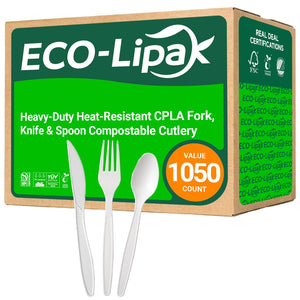
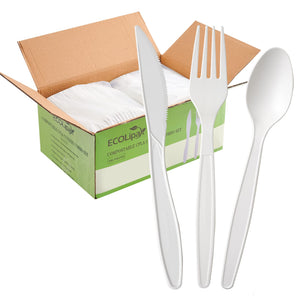
Wooden cutlery is useful for room-temperature and everyday catered meals, but it is not the only option. CPLA cutlery may suit hot-food stations that want a familiar molded shape. Premium events may prioritize a different feel and presentation. Buyers comparing these options can use ECO-Lipak's material and brand overview as context, then test a small quantity against the actual menu before committing to a wholesale format.
The decision is operational: buy complete sets when every meal needs a trio; buy 900-count singles when one utensil drives demand. That distinction prevents a high piece count from becoming the wrong inventory.
Frequently Asked Questions
Does 300 wooden cutlery sets mean 300 utensils?
No. It means 300 forks, 300 knives, and 300 spoons, for 900 utensils total and 300 complete place settings.
Does a 900-piece carton serve 900 guests?
Only when each guest needs one utensil of that type. A 900-fork carton can serve up to 900 fork-only meals, but it does not include knives or spoons.
How many guests does one 300-set carton cover with a buffer?
About 272 guests with a 10% buffer. For a controlled event with no unexpected attendance, it can provide one complete setting for 300 guests.
Are single-utensil cartons always cheaper?
No. They are more efficient when the menu needs one utensil. For a full trio, three single-type cartons currently cost slightly more than three cartons of complete sets.
Can wooden cutlery go in a home compost bin?
Do not assume it can. Follow the product instructions and confirm what the local compost program accepts, especially if wrappers, coatings, or food contamination are involved.