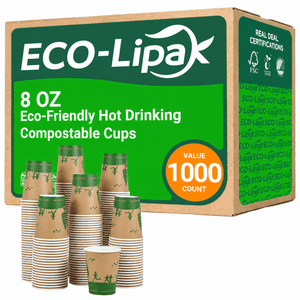
Quick Answer: Choose 8 oz natural kraft hot cups for a short drink, 12 oz for a standard coffee or tea menu, and 16 oz only when a larger beverage is actually offered. ECO-Lipak's wholesale natural kraft PLA-lined cups are listed in 1,000-count cartons for each size. Prices checked September 28, 2026, were $79.99 for 8 oz, $116.99 for 12 oz, and $119.99 for 16 oz, or about 8.0, 11.7, and 12.0 cents per cup before shipping and taxes. Test the cup with your real recipe and service time before placing a multi-carton order.
Key Takeaways
- The 8-, 12-, and 16-oz wholesale variants are separate 1,000-count cartons; a carton is not an assortment of sizes.
- Pick a cup by finished drink volume, milk or foam headroom, and customer handling, not just the menu's nominal ounce number.
- A one-size pilot can use smaller box variants from the related natural-color hot-cup range before a café commits to 1,000 of that size.
- These are PLA-lined paper cups. Confirm the exact item's compostability evidence and local collection route; do not infer a home-compostable or plastic-free outcome from a kraft appearance.
The three sizes on a real coffee menu
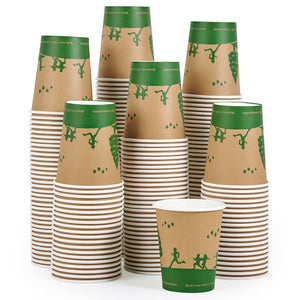
Natural kraft is a presentation choice, not a capacity cue. The same kraft-and-green visual language spans three sizes on the wholesale natural kraft hot-cup listing. An 8 oz cup can suit a short coffee or tea service; 12 oz is a practical starting point for many regular beverages; 16 oz is for drinks that genuinely need more volume. These are menu examples, not rigid recipe rules. A latte's foam can take space without adding much liquid, while a tea service may need room for the customer to add milk.
Pour the finished drink into a sample cup at its actual service temperature and observe the fill line, hand comfort, and carry path. If you sell takeout, test the filled cup with a separately verified lid. Do not assume a lid will fit merely because another listing uses “universal” in its title. Run a brief hold test with the actual beverage; an attractive cup on a product page is not a substitute for service testing.

What the 1,000-count carton prices mean
Prices below were checked September 28, 2026. They can change. Per-cup amounts are simply carton price divided by 1,000 and exclude shipping, tax, sleeves, lids, and drink ingredients.
| Natural kraft cup | Carton count | Listed price | Approx. cost per cup | Menu starting point |
|---|---|---|---|---|
| 8 oz | 1,000 | $79.99 | $0.080 | Short hot drink |
| 12 oz | 1,000 | $116.99 | $0.117 | Regular coffee or tea |
| 16 oz | 1,000 | $119.99 | $0.120 | Large-format drink |
The 16 oz cup is only about 0.3 cents more than 12 oz per cup at the checked prices. That does not mean a café should serve every 12 oz recipe in a 16 oz cup. A too-large vessel can make the beverage look underfilled and encourage unplanned ingredient use. Keep cup cost and recipe cost separate. If a 16 oz menu item sells poorly, its leftover carton has a larger impact than a small per-cup price difference.
Three ordering scenarios
Neighborhood café testing a new size
A café has solid 12 oz sales but wants to trial an 8 oz drink. Buying 1,000 of the new size immediately may tie up space. The related natural-color hot-cup range currently offers smaller box options for 8, 12, and 16 oz. Use a small pack to validate recipe, demand, and any lid fit; then compare the per-unit cost of wholesale cartons once the weekly count is known.
Conference coffee station serving 1,000 drinks
Suppose the forecast is 600 regular 12 oz drinks, 300 short 8 oz drinks, and 100 large 16 oz drinks. A wholesale carton of each size gives 3,000 cups, far beyond the forecast. It might still be acceptable if the venue has several upcoming events and dry storage, but it is not an efficient one-off order. Use smaller packs where available, or simplify the menu size mix before purchasing. Add a deliberate allowance for spills and extra orders rather than assuming exactly 1,000 guests means exactly 1,000 cups.
High-volume 12 oz beverage program
A venue sells 900 12 oz drinks per week. One 1,000-count carton gives only 100 cups of buffer, about 11% over the baseline. If delivery lead time or weekend peaks are uncertain, a second carton or an earlier reorder point may be justified. Record actual cup withdrawals, not just drinks sold: remakes, water service, staff use, and sampling can use the same size.

Line the cup choice up with the disposal route
The lining is part of the finished cup. A brown outer wall is not evidence that the used cup belongs in paper recycling or a home compost pile. The US EPA's foodservice guidance recommends certified commercially compostable ware only where an appropriate local program accepts the specific product type and collection is in place. Check the exact cup variant and your hauler's rules. If those conditions are not met, do not describe the service as a closed-loop composting program.
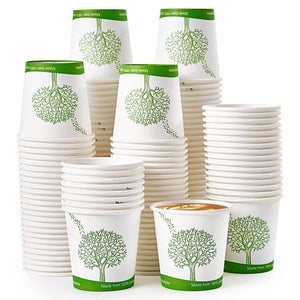
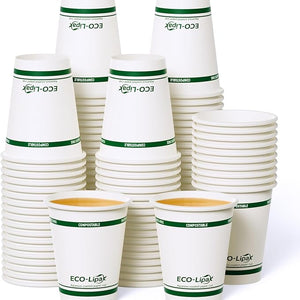
For a different visual presentation, compare the white PLA-lined hot-cup range. For a different lining and a hot/cold concept, review the PHA-lined cup range, but treat it as a separate product with its own size, price, and handling checks. The cup collection can help map a broader drinkware assortment; keep this article's specific carton math tied to the natural kraft variants above.
Frequently Asked Questions
Does one wholesale carton include all three cup sizes?
No. Each 8, 12, or 16 oz variant is listed as its own 1,000-count carton. Order the quantity of each size separately.
Is a 16 oz cup only three-tenths of a cent more than a 12 oz cup?
At the September 28 prices, yes: $0.11999 versus $0.11699 per cup. Recheck live prices before ordering, and include drink ingredients in menu costing.
Should a new café start with 1,000 of every size?
Usually not without demand data. Pilot the recipe and service with smaller packs when available, then scale the sizes that actually sell.
Can a PLA-lined cup go in ordinary paper recycling?
Not automatically. The lining affects processing, and acceptance is local. Ask the recycler about the exact cup, or the composter if seeking a compost route.
Do the cartons include matching lids?
Do not assume so. Confirm the selected cup listing and verify lid fit with a filled-cup test before a takeout launch.