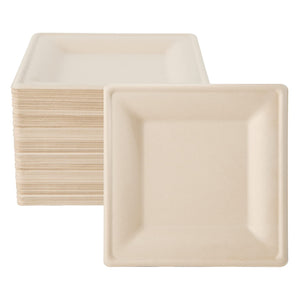
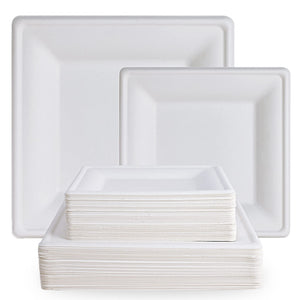
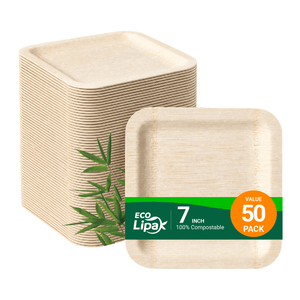
Quick Answer: The best square dinner plate material depends on whether you can wash and reuse plates, what food you serve, and how guests will dispose of or return them. Ceramic or glass usually makes sense for a permanent dining room; melamine can suit some reusable, non-microwave service; molded sugarcane fiber is a practical single-use option for events without a washing setup. For ECO-Lipak's square sugarcane plate range, choose the size and material only after testing a real plated meal.
Key Takeaways
- There is no universal “best” material. Reuse frequency, washing capacity and the menu matter more than square shape alone.
- For reusable plates, compare ceramic, stoneware and glass on weight, chips, storage and replacement cost. Follow the maker's microwave and dishwasher instructions.
- Do not microwave food or drinks on melamine tableware. Choose another material when reheating is part of service.
- For single-use events, trial the exact molded-fiber plate with a full portion, then verify whether local composting accepts that used item.
Decide What the Plate Must Do
The original question sounds simple: which material makes the best square dinner plate? It becomes easier when you describe the service. A square dessert plate carried ten steps across a quiet room has a different job from a dinner plate loaded at a buffet and balanced outdoors. The flat sides also change how food sits near the corners; a sauce that would stay in a deep round dish may move toward the edge of a shallow square plate.
Write down four things before comparing materials: the typical meal, whether guests are seated or walking, how plates are collected, and whether you have a reliable dishwashing setup. If plates are used repeatedly in one location, durable reusable dinnerware can spread its manufacturing impact over many meals. If the event is temporary and washing is not realistic, a suitable single-use plate may be the operational choice. Neither decision is settled by the word “eco-friendly” on a product label.

Material Comparison for Square Dinner Plates
| Material | Best-fit service | Buying check |
|---|---|---|
| Ceramic or stoneware | Repeated dine-in meals with washing and storage | Weight, chip resistance, dishwasher guidance and replacement availability |
| Glass | Reusable service where transparency suits the presentation | Breakage risk, stacking, weight and maker care guidance |
| Melamine | Reusable, lightweight non-microwave service | Manufacturer food-use guidance; never assume it is microwave safe |
| Molded sugarcane fiber | Single-use catering or temporary service | Actual food load, edge grip, stated specifications and local collection route |
| Bamboo-fiber disposable plate | Single-use presentation where the exact product suits the menu | Construction and food-contact instructions for that SKU; do not infer from the word bamboo |
Ceramic and stoneware are familiar for good reason: they feel stable on a table and can be washed repeatedly. They are also heavy to transport in large numbers and can chip. Glass can be striking, but the same practical questions about breakage and storage apply. Melamine may be useful when weight matters, but the FDA advises against microwaving foods and drinks on melamine tableware. For every reusable material, follow the exact manufacturer's care and food-contact instructions rather than assuming all plates in a category behave alike.
For a one-day catered meal, molded sugarcane-fiber square plates remove the need to transport dirty reusable dinnerware back to a kitchen. ECO-Lipak lists 8- and 10-inch sugarcane square plate options as well as smaller sizes. The 6-inch plate can suit dessert or a small side; a full meal usually needs a larger footprint. These are starting points, not a guarantee that every menu fits. If sauce or heavy food reaches the corner, test it there. A plate can look spacious from above while leaving too little usable room once utensils and side dishes are added.
Size, Strength and Temperature: Test the Meal
Set up one plate with the actual entree, sides and sauce. Lift it from the edges, carry it through the real service route and place it on a table. If the center flexes, the edges become hard to grip or food approaches the rim, try the next size or a different plate construction. A square plate's diagonal is longer than its side, so describing it only by a nominal inch size can also mislead a buyer comparing it with a round plate. Check the listed dimensions and test with your portion.
Temperature claims deserve a separate check. A hot serving plate, microwave reheating and oven use are different conditions. Use only the manufacturer's stated guidance for the exact SKU; do not infer heat tolerance from “paper,” “bamboo” or “compostable.” For food that will be reheated, confirm both plate and any lid or liner are approved for the intended equipment. In a buffet, watch how the plate performs over the normal time between plating and eating rather than conducting only a ten-second hand test.

Three Buying Situations
1. Everyday Home or Restaurant Dining
If plates return to the same kitchen and can be washed, start with a durable reusable option. Compare the cost of replacing chips, the load on shelving and how many plates fit in a dishwasher rack. For restaurants, buy enough matching replacements to maintain a consistent table setting. A lower initial price is not necessarily cheaper after repeated breakage or transport.
2. A Catered Outdoor Dinner
At a temporary venue without washing, trial a full plated meal on a molded-fiber square plate. Have a server walk with it across the actual ground and confirm guests can cut food comfortably. For a large catered order, ask whether a wholesale square sugarcane plate carton matches the event count, then add a small reserve for dropped plates and extra servings. Buying by case only makes sense when the size and food performance have already passed the trial.
3. A Modern Buffet With Mixed Courses
Guests may take both an entree and dessert. One plate size can lead to overserving dessert or crowding dinner. Consider a smaller square plate for sides and a larger one for mains; keep the materials and visual finish consistent if presentation matters. ECO-Lipak's square bamboo plate range is another product-specific option to compare, but trial it independently rather than assuming all plant-based plates feel or perform the same.
Material and End-of-Use Are Different Decisions
Choosing molded fiber does not automatically mean the used plate will be composted. Food-soiled serviceware acceptance varies by collector and facility. The EPA's food-service-ware guidance says reusables should be considered where practical and that compostable products should match the local collection system. Check the exact product's current claims and your hauler's accepted-material list. If your site has no route for that plate, do not place a compost label over a regular waste bin.
Material words can also hide important differences. “Bamboo plate” might describe different constructions, and “paper plate” does not tell you whether there is a coating. The ECO-Lipak tableware material guide gives a broader material overview; your purchasing test should still focus on the exact SKU, menu and local end-of-use route. That is how the “best” choice becomes a specific, repeatable decision rather than a slogan.
Frequently Asked Questions
What is the most durable square dinner plate material?
For repeat dine-in service, durable ceramic or stoneware may be appropriate if you can wash, store and replace pieces. Durability depends on the exact product and how it is handled; test samples for your operation.
Are sugarcane square plates suitable for a full dinner?
They can be, but plate size and the menu matter. Put the actual entree, sides and sauce on a sample, then carry and use it as guests will. For a full meal, compare larger listed sizes.
Can I microwave a melamine square plate?
No. The FDA advises against heating food or drinks on melamine-based tableware in a microwave. Use a plate specifically approved for reheating instead.
Are all bamboo square plates the same?
No. “Bamboo” can describe different constructions. Read the food-use, care and temperature guidance for the particular plate you intend to buy.
Will a compostable square plate be accepted in my compost bin?
Not necessarily. Ask your local composting facility or hauler whether it accepts that exact food-soiled serviceware before planning an organics collection station.