Quick Answer: The best heavy-duty disposable cutlery depends on the meal, not a single material ranking. CPLA is a practical option when you want a familiar molded utensil for hot food; bamboo and birchwood offer an uncoated wood feel but should be tested for the exact fork, knife and spoon task. Before buying for an event, sample the utensil on the toughest item on your menu and check the pack's actual available pieces or sets.
Key Takeaways
- Choose by the food job: a fork for dense pasta, a spoon for soup, or a knife for a firm protein.
- "Heavy-duty" has no universal performance rating across listings. Do a short, repeatable service test.
- Do not confuse individual utensil pieces with complete fork-knife-spoon sets when counting guests.
- Compostable is not a disposal instruction by itself. Confirm the exact item and local facility rules.
Start with your menu, not a best-of list
The older version of this guide treated durability as a brand leaderboard and gave precise heat and composting timelines without a defensible test method. That is not how a caterer buys flatware. A spoon that feels sturdy in a dry hand can still be awkward in soup; a fork that handles salad may bend at the neck when guests twist it into dense pasta. The useful question is: Which utensil completes our hardest serving task comfortably?
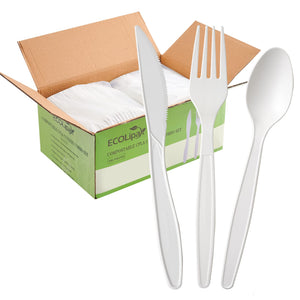
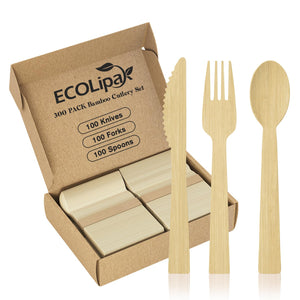
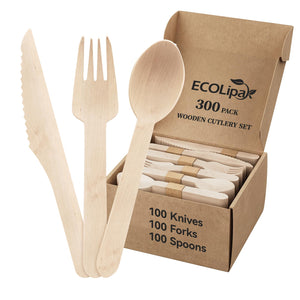
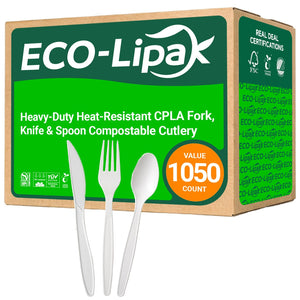
ECO-Lipak currently offers white CPLA cutlery, bamboo cutlery and birchwood cutlery. Those pages have different pack formats and availability by variant. They are not interchangeable just because each is called disposable. CPLA is a molded, plant-derived polymer; bamboo and birchwood are fiber/wood utensils. The surface feel, rigidity and how a guest handles the utensil can be noticeably different.
For a fast shortlist, browse the compostable cutlery collection, then open the exact product page and variant. If you need a basic primer on materials and certification language, consult the material guide before writing procurement claims.

A menu-first comparison
| Material | What to test first | Potential service fit | Buying caution |
|---|---|---|---|
| CPLA | Fork neck, spoon bowl and knife edge on warm food | Counter service, catered lunch, takeout | Check exact heat guidance and accepted composting route for the SKU. |
| Bamboo | Fork tip and knife performance on the actual menu | Natural-look events, salads, finger-food stations | Check whether the chosen fork or set variant is in stock. |
| Birchwood | Mouthfeel, splinter finish and cutting task | Picnics, dessert, rustic table settings | Some set variants may be unavailable even when single pieces are sold. |
This table is a testing plan, not a laboratory strength score. The plastic-like appearance of CPLA should not be taken as a guarantee that it tolerates every hot meal. Equally, a natural wood appearance does not prove that a knife will cut steak. Cutlery is a small part of the meal, but failure is conspicuous; a five-minute test can prevent a box of unusable forks at an event.
The five-minute loaded-meal test
Order or borrow a small sample of the exact variant. Plate the meal as a guest would receive it, at the normal serving temperature. Use three utensils from different positions in the package, not one unusually good piece from the top. Perform these steps with each candidate:
- Fork: lift the heaviest typical bite and twist into the dense item on the plate. Note any neck bending or uncomfortable tines.
- Knife: cut the firmest food you actually serve, using a disposable plate like the one planned for service. Watch the edge, handle flex and plate damage.
- Spoon: carry a normal spoonful of soup, chili or dessert from the bowl to mouth height without spills.
- Hold: keep the utensil in hand for a few minutes. Finish and mouthfeel matter during a full meal, not just the first bite.
- End of service: ask the hauler which of these exact materials it accepts, and design a bin sign around the answer.
If no candidate passes the knife test for a firm entree, change the menu cut, pre-slice the protein or use a reusable service option. Calling a weak disposable knife "heavy-duty" in the order sheet does not make it more functional. The same logic applies to a hot broth station: test a spoon in the actual cup or bowl, not on a dry table.

Count pieces and complete sets differently
A complete set normally provides a fork, knife and spoon, but an individual-piece pack may hold only forks, only spoons or only knives. On the current CPLA product page, the listed options include 350 sets per box, 1,050 sets per carton, and separate fork or spoon packs. The wholesale CPLA listing also offers a fork carton and a set carton. Use the variant label itself as the source of truth; a headline containing "1,050" does not tell you whether that means sets or individual utensils.
Suppose a 120-guest lunch serves pasta and a dessert cup. If everyone needs a fork and only 60 people choose spoonable dessert, the baseline is 120 forks plus 60 spoons, before a reserve. Buying 120 complete sets would also bring 120 knives that the menu may never use. On the other hand, for a plated dinner with a firm entree, setting 120 full sets may make service smoother than managing separate piece bins. Compare the cost and waste of the actual configuration, not a vague "cost per utensil" claim.
When a variant shows unavailable, do not link a buyer to it as though it can ship. At the time this guide was updated, the bamboo product had available set and spoon options while the bamboo fork-only variants were not available. The wooden product showed available individual utensils but not its set variants. Stock can change, so check the live selector immediately before ordering. For a larger event, ask about lead time through the bulk inquiry page.
Three situations, three sensible choices
Hot lunch counter
A hot pasta or grain bowl station benefits from a fork with predictable handling. Test CPLA against the actual food and the service temperature. If the fork works but the spoon is unnecessary, buy fork-only quantities rather than full sets. Place spare forks where staff can reach them without a long walk.
Outdoor wedding buffet
The table may be part of the visual brief. Natural bamboo or birchwood can suit that setting, but do not decide by appearance alone. Run the knife test on the plated entree, then test mouthfeel through the full meal. If one material works for appetizers and another for dinner, it is acceptable to split the service by course as long as cleanup sorting stays clear.
Takeout with unpredictable menus
A delivery operation serving soup, salads and warm entrees may prefer complete sets for simplicity, but a fork-only or spoon-only packet can be more efficient when the order system knows the item. Check whether customers actually request cutlery. Ask at checkout where possible and keep extras for genuine need, rather than putting a set into every bag by default.
Keep disposal claims precise
Do not put a blanket "decomposes in 90 days" promise on a purchasing sheet. Composting conditions vary, and an item-level certification is not the same as acceptance by every local facility. The EPA's foodservice guidance recommends buying commercially compostable serviceware where an accepting local program and collection service exist. Ask for certification evidence tied to the exact SKU and verify the receiving facility's rules.
The bottom line: buy a sample for performance, count the needed fork/knife/spoon mix, and set disposal instructions based on the actual facility. This is more reliable than ranking materials from their names alone.
Frequently Asked Questions
Is CPLA cutlery always stronger than wood or bamboo?
No universal ranking applies. Design, thickness and the food task vary. Test the exact fork, knife and spoon on your menu.
What does "heavy-duty" mean on a cutlery listing?
It is a marketing description unless accompanied by a specific test standard or measurable performance claim. Use a real meal test to decide whether it is heavy-duty enough for you.
Can CPLA cutlery go in a home compost bin?
Do not assume that. Confirm item-level certification and check whether the product requires a commercial composting program accepted locally.
Are 1,050 pieces the same as 1,050 complete sets?
No. Read the selected variant carefully. A set and a piece are different units, and the quantity changes your per-guest calculation.
Should I buy a set for every guest?
Only if the menu and service model require all three utensils. If guests need only forks or spoons, individual-piece packs may be more efficient.