Quick Answer: The best disposable bowls for hot soup are sized for the actual portion, remain stable when full, and pass a hot-fill test with your real broth. Molded sugarcane bowls are a practical option, but “leak-proof” should never be assumed from a product photo. Fill one bowl, wait ten minutes, carry it, and inspect the base and rim before ordering event quantities.
Key Takeaways
- Choose capacity from the served portion plus headspace, not from appetite guesses.
- Test thin broth and oily soup because they challenge a bowl differently from chili or stew.
- A broad rim and stable base matter when guests stand, walk, or eat from their laps.
- Use “leak-resistant” as a conditional performance description unless testing supports a stronger claim.
- Order by serving count, reserve, and case quantity; do not use the ounce label as the inventory plan.
People searching for the best disposable bowls for hot soup usually want a simple answer: which bowl will hold broth without softening, leaking, or becoming awkward to carry? Material matters, but so do fill height, food composition, hold time, and handling. This guide turns those variables into a short buyer’s test instead of relying on a vague promise.
Start With Soup Portion, Not Bowl Size
A bowl filled to the rim is hard to carry even when the material performs well. Leave headspace for steam, toppings, a spoon, and normal movement. Measure the serving with the same ladle staff will use. If a “12 oz serving” regularly receives an extra half-ladle, test the next size rather than expecting the rim to solve the problem.
| Bowl Capacity | Useful Starting Role | Test Portion | Common Risk |
|---|---|---|---|
| 8 oz | Tasting portion, soup side, kids' serving | 6–7 oz | Too small for toppings or a full meal |
| 12 oz | Cup-of-soup service, light lunch side | 9–10 oz | Overfill when staff use a large ladle |
| 16 oz | Standard entree soup or chili | 12–14 oz | Carry comfort when filled too high |
| 20 oz | Hearty soup with noodles or toppings | 16–18 oz | Weight and slosh during standing service |
| 32 oz | Large meal, family-style or takeout portion | 24–28 oz | Needs a deliberate transport plan |
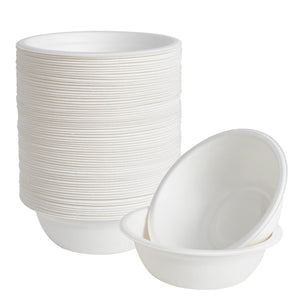
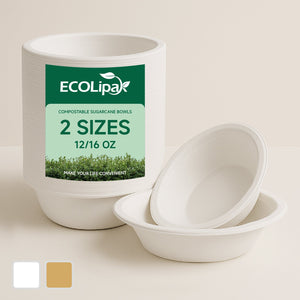
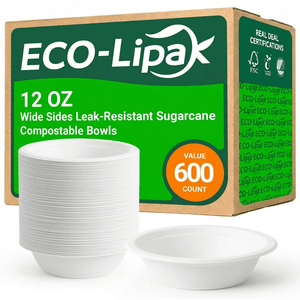
The ECO-Lipak molded sugarcane bowl range includes 12, 16, 20, and 32 oz variants in white or natural, depending on size and pack. An additional 8 oz white sugarcane bowl covers smaller portions. Product availability and configurations can change, so confirm the live variant before purchasing.
The 10-Minute Hot-Fill Test
This test does not require laboratory equipment. It does require the actual soup, bowl, fill quantity, and service conditions.
- Place a dry bowl on a fresh white absorbent sheet and photograph the starting condition.
- Measure the soup temperature used at service and follow the bowl’s product instructions.
- Fill to the planned portion, leaving the headspace staff will use.
- Wait ten minutes, the typical period in which a bowl may sit before pickup or seating.
- Lift from the sides, carry it for 30 seconds, set it down, and inspect the base, wall, and rim.
- Repeat with the thinnest broth and the oiliest soup on the menu, then extend the hold time if your operation needs it.

Look for more than a visible drip. A damp ring on the sheet, a soft base, rim distortion, or a sidewall that becomes hard to grip can all disrupt service. Record the soup, portion, starting temperature, hold time, and result. “Passed” should mean the bowl stayed dry enough, rigid enough, and comfortable enough for the way your guests will use it.
Why “Leak-Proof” Needs Context
No disposable bowl performs independently of time, temperature, and food. A thick chowder held for ten minutes is not the same test as hot, oily broth carried for 30 minutes. Even when a product listing uses “leak-proof,” buyers should interpret that claim within the stated use instructions and verify their hardest menu item.
For customer-facing copy, “leak-resistant in our tested service conditions” is more useful than a blanket promise. It tells staff and guests what was actually checked. It also follows the broader principle in the FTC Green Guides: product claims should be specific and supported rather than broad and unqualified.
Three Event Scenarios
1. Seated fundraiser with plated soup
A 12 or 16 oz bowl can work when servers carry bowls on trays and guests eat at tables. Test the bowl on the same tray liner, with the same walk from kitchen to table. The greatest risk may be a sliding or overfilled bowl, not material leakage.
2. Standing chili station
A 16 or 20 oz bowl gives room for chili, cheese, onions, and a spoon while leaving a grip area at the rim. Run the test with toppings added because the total weight matters. Place waste and collection signs where guests finish eating so full bowls are not carried across the venue.
3. Catering pickup or takeout
Transport adds vibration, stacking, and time. A bowl that works at a buffet may still need a verified lid or a separate carrier for takeout. The variants in the referenced bowl listing do not state that lids are included, so do not assume lid compatibility. Test the exact bowl-and-lid combination as a unit before selling delivery orders.

Order the Right Quantity
Use servings, not guests, as the base. Some events offer soup as one option, while others serve it to everyone. A workable formula is:
Bowls required = expected soup servings × bowls per serving × (1 + reserve rate).
| Event | Expected Soup Servings | Reserve | Bowls to Cover |
|---|---|---|---|
| 100-person seated dinner | 100 | 10% | 110 |
| 150-person buffet, 70% choose soup | 105 | 15% | 121 |
| 300 takeout orders, soup on 40% | 120 | 15% | 138 |
Round up to the available box or carton. The 12 oz options include 150-, 600-, and 1,800-count configurations in the current listing; 16 and 20 oz options include 150- and 900-count configurations; the natural 32 oz option is listed in 70 or 560. A one-time event may favor the smaller pack even when a carton has a lower unit cost. A weekly soup program can justify the carton if storage stays clean and dry.
Check Material Claims and Disposal Access
The referenced bowls are molded from sugarcane fiber and listed as BPI certified, PFAS-free, and BPA-free. Certification does not mean every local compost program accepts every item. The U.S. EPA notes that compost feedstocks vary by facility. Ask the receiving program whether it accepts certified foodservice ware and how much food residue is allowed, then give guests instructions that match that route.
Do not place food-soiled molded-fiber bowls in paper recycling unless the local recycler explicitly accepts them. If composting is unavailable, describe the product material accurately without promising a disposal outcome that the local system cannot deliver.
A Buyer’s Final Checklist
- Measured serving volume and headspace
- Hardest soup tested: thin, oily, hot, or heavy
- Ten-minute hold and carry test passed
- Longer hold tested when takeout requires it
- Exact lid fit verified if a lid is needed
- Pack count covers servings plus reserve
- Dry storage space confirmed
- Local disposal instructions confirmed
Frequently Asked Questions
What is the best disposable bowl for hot soup?
The best bowl is the one that matches your portion, remains stable when full, and passes a timed test with your hottest and thinnest soup. Molded sugarcane is a strong candidate, but real-menu testing is still necessary.
Are sugarcane bowls completely leak-proof?
Performance depends on the product, food, temperature, and hold time. Treat them as leak-resistant within tested conditions instead of assuming unlimited leak protection.
What size disposable bowl works for an entree soup?
A 16 oz bowl is a common starting point; 20 oz gives more room for noodles, chili toppings, or a hearty portion. Measure the actual ladle serving and leave headspace.
Can disposable soup bowls go in the microwave?
Only when the specific product instructions say they can. Follow the stated limits, remove any incompatible accessories, and avoid overheating or reheating an empty bowl.
How many soup bowls should I order for an event?
Multiply expected soup servings by bowls per serving, add a 10% to 15% starting reserve, and round up to the available pack. Adjust the reserve using attendance certainty and service history.