Quick Answer: For palm leaf bowls, good receiving and storage starts with a dry, intact delivery, the correct size and count, and a check of individual rims and bases before service. Natural grain can vary between bowls; cracks, loose fibers, damp packaging, or an unusual smell deserve a separate hold-and-review step. Keep unused stock protected in clean, dry storage, and test the actual menu in a sample bowl before committing the delivery to an event.
Key Takeaways
- Check the carton and the bowls separately. An undamaged outer box does not replace a product check.
- Color variation alone cannot establish whether a bowl is acceptable or defective.
- A 5-inch or 6.3-inch diameter is not a fluid-capacity rating.
- Separate reserve stock, service stock, and anything awaiting supplier review.
- Keep the size, pack count, delivery date, and supplier details together so a reorder or query is straightforward.
The delivery arrives while someone is setting a buffet and someone else needs the prep counter. It is tempting to open the carton, glance at the top bowl, and move everything onto a shelf. A short receiving routine is easier than discovering a count mismatch when the first guests arrive.
This checklist is for a caterer, cafe, or event team receiving palm leaf bowls. It is a practical workflow, not a laboratory inspection standard or a substitute for your supplier's instructions.
Start With the Order, Not the Grain
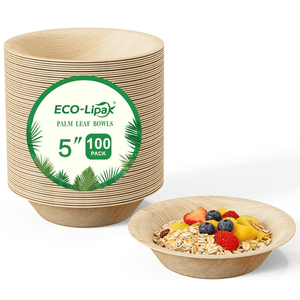
Put the order confirmation beside the delivery and match the selected variant. ECO-Lipak's round palm leaf bowls list 5-inch and 6.3-inch options. In the current retail listing, the 5-inch box contains 100 bowls and the 6.3-inch box contains 50; both sizes also have 300-piece carton variants. These are different quantities, even though they share one product page.
For example, an order of two 6.3-inch boxes means 100 bowls, not 200. Record the variant and quantity before opening multiple packs. For a different wholesale listing, check that listing's own count rather than carrying over the retail pack size.
The palm leaf tableware collection helps when you need matching pieces, but a collection name is not a specification sheet. Confirm the exact item, size, and quantity on the selected product.

What to Check Before Releasing Stock
| Checkpoint | What to look for | Next action |
|---|---|---|
| Outer carton and inner protection | Wet areas, crushing, punctures, or an opened protective sleeve | Photograph concerns and separate affected stock for supplier review. |
| Size and count | Variant label, number of packs, and pieces per pack | Resolve a mismatch before assigning the delivery to an event. |
| Rim and interior | Splits, sharp edges, loose fibers, or material lifting away | Hold the affected bowl; do not try to trim or repair it for service. |
| Base | A bowl that rocks noticeably on a flat surface | Set it aside and check whether the issue affects more of the pack. |
| Surface and odor | Unexplained residue, fuzzy growth, moisture, or an unusual smell | Do not use uncertain stock. Ask the supplier to review it. |
| Menu trial | Fit, carrying stability, and condition during the intended serving period | Adjust the portion or choose another bowl if the trial is unsuitable. |
Check more than the first bowl in an opened stack. If something looks wrong, pause use of the affected pack and ask the supplier how broadly to inspect the delivery. A quick sample cannot certify that every bowl is acceptable. Staff should still notice problems as they separate bowls for service.
Natural Variation Is Not the Same as a Defect
The product listing identifies fallen areca palm leaves as the material. Unlike a printed surface, the visible grain does not repeat perfectly from piece to piece. Subtle differences in tone and grain direction are therefore something to expect, not an automatic reason to reject a carton.
But “natural” should not become a reason to overlook a concern. A darker line may follow the grain; a split can also run along it. Look at the physical condition, not just the color. If a mark cannot be confidently explained, photograph the whole bowl and a close view, keep the packaging details, and ask the supplier.
A photograph of natural grain does not verify food-contact compliance. For documentation questions, start with the ECO-Lipak resource library and request information for the exact product. Material appearance and supporting documents answer different questions.
Use a Real Portion to Check the Bowl
The listed diameter tells you about size across the bowl, not how many ounces of food it comfortably serves. The depth, rim, food shape, and amount of sauce all affect the result. Do not convert inches into a guessed capacity.
Try the intended portion with the actual serving spoon. Set the bowl down, lift it as a guest would, and check that there is a sensible margin below the rim. For a wet dish, observe the bowl through your expected serving period under the intended conditions. This is a menu-fit trial, not proof of a universal leak or heat rating. Keep food-safety controls separate and follow the product's specific use instructions.

Three Deliveries, Three Practical Decisions
A Cafe Receiving Its First Box
A cafe wants a bowl for a grain-salad side. Start with the listed box variant, check the delivery, and trial that portion before ordering a larger carton. Keep a note of the successful size and serving spoon. If the portion crowds the rim, changing the bowl is more useful than relying on the product photograph.
A Caterer Preparing Several Events
A caterer receives stock for three bookings. Keep the protected reserve together and allocate counts to each event in a simple stock record. Open only what is needed for preparation. If one event changes its menu, the unopened reserve remains easy to count and reassign; the team's stock total does not depend on remembering several half-used stacks.
An Outdoor Venue With Limited Back-of-House Space
An outdoor venue needs a small working supply close to service and the rest protected indoors. Put the working stack in a clean, stable location away from splash and direct exposure. Refill it from the reserve as needed. For buffet food, the FDA's small-batch serving advice recommends replacing serving dishes with fresh ones instead of topping up old food. Do not confuse replenishing clean bowls with adding food to a used bowl.
Make Storage Easy to Maintain
Keep bowls in their protective packaging in a clean, dry location, away from leaks, cleaning chemicals, and areas where cartons can be splashed. Support the stock so it cannot be crushed or knocked over. Keep the receiving date visible and use older acceptable stock before newer deliveries.
Do not invent a shelf life from the material name. Follow the supplier's storage and shelf-life instructions, and recheck any stock exposed to a storage problem. Washing or air-drying questionable stock is not a substitute for resolving contamination or moisture concerns.
Finally, confirm the cleanup route before choosing a disposal claim for the event. The EPA's food-service guidance treats collection systems and local acceptance as essential parts of a compostable-foodware decision. The bowl, its sleeve, and its shipping carton should not automatically go into the same bin.
FAQ
Are darker marks on a palm leaf bowl always a defect?
No. Natural grain can vary in color, but color alone cannot clear a bowl for use. Hold bowls with unexplained residue, growth, splits, loose fibers, or other concerns and ask the supplier to review them.
Does a 6.3-inch bowl hold a specific number of ounces?
Not from diameter alone. Ask for a stated capacity if you need one, and test your actual portion with carrying space below the rim.
Should I wash new disposable palm leaf bowls?
Follow the supplier's preparation instructions. Do not wash questionable bowls to make a delivery usable; separate them and resolve the concern first.
What should I do with a damp carton?
Hold the affected stock, photograph the carton and protective packaging, and contact the supplier. Do not assume the contents are acceptable because the outside later dries.
How long can I store unused palm leaf bowls?
Use the supplier's stated storage and shelf-life guidance. Without a verified duration for the exact item, keep stock protected and dry, rotate deliveries, and inspect it again before service.