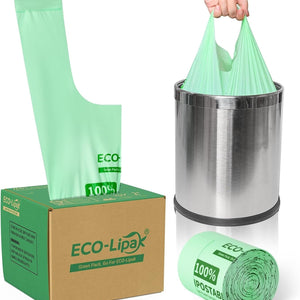
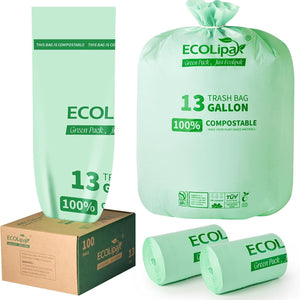
Quick Answer: Choose a 2.6-gallon compostable trash bag with handles for a small countertop bin, light daily scraps, or compact cleanup; choose 13 gallons for a compatible kitchen bin and larger routine loads. Gallon labels are only a starting point. Measure the bin opening and depth, test the handle reach, and calculate box quantities from actual change frequency before ordering.
Key Takeaways
- Bin fit depends on shape, rim size, depth, and handle reach, not gallon capacity alone.
- The current ECO-Lipak listing offers 2.6 gallon / 50 per box and 13 gallon / 50 or 100 per box.
- Built-in handles simplify closing and carrying, but they should not be stretched to compensate for an undersized liner.
- Match the bag to waste weight, moisture, sharp edges, and change frequency.
- Certification does not guarantee that a local compost program accepts bagged household waste.
A countertop liner and a tall kitchen liner solve different problems. The smaller bag may be changed frequently before odor or moisture builds. The larger bag may stay in service longer and carry more weight. Buying one size for every bin often creates loose folds in the small bin and overstretched handles in the large one.
The simplest routine is to fit first, load-test second, and buy the box count third.
Compare the Current Sizes and Counts
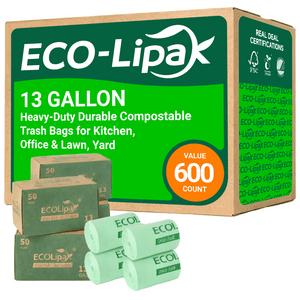
The ECO-Lipak compostable trash bags with handles currently list three variants:
| Variant | Likely starting point | What to test | Quantity question |
|---|---|---|---|
| 2.6 gallon / 50 per box | Countertop or compact household bin | Rim fit, depth, light wet scraps, handle reach | How many changes occur per day? |
| 13 gallon / 50 per box | Standard kitchen-bin trial or lower usage | Full-bin lift, knot security, bottom clearance | Will 50 changes cover the review period? |
| 13 gallon / 100 per box | Stable fit with higher routine usage | Storage conditions and rotation | Does the larger box reduce reorder risk? |
These are use-case starting points, not universal bin matches. Two bins marketed with the same gallon capacity can have different rectangular or round openings. Compare the bag's listed dimensions when available and run a physical fit test before committing to volume.
The broader trash bag collection includes other capacities and carton formats when the handled-bag variants do not fit the job.

Measure the Bin Before Opening the Box
- Measure the rim. Record width and depth for a rectangular bin or diameter for a round bin.
- Measure internal depth. The liner should reach the bottom without hanging under tension.
- Allow for the rim and knot. The handles need enough material above the rim to close comfortably.
- Test the lid. A thick fold of extra film can interfere with a tight lid or pedal mechanism.
- Remove a typical load. Lift it out, tie the handles, and carry it over the real route to the collection point.
An undersized bag may appear to fit when empty but pull away from the rim as waste accumulates. An oversized liner may bunch under the lid, waste material, and make it harder to tell when the bin is full.
Match the Bag to the Waste
Use the 2.6-gallon size for small, frequently emptied loads. Food prep scraps, coffee grounds, or pet cleanup can be heavy relative to their volume, so do not wait for the bag to look full if the handles or bottom are under strain.
Use 13 gallons for a compatible kitchen bin and ordinary household waste that passes a realistic load test. Keep sharp packaging corners, hot materials, free liquid, and unusually heavy contents out unless the exact product instructions allow them. A sealed bottom helps containment, but it is not a promise against every puncture or liquid condition.
Turn Change Frequency Into Box Quantity
Track actual bag changes for one or two weeks, then use:
Bags needed = ceiling of [changes per week x weeks planned x (1 + chosen reserve rate)].
Round the result up to the selected box count. A 10% or 15% reserve can illustrate the method, but the correct rate depends on demand variation and reorder lead time.
- Countertop bin, twice daily: 14 changes per week x 4 weeks x 1.10 = 61.6, rounded to 62 bags. Two 50-count boxes cover the plan.
- Kitchen bin, five times weekly: 5 x 8 weeks x 1.20 = 48 bags. One 50-count box covers the plan.
- Busy shared kitchen, twice daily: 14 x 4 weeks x 1.15 = 64.4, rounded to 65. One 100-count box covers the period and leaves 35.
Track the projected closing balance. A larger box is useful when the fit is proven and stock rotates; it is not automatically better when storage is warm, humid, or exposed to sunlight.

Four Everyday Scenarios
Countertop Food-Scrap Bin
Use a small liner only when it fits the rim and reaches the base. Change it frequently enough for the household's moisture and odor pattern. Confirm whether the destination program accepts both the liner and its contents.
Standard Kitchen Bin
Trial the 13-gallon bag with a normal three-day or one-week load pattern, whichever reflects the home. Watch the rim while the bag fills and do not rely on handles to hold an overloaded liner in place.
Pet Mess Cleanup
Choose the smallest practical liner for the cleanup task, tie it promptly, and follow local rules for pet waste. Many composting programs do not accept pet waste, even when a bag carries a compostability certification.
Office Break Room
Measure the actual bin and review what employees discard. Food packaging, utensils, and mixed trash can make a compost collection stream unsuitable. Use clear signage only after the hauler confirms accepted materials.
Storage and Disposal Matter
Store unopened rolls in a cool, dry place away from direct sunlight and heat. The article on compostable bag storage mistakes explains why rotation and storage conditions belong in the purchasing plan.
The FTC Green Guides summary explains that compostable claims need appropriate evidence and qualifications. The BPI FAQ provides certification context. Verify the exact item's documents through the ECO-Lipak resource library and ask the local facility whether it accepts the bag and the intended contents.
FAQ
What bin fits a 2.6-gallon trash bag?
A compact countertop or small household bin is the likely starting point, but rim shape and depth vary. Measure and test the exact bin before buying multiple boxes.
Do 13-gallon bags fit every kitchen trash can?
No. A 13-gallon label does not guarantee fit across round, rectangular, slim, or lidded bins. Check dimensions and handle reach.
Are trash bags with handles easier to close?
Built-in handles provide a direct tying and carrying point. They still need enough material above the rim and should not be used to compensate for an overloaded bag.
Can compostable bags hold wet food scraps?
Use the exact product instructions and run a short, realistic test. Drain free liquid, avoid hot contents, and change heavy wet loads before the film is strained.
Can pet waste in a compostable bag go into compost?
Often not. Acceptance depends on the local program, and many facilities exclude pet waste. Follow local sanitation and disposal rules.
Should I buy 50 or 100 bags?
Start with 50 when fit or usage is still being tested. Choose 100 when the fit is proven, change frequency is stable, and storage conditions are appropriate.