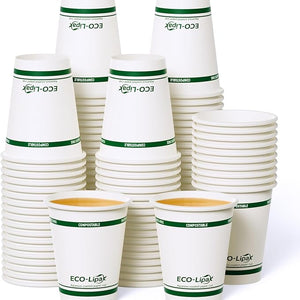
Quick Answer: A PHA-lined paper cup and a PLA-lined paper cup can both serve a beverage, but the liner name alone does not tell you which cup to buy or where it can go after use. Choose by hot-and-cold performance, available size and case count, lid compatibility, verified certification for the exact item, and the acceptance rules of your local collection program. For a mixed menu, test the actual 8-, 12-, or 16-oz cup with your drinks before committing to cartons.
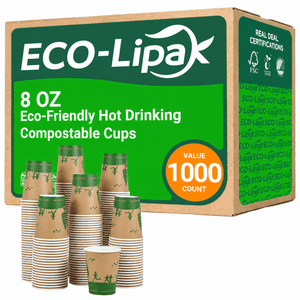
Paper cups need a barrier to hold liquid. PHA and PLA are two plant-derived polymer options used as liners, but neither abbreviation is a shortcut for "compost anywhere." ECO-Lipak's PHA-lined hot-and-cold paper cups come in 8, 12, and 16 oz. The store also carries PLA-lined kraft cups in 1,000-count cartons. Both can be practical, but they answer different purchasing questions.
Key Takeaways
- Read the full product construction and certification evidence; "paper" does not mean unlined.
- ECO-Lipak's PHA cup packs currently list 8 oz/400, 12 oz/270, and 16 oz/240 per box.
- Its wholesale natural kraft PLA-lined option lists 1,000 cups per carton in 8, 12, or 16 oz.
- A liner material does not guarantee that a municipal program accepts the finished, printed cup.
- Lids are a separate purchasing and disposal decision; confirm diameter and fit with a physical sample.
PHA vs PLA: A Buyer's Comparison
| Question | PHA-lined ECO-Lipak cup | PLA-lined ECO-Lipak cup | Buyer action |
|---|---|---|---|
| What is being purchased? | White paper cup with a PHA barrier | Natural kraft paper cup with a PLA barrier | Check the exact item and size, not only the liner acronym |
| Current pack sizes | 8 oz/400; 12 oz/270; 16 oz/240 | 8, 12, or 16 oz; 1,000 per carton | Compare total weekly use and storage capacity |
| Drink application | Listed for hot and cold beverages | Listed for coffee and refreshments | Test fill temperature, holding time, and condensation |
| Lid decision | No lid included in the listed pack | No lid included in the wholesale carton | Request a fit sample; do not assume universal fit |
| End-of-life decision | Verify exact cup certification and local acceptance | Verify exact cup certification and local acceptance | Ask the hauler about the finished cup, not just the polymer |
This comparison is not a laboratory verdict on one polymer. Cup wall thickness, the coating formulation, seam construction, fill temperature, and the drink itself all matter. It is also not proof that either cup will biodegrade in the ocean or in an ordinary landfill. Procurement teams should ask for evidence for the finished cup and the intended disposal route rather than repeating broad claims from packaging.

Three Buying Scenarios
1. A cafe with coffee and iced tea on one counter
A single cup family may simplify storage, but only if it handles both drinks well. Start with the 12-oz PHA-lined cup, fill one with the hottest normal coffee and another with iced tea, and let both sit for the average pickup time. Check for seepage at the seam, wet exterior feel, and whether the cup fits the counter's current carrier. ECO-Lipak's PHA 12-oz option is listed as 270 per box, so calculate cartons against a week of actual sales rather than assuming a round 250 or 300.
2. An office ordering for recurring meetings
Offices often want a lid with every cup. The 12-oz natural cup and CPLA lid bundle may be operationally simpler than buying cups and lids separately. Its current box lists 240 cups with 200 lids, while the carton lists 1,000 cups and 1,000 lids. That 40-lid difference in the smaller pack is easy to miss when every attendee expects a covered drink. Count hot drinks, cold drinks, and lid take-rate separately before choosing a bundle.
3. A venue buying thousands of cups
For an event expecting sustained volume, the 1,000-count kraft PLA-lined cup carton can reduce purchase-order lines. It does not automatically reduce waste: over-ordering, mismatched lids, and no accepted collection route can erase the operational benefit. Start with menu size mix, expected attendance, peak service rate, and existing stock, then order each capacity deliberately.

Certification, Claims, and the Green Bin
The FTC's compostable-claims guidance in 16 CFR 260.7 calls for evidence behind compostable claims and qualification when suitable facilities are not widely available. That applies to a finished paper cup, including liner, inks, adhesives, and any other components, not merely to a resin in isolation. Check the specific product in the BPI certified-product catalog when certification is important to your contract.
Even a certified cup needs a place to go. The US EPA's food-serviceware guidance recommends buying commercially compostable foodware only if an appropriate local program exists, accepts the type being purchased, and can collect it. If your office or cafe has no such route, do not label the cup collection bin "compost" merely because the liner is bio-based. Ask the hauler which cups, lids, and beverage residues are accepted, then write signage for those exact rules.
Lid Fit Is a Separate Specification
The PHA cup product page does not list a lid in the box. The existence of a nominal cup size does not tell you rim diameter or secure fit. A 12-oz cup and a 12-oz lid from different ranges may not mate. Bring a sample to the counter, press the lid around the full rim, and do a controlled carry test with a normal drink. ECO-Lipak also offers a white cup-and-CPLA-lid range, but this is an alternative complete system, not proof that its lids fit every PHA cup.
What to Ask Before Ordering
Request the current product specification and certification for the exact SKU; confirm that the cup is suitable for your hot and cold menu; test a full cup for at least the usual hold time; check the final lid combination; compare per-cup price including freight and spoilage; and get written confirmation from your collection provider. Then choose the pack size that matches a real restock cycle. The current PHA-lined cup listing is the right place to verify today's available variants and quantities.
Frequently Asked Questions
Is a PHA-lined paper cup automatically better than a PLA-lined cup?
No. Compare the exact finished cups for your drink, pack size, price, evidence, and local end-of-life route. The liner acronym alone is not a complete purchasing decision.
Can ECO-Lipak's PHA cups hold both hot and cold drinks?
The current product listing describes them for both. Test your own fill temperatures and waiting time before standardizing a service setup.
Do the PHA cup packs include lids?
The listed PHA variants are cup counts only. Treat lids as a separate specification unless a particular product page explicitly includes them.
Can I put a PHA or PLA cup in a home compost bin?
Do not assume so. Check the exact item's certification and your local program's rules. Commercial compostability does not automatically mean home compostability.
What size should a cafe buy first?
Begin with the drink size ordered most often, then test the 8-, 12-, and 16-oz options against your menu and cup-holder or lid setup. Order the first box before committing to bulk cartons.