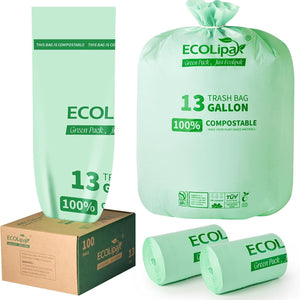
Quick Answer: The best compostable trash bag is the one that fits the bin, holds the actual waste without chronic overloading, has a credible certification for the intended composting route, and is accepted by the local organics program. Start with 13 gallons for common tall kitchen bins, 33 gallons for larger indoor or light commercial stations, and 55 gallons for high-capacity containers. Measure the bin before ordering because gallon labels are only a starting point.
A search for the “best” bag often produces a list of vague superlatives. A useful buying guide should do something else: help you eliminate the wrong size, the wrong closure, and the wrong disposal claim. ECO-Lipak's 13, 33, and 55 gallon compostable trash bags are pale mint, flat-top liners available in household boxes and larger cartons. This guide shows how to compare them without promising that any bag will disappear in a landfill or solve a poorly matched waste system.
Key Takeaways
- Measure bin width, depth or diameter, and height; do not buy by gallon label alone.
- Match bag size to the heaviest and wettest waste you expect, not the average empty-bin appearance.
- Flat-top bags need enough extra material to fold over the rim and tie or secure after removal.
- Look for current third-party certification and confirm that the receiving composting program accepts the exact item.
- “Compostable” is not the same as “recyclable,” and it is not a promise of rapid breakdown in a landfill.
Choose the Size by Bin and Job
| Size | Typical use | ECO-Lipak pack options | What to verify |
|---|---|---|---|
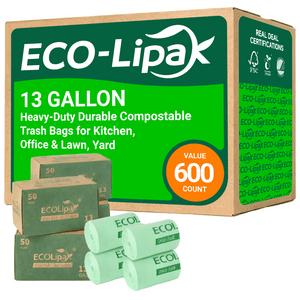
| 13 gallon | Tall kitchen bin, break room, household organics setup where accepted | 100/box or 200/carton | Featured bag is 24 x 32.28 in; check rim overlap and bin height |
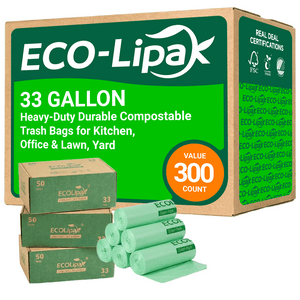
| 33 gallon | Office station, event cleanup, medium commercial can | 25/box, 50/box, or 150/carton | Test the actual container and load; gallon labels vary across bins |
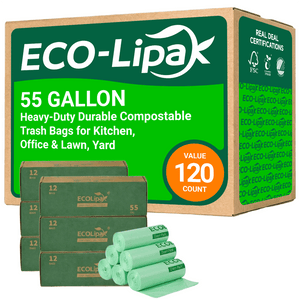
| 55 gallon | Large facility can, venue cleanup, back-of-house collection | 12/box or 36/carton | Featured bag is 33.08 x 38.98 in; confirm opening and height fit |
If you already know the bin size, use ECO-Lipak's 13 vs 33 vs 55 gallon size guide for a focused comparison. If you manage several locations, shop the compostable trash bag collection and standardize only after testing each bin model.

How to Measure a Trash Can
For a rectangular bin, measure the opening width and depth, then measure from the bottom to the rim. A practical flat-width estimate starts with half the perimeter of the opening: width plus depth. Add a little tolerance so the liner is not stretched across the corners. For length, add bin height, half the shorter bottom dimension, and the extra material needed to fold over the rim and close.
For a round can, measure the diameter and height. A flat bag needs enough width to cover half the can's circumference, plus fitting tolerance. Length must cover the height, half the diameter at the base, rim overhang, and closure allowance. These are estimates; tapered cans, handles, lids, and internal hardware can change the result. Testing one liner in the real bin remains the most reliable step.
Three Real-World Buying Scenarios
1. A household tall kitchen bin
The 13-gallon option is the logical first test for a common tall kitchen can. ECO-Lipak lists the bag at 24 x 32.28 inches. Fit it empty, fold the top over the rim, close the lid, and add a normal day's waste. If the liner slides inside the bin, the opening is too tight or there is too little overhang. If a large pocket of material collects at the bottom, compare the bag length with the bin height.
2. An office or cafe using 33-gallon stations
Volume can be deceptive. Cups, napkins, and lightweight packaging fill a bag without adding much weight, while prep scraps and wet food create a heavier load. Test the 33-gallon liner with the heaviest normal shift, not only dry waste. Place liquids in appropriate containers and avoid sharp edges. If the site separates organics, make the bin signage match the hauler's accepted-material list.
3. A venue or facility using 55-gallon cans
The 55-gallon option, listed at 33.08 x 38.98 inches, is intended for high-capacity containers. Large bags tempt teams to keep filling until removal is difficult. Set a maximum practical load based on the staff's lifting procedure and the waste type. More bag volume should not override workplace handling rules. A 36-count carton may work for an occasional venue, while recurring operations should calculate weekly usage before moving to a larger supply plan.
Certification and Disposal Claims
“Biodegradable” is broad; “compostable” should be tied to conditions and a disposal route. The U.S. Federal Trade Commission's Green Guides summary explains that compostable claims need competent and reliable scientific evidence and should be qualified when an item cannot be composted safely or in a timely manner at home, or when suitable facilities are not available to a substantial majority of consumers.
For products represented as certified compostable, buyers can search the BPI product catalog and compare the exact company, item, and certification status. A certification does not guarantee curbside acceptance. Call the local hauler or composting facility and ask whether certified compostable liners are accepted in the relevant stream. If they are not, follow local waste rules instead of wish-cycling the bag into recycling or organics.

A Seven-Point Buying Checklist
- Measure the bin: Record opening dimensions, height, and any lid or handle obstruction.
- Define the waste: Note typical weight, moisture, temperature, and sharp items.
- Choose the closure: A flat-top liner offers a simple open rim; leave enough length to secure it after use.
- Check pack math: Divide pack price by bag count, then include shipping and expected bag changes per week.
- Verify certification: Search the current third-party directory when a program or purchasing policy requires certification.
- Confirm local acceptance: Ask where the used bag should go and what contamination rules apply.
- Run a live trial: Test fit, removal, and normal load before standardizing across a site.
What Not to Use as a Buying Shortcut
Color is not a performance rating. A green or pale-mint bag may help staff distinguish a waste stream, but it does not prove compostability. Scent is also not evidence of odor control or environmental performance. Finally, do not treat a single thickness number as the whole strength story: film formulation, seams, load shape, storage conditions, and handling all affect real use.
Store compostable liners in a cool, dry place away from prolonged heat and direct sunlight. Rotate older cartons forward and keep labels visible. This makes supply counts easier and reduces avoidable damage before the bag reaches the bin.
Frequently Asked Questions
What are the best compostable trash bags for a kitchen?
Start with a correctly fitted 13-gallon liner for a common tall kitchen bin, then verify its behavior with the household's normal waste. The best choice also depends on whether a local organics program accepts compostable bags.
Are compostable trash bags biodegradable in a landfill?
Do not assume they will break down quickly in landfill conditions. Compostability claims refer to specified composting conditions, and local facilities may or may not accept the item.
Can compostable bags go in recycling?
Generally no. Flexible compostable film is not conventional plastic recycling feedstock and can contaminate a recycling stream. Follow the local program's instructions.
How do I stop a trash bag from slipping into the bin?
Check that the bag opening has enough width and that there is adequate material to fold over the rim. A retaining band or bin designed to hold liners can help, provided it does not puncture the film.
Should I buy 33 or 55 gallon bags for commercial use?
Measure the actual can and test the normal load. A 55-gallon bag is not automatically stronger; it is simply sized for a larger container. Using an oversized liner can waste material and complicate removal.