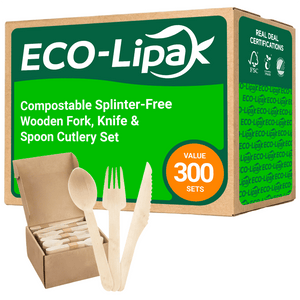
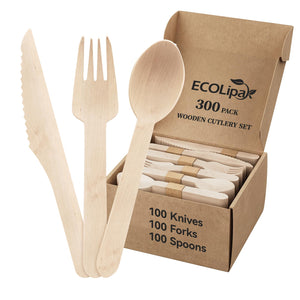
Quick Answer: Buy bulk wooden cutlery for an event by counting the utensils each menu actually needs. ECO-Lipak currently offers birchwood cutlery as 300 complete fork-knife-spoon sets per carton or 900 forks, knives or spoons per single-utensil carton. A complete set is simplest for a plated meal; individual cartons make more sense when guests mostly need one utensil. Add a practical service buffer, then round to the carton format you can reuse at a future event.
Key Takeaways
- Match utensils to menu items before calculating cartons; headcount alone is not enough.
- One 300-set carton gives 300 forks, 300 knives and 300 spoons, or 900 total pieces.
- A 900-piece fork-only carton is useful for fork-heavy menus but creates excess if you really need balanced place settings.
- Check smoothness, food performance and the exact disposal route rather than assuming all wooden utensils have the same certification.
Keep the original selection question, make it measurable
The original guide asked buyers to consider material quality, durability and event needs. Those are still the right starting points. What was missing was a way to connect them to an actual order. Every event is different: a buffet with pasta and salad uses forks heavily, a soup course requires spoons, and a served dinner may need all three pieces at each place. The better first question is not “How many guests?” but “What will each guest be served, and at which station will they pick up a utensil?”
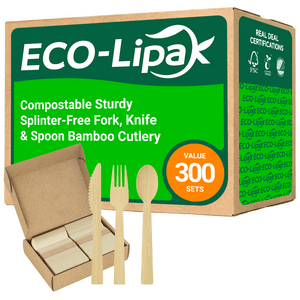
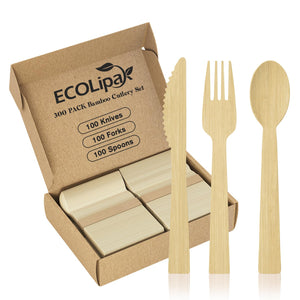
ECO-Lipak's wholesale wooden cutlery listing identifies natural birchwood, a smooth finish, and a choice between complete sets and single-utensil cartons. These light-colored wooden forks, spoons and knives have the understated look many caterers want. They are not metal utensils, bamboo utensils, or reusable flatware. If you need a small trial before a bulk order, compare the smaller-pack wooden cutlery options and test them with the actual menu.

Sets or singles: an event calculation
Suppose a caterer expects 240 guests for a lunch with a grain bowl, a side salad and a dessert. If each guest takes a fork and 15% also take a spoon, the working demand is 240 forks and about 36 spoons before any buffer. A 300-set carton covers both, but also supplies 300 knives that the menu may not need. A 900-fork carton alone cannot serve the spoon demand. The sensible purchase depends on whether the caterer has spoons on hand and whether unused pieces can be used at the next booking.
| Service pattern | Working count before buffer | Likely carton logic | Question to ask |
|---|---|---|---|
| 240 plated dinners with three utensils each | 240 forks, knives and spoons | One 300-set carton | Will 60 spare sets cover late guests and replacements? |
| 240 fork-led buffet meals, few soups | 240 forks plus about 36 spoons | Use on-hand spoons with a fork source, or buy sets for future use | What stock remains from previous jobs? |
| 700 dessert samples served with forks | 700 forks | One 900-fork carton | Will the remaining 200 forks be used soon? |
That table is a planning model, not a rule that guests take exactly one piece. For self-service stations, count the number of pickup points and leave a refill sleeve with each attendant. Start with a buffer of roughly 10% for a controlled plated service and adjust upward if guests can return to a buffet multiple times. The buffer should be based on your own historical waste and replacement rate, not a universal percentage copied into every order.
Three event scenarios that change the answer
Formal catered dinner
Complete sets make setup predictable when each place setting needs a fork, knife and spoon. For 280 guests, one 300-set carton leaves only 20 spare settings; a late guest list increase or damaged pieces can consume that margin quickly. Confirm the final guest guarantee and ask whether the venue has backup utensils before relying on the last carton. For a very large event, stage full sets by table count so the crew can count what remains.
Food truck or market booth
A booth selling bowls may use forks all day and almost no knives. Here a single-utensil carton can reduce unnecessary pieces. Keep a small spoon supply if a rotating menu occasionally includes soup or dessert. The carton's 900-piece count is meaningful only after you know daily order volume and expected event frequency. A shelf-stable carryover can be efficient, but avoid leaving loose wooden pieces in damp or exposed storage.
Outdoor wedding with multiple food stations
Guests may pick up a fork at the main meal, another at dessert, and a spoon at a late-night station. Count station visits, not just the guest list. A simple station sheet with expected portions, utensil type and refill count helps the caterer avoid placing all cartons at the first buffet. If the wedding uses compostable wedding plates, coordinate plate and utensil counts, but do not assume every plate requires a complete cutlery set.

Evaluate the real unit cost and sample the food
Compare cost per usable place setting or per required utensil, not only cost per carton. A 300-set carton has 300 complete place settings. A 900-fork carton has 900 forks but zero knives or spoons. Those quantities are not interchangeable. If your menu needs three pieces, include the cost of acquiring all three and any unavoidable leftovers. If the menu needs forks only, paying for complete sets can create a storage problem rather than a bargain.
Before making a recurring wholesale buy, use a sample to test the heaviest food served: cut a dense protein with the knife, spear a dressed salad with the fork, and stir a hot soup with the spoon. The original guide rightly emphasized a smooth, comfortable finish; check that in the hand, especially at the edges. Also test the workflow: do prepacked sets save labor, or will staff have to open each set to remove a knife that the menu never uses? For alternatives, compare the wooden cutlery collection with wholesale bamboo cutlery as a separate material and price decision.
Make disposal instructions specific
The old article treated “wooden,” “biodegradable” and “compostable” as though they guaranteed the same outcome. They do not. A wood material claim, a finished-product certification and a local compost facility's acceptance are separate checks. Ask the venue or waste contractor whether it accepts this exact cutlery with food scraps; if not, use the route it specifies. Do not promise a particular decomposition time in a landfill or tell guests that any wood utensil can be composted anywhere. The U.S. EPA's composting overview explains why processing conditions and local options matter. ECO-Lipak's certification guide is a useful purchasing checklist, not a substitute for checking a particular SKU.
For a business buyer, this gives a clear next step: build a menu-based count, choose the carton format that matches it, request a sample for food-performance checks, and verify the disposal plan before printing a sign. That is a more dependable purchasing decision than choosing a product on environmental adjectives alone.
Frequently Asked Questions
How many wooden cutlery sets should I buy for 250 guests?
If every guest needs a fork, knife and spoon, one 300-set carton covers 250 place settings with 50 spare sets. If the menu needs only forks, compare a fork-only option and the useful life of the carryover stock.
Does a 300-set carton contain 300 or 900 utensils?
Both descriptions are true in different units: it has 300 complete sets, each with a fork, knife and spoon, for 900 individual pieces total.
Should I buy 900 forks for a buffet?
Only if the menu and upcoming bookings justify that many forks. Count likely fork pickups per station and compare the unused balance with the simplicity of buying sets.
Are wooden utensils automatically compostable locally?
No. Check the exact product's claims and the venue's collection rules. A facility may have restrictions even when the item is plant-based.
Can wooden cutlery handle hot food?
It can be used with many hot meals, but test the specific utensil against the menu, serving temperature and expected hold time before a large event.