Quick Answer: As of August 2026, twelve U.S. states have statewide or statewide-equivalent plastic carryout bag laws: California, Colorado, Connecticut, Delaware, Hawaii, Maine, New Jersey, New York, Oregon, Rhode Island, Vermont, and Washington. The rules are not identical. They vary by retailer, bag type, fee, exemption, and local authority, so shoppers and businesses should confirm the current state and city requirements before relying on a national list.
Key Takeaways
- The United States does not have one nationwide plastic shopping bag ban.
- Twelve states have statewide or statewide-equivalent bag laws in effect in 2026.
- California changed its checkout-bag rules on January 1, 2026, closing the thicker-plastic-bag pathway at covered stores.
- Hawaii is counted as statewide-equivalent because county ordinances cover the state's major jurisdictions.
- Produce, pharmacy, meat, bulk-food, and other protective bags may be exempt depending on the law.
- Checkout-bag laws do not automatically regulate trash liners, food-storage bags, or every flexible-plastic format.
The phrase “plastic bag ban” sounds uniform, but state laws solve the problem in different ways. Some prohibit common single-use checkout bags and require a fee for paper. Some allow thicker reusable bags under specific standards. Some exempt small retailers or particular protective uses. Local rules can add another layer where state law permits them.
For a shopper, the practical response is to carry a reusable bag and expect that paper bags may cost extra. For a retailer, the work is more detailed: identify covered locations, approved bag formats, fee rules, exemptions, receipt requirements, and local ordinances. This article is a planning overview, not legal advice.

Which States Have Plastic Carryout Bag Laws?
| State | 2026 status | Important planning note |
|---|---|---|
| California | Statewide restrictions strengthened January 1, 2026 | Covered stores generally may provide recycled paper carryout bags for at least $0.10; specific exemptions remain |
| Colorado | Statewide single-use plastic carryout bag ban in effect | Coverage, small-store exceptions, paper-bag fees, and assistance-program exemptions matter |
| Connecticut | Statewide plastic checkout bag ban in effect | Retailers should distinguish banned checkout bags from exempt protective bags |
| Delaware | Statewide carryout bag restrictions in effect | Rules have been updated to address thicker-film substitutions |
| Hawaii | Statewide-equivalent county coverage | Check the county ordinance because Hawaii's structure is local rather than one statewide statute |
| Maine | Statewide single-use carryout bag restrictions in effect | Paper-bag charges and product exemptions require operational review |
| New Jersey | Statewide bag restrictions in effect | Certain grocery stores face restrictions on both plastic and paper carryout bags |
| New York | Statewide plastic carryout bag ban in effect | Some localities apply a paper carryout bag fee |
| Oregon | Statewide bag restrictions and fees in effect | Retail and restaurant requirements differ by bag and transaction type |
| Rhode Island | Statewide retail plastic bag ban effective since 2024 | Retailers should review reusable-bag standards and exemptions |
| Vermont | Statewide single-use product restrictions in effect | The law covers plastic carryout bags and additional disposable items |
| Washington | Statewide bag law and fees in effect | Approved reusable-film standards and bag charges can change over time |
The current twelve-state list is consistent with the July 2026 overview from PlasticBagLaws.org, which also tracks local ordinances and state preemption. Because statutes and local rules can change, businesses should use that map as a starting point and then confirm details with the relevant state agency.
What Changed In California In 2026?
California made the most visible 2026 change. According to CalRecycle's current bag requirements, SB 1053 took effect on January 1, 2026 for covered grocery and retail locations. The prior reusable-grocery-bag framework was repealed, and covered checkout points generally shifted to qualifying recycled paper carryout bags sold for a minimum charge.
The rule applies to checkout, self-checkout, pickup, curbside delivery, and home-delivery situations covered by the statute. It also preserves exemptions for certain nonhandled bags used to protect or contain items. A retailer should not convert that summary into store instructions without reviewing the official coverage and exemption language.

Bag Types That Are Often Treated Differently
- Checkout carryout bags: the main target of statewide bans and fees.
- Produce and bulk-food bags: frequently exempt because they contain loose or damp goods.
- Meat and pharmacy bags: often exempt for sanitation, privacy, or contamination control.
- Reusable fabric bags: generally encouraged, but retailers still need a cleaning and customer-handling policy.
- Trash liners: a separate product category and not a substitute for a checkout carryout bag.
- Compostable carryout bags: acceptance varies; a compostable label does not automatically create an exemption.
A Retailer Checklist Before Changing Bags
- Confirm whether the location and store type are covered by state law.
- Check city and county ordinances, plus any state preemption rule.
- Separate checkout bags from produce, pharmacy, meat, and bulk-food bags.
- Verify material, thickness, recycled-content, marking, and fee requirements with official sources.
- Update point-of-sale buttons, receipts, pickup instructions, and staff training together.
- Review the policy at least annually and whenever a state agency announces an implementation change.
The EPA notes that bag policies often combine restrictions with fees to encourage source reduction and reuse. Its plastic recycling and composting FAQ also explains why replacement-bag requirements differ and why plastic film is a poor fit for many curbside recycling systems.
Where ECO-Lipak Products Fit
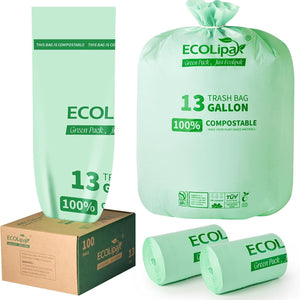
ECO-Lipak's compostable trash bag collection is intended for waste collection, not as a claim of compliance with checkout-bag laws. Businesses managing back-of-house waste can compare retail compostable trash bags and larger operational sizes after checking the local composting pathway. For broader environmental and material guidance, visit the ECO-Lipak resource list and About ECO-Lipak.
FAQ
How many U.S. states ban plastic shopping bags in 2026?
Twelve states have statewide or statewide-equivalent bag laws: California, Colorado, Connecticut, Delaware, Hawaii, Maine, New Jersey, New York, Oregon, Rhode Island, Vermont, and Washington.
Is there a federal plastic bag ban?
No. The United States does not have one nationwide checkout-bag ban. State and local laws create the current requirements.
Are paper bags free in states with plastic bag bans?
Not always. Many laws require or allow a fee for paper carryout bags to encourage shoppers to bring reusable bags.
Are compostable bags automatically allowed at checkout?
No. The law may define approved carryout bags by material, certification, thickness, recycled content, or store type. Check the exact jurisdiction.
Do plastic bag bans cover trash bags?
Usually not in the same way. Checkout carryout bags and trash liners serve different purposes and are typically treated as different product categories.
How often should a retailer review bag-law compliance?
Review it at least annually and whenever the state or city announces a new effective date, fee, exemption, or enforcement update.